IEC Standard for Transformer Noise Level: Best Guide on Limits, Measurement Methods and Compliance
Power transformers are essential assets in electrical power systems, but they also generate audible noise during operation. Excessive transformer noise can cause environmental concerns, regulatory issues, and public complaints, particularly when transformers are installed near residential areas. To control and standardize acceptable noise emissions, the International Electrotechnical Commission (IEC) has established clear guidelines.
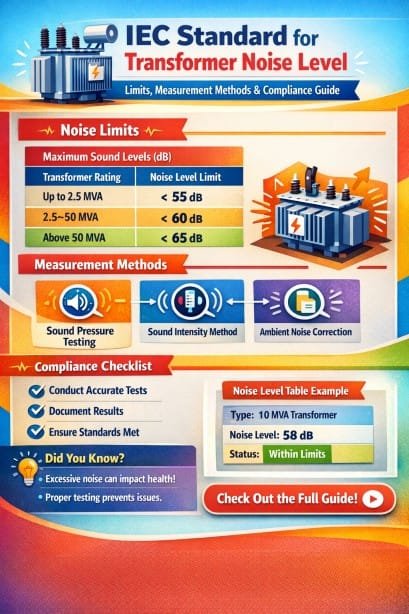
Table of Contents
The IEC standard for transformer noise level provides internationally recognized limits, measurement procedures, and compliance requirements for manufacturers, utilities, and engineers. These standards ensure that transformers operate within acceptable acoustic limits while maintaining performance and reliability.
This article explains the IEC noise limits for transformers, measurement techniques, testing procedures, and how manufacturers ensure compliance with these international standards.
Know more about IEC Standard for Neutral to Earth Voltage – Limits, Measurement & Safety Guidelines
Understanding Transformer Noise
Transformer noise mainly originates from mechanical vibrations within the transformer core and windings. The most common source is magnetostriction, a phenomenon where the transformer core laminations expand and contract when subjected to alternating magnetic flux.
These vibrations propagate through the transformer tank and radiate as audible sound waves.
Common sources of transformer noise include:
- Core magnetostriction
- Electromagnetic forces in windings
- Cooling fans and pumps
- Structural vibrations of the tank and enclosure
In most cases, the core vibration is responsible for the dominant noise component, typically at twice the system frequency (100 Hz or 120 Hz depending on the power frequency).
Because transformers are installed in substations, industrial plants, and urban areas, noise control becomes essential to meet environmental and regulatory standards.
Find all about Capacitor Bank Sizing for Power Factor Correction – Step by Step
IEC Standard for Transformer Noise Level
Several IEC standards address transformer noise measurement and limits. The most widely referenced document is IEC 60076-10, which defines methods for determining transformer sound levels.
The key standards include:
| IEC Standard | Title | Purpose |
|---|---|---|
| IEC 60076-10 | Determination of Sound Levels | Defines methods for measuring transformer noise |
| IEC 60076-10-1 | Application Guide | Provides guidance on sound level evaluation |
| IEC 60076-1 | Power Transformers – General | Includes general performance requirements |
| IEC 60551 | Measurement of Transformer Noise | Older reference for sound measurement |
Among these, IEC 60076-10 is the primary reference used globally when evaluating transformer acoustic performance. Find all about IEC Standard for Relay Testing: Best Guide
Noise Limits According to IEC Standards
Unlike some regulatory standards, IEC does not strictly enforce universal noise limits for all transformers. Instead, the standard provides recommended sound power levels based on transformer rating and cooling type.
Manufacturers and utilities often use these values as reference limits during design and procurement.
Typical transformer noise limits based on power rating are shown below.
| Transformer Rating (MVA) | Typical Noise Level dB(A) |
|---|---|
| Up to 1 MVA | 50 – 55 dB |
| 1 – 10 MVA | 55 – 65 dB |
| 10 – 50 MVA | 65 – 75 dB |
| 50 – 150 MVA | 70 – 80 dB |
| Above 150 MVA | 75 – 85 dB |
These values represent typical sound power levels measured at rated voltage and frequency. Find all about BS 7671 Wiring Regulations: Expert Guide to Compliance, Safety, and Practical Applications
Actual limits may vary depending on:
- Utility specifications
- Environmental regulations
- Installation location
- Urban noise restrictions
Many utilities specify lower noise limits for transformers installed in residential or urban substations.
IEC Transformer Noise Measurement Methods
The IEC standard for transformer noise level provides detailed procedures to measure acoustic emissions accurately. The objective is to ensure consistent and repeatable measurements across different testing facilities.
Transformer noise testing is normally performed during factory acceptance testing (FAT).
Measurement Environment
IEC standards specify that measurements should be conducted in an environment that minimizes sound reflections and external noise interference.
Common testing environments include:
- Open test areas
- Semi-anechoic chambers
- Outdoor measurement zones
The ambient noise level must be at least 10 dB lower than the transformer noise level to ensure measurement accuracy.
Know all about ieee and iec standards
Measurement Distance
Sound pressure measurements are typically taken at a fixed distance around the transformer.
The common measurement distances include:
| Transformer Size | Measurement Distance |
|---|---|
| Small transformers | 1 meter |
| Medium transformers | 3 meters |
| Large power transformers | 5 meters |
Microphones are placed at multiple points surrounding the transformer to capture noise radiation uniformly.
Measurement Points
IEC testing requires sound measurements at several predefined positions around the transformer perimeter.
Typical measurement arrangement includes:
- Points along the transformer sides
- Points near cooling equipment
- Points around the tank perimeter
The final sound level is calculated as the average of all measured sound pressure values.
Know more about Transformer Oil Testing: 9 Important Tests for Healthiness
Instrumentation
Accurate sound measurement requires calibrated acoustic instruments.
Common equipment used in testing includes:
- Precision sound level meters
- Calibrated microphones
- Acoustic calibrators
- Data acquisition systems
The instruments must comply with IEC 61672 standards for sound measurement equipment.
Calculation of Sound Power Level
The IEC standard focuses on sound power level (Lw) rather than only sound pressure level. Sound power represents the total acoustic energy emitted by the transformer.
The relationship between sound pressure and sound power is determined using standardized formulas and measurement surfaces.
The general formula is:
Lw = Lp + K
Where:
- Lw = Sound power level
- Lp = Measured sound pressure level
- K = Environmental correction factor
This calculation ensures that the transformer noise level can be compared consistently regardless of measurement location.
Know more about IEC Standard for MV Cable Testing: Complete Acceptance, Routine & Type Test Guide
Factors Affecting Transformer Noise Levels
Several design and operational factors influence transformer noise emissions.
Important factors include:
- Core material quality
- Flux density
- Transformer loading
- Tank stiffness
- Cooling system design
- Mounting structure
For example, higher flux density increases magnetostriction, which leads to higher acoustic emissions.
Modern transformer manufacturers use optimized core materials and improved mechanical design to reduce noise levels.
Transformer Noise Reduction Techniques
To comply with the IEC standard for transformer noise level, manufacturers incorporate several noise mitigation techniques during transformer design.
Some commonly used methods include:
Core Design Optimization
Using high-grade grain-oriented silicon steel reduces magnetostriction effects. Step-lap core joints also minimize vibration.
Know more about IEC Standard for Insulation Resistance Test – Procedures, Limits & Best Practices Explained
Flux Density Reduction
Operating transformers at slightly lower flux density reduces core vibration and noise generation.
Tank Stiffening
Reinforcing transformer tank structures prevents vibration amplification.
Vibration Isolation
Elastic mounting pads or vibration isolators are used to prevent vibration transmission to the foundation.
Acoustic Enclosures
For installations in noise-sensitive areas, transformers may be enclosed within soundproof barriers or acoustic walls.
These engineering solutions significantly reduce transformer sound levels.
Compliance Requirements for Utilities and Manufacturers
Compliance with IEC transformer noise standards is typically verified during factory acceptance tests and site acceptance tests.
The compliance process generally includes:
- Noise measurement at rated voltage and frequency
- Verification of sound power levels
- Comparison with specified noise limits
- Documentation in the test report
Transformer manufacturers must provide certified noise test reports to confirm that the equipment meets contractual specifications.
Utilities may also require additional site noise measurements after installation.
Know more about IEC Standard for Earthing System
Practical Considerations in Substation Design
Substation planners must consider transformer noise when selecting equipment and designing layouts.
Important considerations include:
- Distance between transformer and residential areas
- Use of noise barriers
- Transformer orientation
- Installation of low-noise transformers
In urban substations, noise impact studies are often performed before installation to ensure compliance with environmental noise regulations.
Importance of Transformer Noise Standards
The IEC standard for transformer noise level plays a critical role in modern power system design. It provides a consistent framework for evaluating transformer acoustic performance.
The benefits of these standards include:
- Reduced environmental noise pollution
- Improved community acceptance of substations
- Standardized transformer testing procedures
- Better product comparison between manufacturers
- Compliance with regulatory noise limits
As power infrastructure expands closer to populated areas, transformer noise management becomes increasingly important.
Know more about IEC Standard for Busbar Clearance
Conclusion
Transformer noise is an unavoidable byproduct of electromagnetic operation, but it can be controlled through proper design, testing, and compliance with international standards. The IEC standard for transformer noise level provides a globally accepted methodology for measuring transformer acoustic emissions and evaluating performance.
By following IEC 60076-10 measurement procedures and adopting effective noise reduction techniques, manufacturers can produce transformers that meet modern environmental requirements. Utilities and engineers can also use these standards to specify acceptable noise limits during procurement and installation. Know more about Phase to Phase Clearance as per IEC 61439: Best Guide
Follow Us on Social:
Subscribe our Newsletter on Electrical Insights for latest updates from Electrical Engineering Hub
#IECStandardForTransformerNoiseLevel, #TransformerNoiseLevel, #IEC60076, #PowerTransformerTesting, #ElectricalEngineeringStandards, #TransformerNoiseTest, #SubstationEquipment, #ElectricalTesting, #PowerEngineering, #TransformerDesign