IEC Standard for Capacitor Bank Explained: Ratings, Safety Rules & Compliance Checklist
The IEC standard for capacitor bank plays a critical role in modern electrical power systems, especially where power factor correction and reactive power management are required. From industrial plants to utility substations, capacitor banks are expected to operate safely, reliably, and within clearly defined limits. Without internationally accepted rules, the risks of overheating, insulation failure, or catastrophic faults increase significantly.
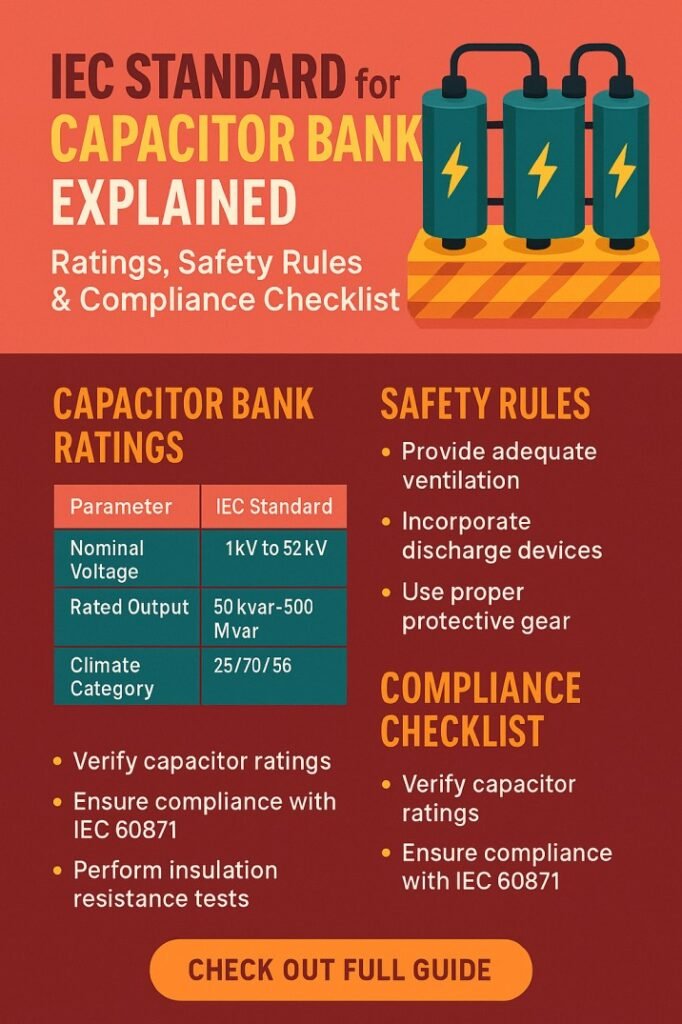
Table of Contents
This article explains the IEC framework governing capacitor banks in a practical and easy-to-follow way. It covers ratings, safety rules, testing requirements, and a clear compliance checklist that engineers, technicians, and students can apply in real projects.
Why IEC Standard for Capacitor Bank is Important?
Capacitor banks are not passive components. They store electrical energy, interact with harmonics, and are exposed to switching transients and thermal stress. The IEC standard for capacitor bank ensures that these systems are designed to withstand electrical, thermal, and mechanical challenges throughout their service life.
IEC standards provide a common technical language across manufacturers, consultants, and utilities. They help ensure compatibility between components and reduce the risk of failure due to poor specification or installation practices.
Explore details on iec standard for underground cable laying
Key benefits of IEC compliance include improved system reliability, predictable performance, enhanced safety for personnel, and easier regulatory approval.
Key IEC Standards Applicable to Capacitor Banks
Several IEC documents apply depending on voltage level, application, and installation environment. The most widely referenced standards are summarized below.
| IEC Standard Number | Standard Title | Application Area |
|---|---|---|
| IEC 60831 | Shunt power capacitors of the self-healing type | Low-voltage capacitor banks |
| IEC 61921 | Power capacitors for power factor correction | General capacitor applications |
| IEC 60143 | Series capacitors for power systems | High-voltage and transmission systems |
| IEC 62271 | High-voltage switchgear and controlgear | Switching and protection of capacitor banks |
| IEC 60529 | Degrees of protection provided by enclosures | Ingress protection ratings |
Among these, IEC 60831 is the most commonly referenced IEC standard for capacitor bank installations in industrial and commercial facilities.
Know more about 11kV Capacitor Bank Manufacturers in China: Top 15 Trusted Suppliers for Utilities & Industry
Capacitor Bank Ratings as per IEC Standards
Correct rating selection is a core requirement under the IEC framework. A capacitor bank must be rated not only for nominal system values but also for permissible overvoltage, overcurrent, and ambient conditions.
Voltage Rating Requirements
According to the IEC standard for capacitor bank, capacitors must operate continuously at up to 1.10 times the rated voltage. Short-duration overvoltage limits are also defined to account for switching events and system disturbances.
| Condition | Maximum Allowable Voltage |
|---|---|
| Continuous operation | 110% of rated voltage |
| Short duration (8 hours per day) | 115% of rated voltage |
| Short-time transient | Up to 120% for limited duration |
These limits help prevent dielectric breakdown and premature aging of the capacitor elements.
Current Rating Requirements
Capacitors must be capable of carrying at least 1.30 times the rated current continuously. This margin accounts for harmonic currents and system voltage distortion, which are common in networks with nonlinear loads.
Ignoring this requirement often leads to overheating and bulging of capacitor units in harmonic-rich environments.
Frequency and Temperature Ratings
IEC standards assume a rated frequency of 50 Hz or 60 Hz. Capacitor banks must also be designed for the ambient temperature class specified by the manufacturer, typically ranging from -25°C to +55°C.
Temperature classification is critical, as excessive heat significantly reduces capacitor life.
Find all about Capacitor Bank Sizing for Power Factor Correction – Step by Step
Safety Rules Defined by IEC for Capacitor Banks
Safety is a major focus of the IEC standard for capacitor bank, as stored electrical energy poses a serious hazard even after disconnection from the supply.
Discharge Requirements
IEC standards require that capacitor units include built-in discharge resistors. These resistors must reduce the residual voltage to below 50 V within one minute after disconnection.
This rule protects maintenance personnel from electric shock during inspection or replacement activities.
Protection Against Overcurrent and Faults
Capacitor banks must be protected against internal faults and external short circuits. Typical protection methods include HRC fuses, circuit breakers, and contactors rated specifically for capacitor switching duty.
For large banks, unbalance protection is often applied to detect failed units before cascading damage occurs. Know more about IEC Standard for Insulation Resistance Test – Procedures, Limits & Best Practices Explained
Enclosure and Ingress Protection
The enclosure must meet appropriate IP ratings as defined in IEC 60529. Indoor capacitor banks commonly use IP20 or IP30, while outdoor installations may require IP54 or higher.
Proper enclosure design reduces the risk of accidental contact, moisture ingress, and contamination.
Testing and Type Approval Requirements
Before a capacitor bank can be declared IEC compliant, it must undergo a series of routine and type tests. These tests verify that the design meets performance and safety expectations.
| Test Type | Purpose |
|---|---|
| Voltage test between terminals | Verifies insulation integrity |
| Capacitance measurement | Confirms rated reactive power |
| Thermal stability test | Ensures safe operation under load |
| Discharge test | Confirms safe residual voltage decay |
| Short-circuit test | Validates fault withstand capability |
Routine tests are performed on every unit, while type tests are conducted on representative samples.
Know more about IEC Standard for Busbar Clearance
Installation and Application Guidelines
The IEC standard for capacitor bank does not replace good engineering practice. Proper installation plays a major role in long-term performance.
Capacitor banks should be installed away from heat sources and provided with adequate ventilation. Cable sizing must consider continuous current and harmonic content. Earthing arrangements must comply with local electrical codes and IEC grounding principles.
In systems with high harmonic distortion, detuned reactor banks are strongly recommended to avoid resonance and capacitor overstress.
Maintenance Expectations Under IEC Framework
IEC standards assume periodic inspection and maintenance throughout the service life of a capacitor bank. Visual checks, thermal scanning, and capacitance measurements help identify early signs of degradation.
Any unit showing bulging, oil leakage, or abnormal temperature rise should be replaced immediately to maintain system safety and compliance.
IEC Compliance Checklist for Capacitor Banks
The following checklist provides a practical way to verify compliance with the IEC standard for capacitor bank installations.
| Checklist Item | Compliance Status |
|---|---|
| Rated voltage and current within IEC limits | Verified |
| Harmonic current allowance considered | Verified |
| Built-in discharge resistors installed | Verified |
| Suitable protection devices provided | Verified |
| Enclosure IP rating appropriate for environment | Verified |
| Type and routine test certificates available | Verified |
| Installation follows manufacturer and IEC guidelines | Verified |
| Maintenance plan documented | Verified |
Using such a checklist during design and commissioning reduces the risk of non-compliance and operational issues.
Use our online tool Creepage Distance Calculator – Calculate Safe Insulation & Clearance for PCB and High Voltage Design
Common Compliance Mistakes to Avoid
One frequent mistake is selecting capacitor banks based solely on kvar rating without checking voltage and current margins. Another common issue is ignoring harmonic conditions, which leads to repeated capacitor failures despite IEC-rated components.
Lack of proper documentation, such as missing test certificates or unclear nameplate data, can also cause problems during audits or inspections.
Conclusion
The IEC standard for capacitor bank provides a structured and reliable framework for designing, installing, and maintaining capacitor banks across a wide range of applications. By understanding rating rules, safety requirements, and testing expectations, engineers can avoid common pitfalls and ensure long-term system reliability.
Know more about Phase to Phase Clearance as per IEC 61439: Best Guide
Compliance is not just about meeting a specification. It is about protecting equipment, ensuring personnel safety, and maintaining power quality in increasingly complex electrical networks. When applied correctly, IEC standards turn capacitor banks from a vulnerable component into a dependable asset in the power system.
Follow Us on Social:
Subscribe our Newsletter on Electrical Insights for latest updates from Electrical Engineering Hub
#IECStandard, #CapacitorBank, #PowerFactorCorrection, #ElectricalStandards, #IEC60831, #PowerQuality, #ElectricalEngineering, #LVSystems, #EnergyEfficiency, #IndustrialPower