IEC Standard for Cable Joint: Complete Compliance Guide for Safe & Reliable Electrical Connections
Electrical systems depend heavily on the quality of their connections, and cable joints are one of the most critical points in any network. Following the iec standard for cable joint is essential to ensure safety, durability, and optimal performance in both low and high voltage installations. Whether you are working in power distribution, industrial setups, or infrastructure projects, understanding these standards can help you avoid failures, reduce maintenance costs, and ensure long-term reliability.
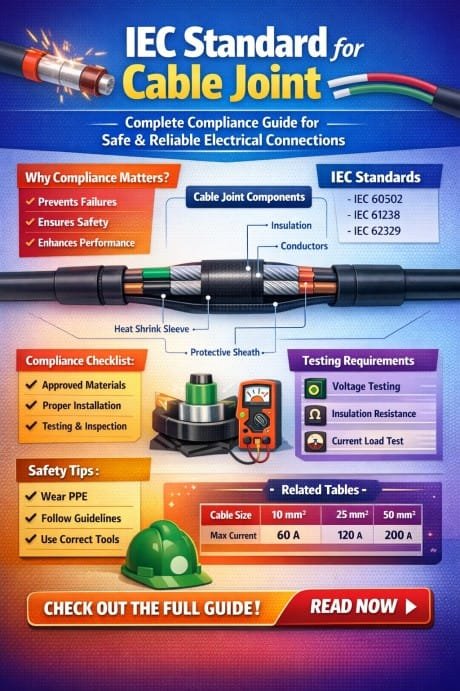
Table of Contents
Understanding IEC Standards for Cable Joints
The International Electrotechnical Commission (IEC) develops globally accepted standards for electrical technologies. The iec standard for cable joint defines how cable joints should be designed, tested, and installed to ensure consistent performance under various conditions.
Know more about IEC Standard for Insulation Resistance Test – Procedures, Limits & Best Practices Explained
These standards cover different types of cables, including:
- Low voltage (LV) cables
- Medium voltage (MV) cables
- High voltage (HV) cables
- Extra high voltage (EHV) systems
The purpose is to ensure that cable joints maintain electrical continuity, insulation integrity, and mechanical strength throughout their service life.
Key IEC Standards Related to Cable Joints
Several IEC standards govern cable jointing practices. Each standard focuses on specific voltage levels and testing requirements.
| IEC Standard | Application Area | Voltage Range | Key Focus |
|---|---|---|---|
| IEC 60502-4 | Power cable accessories | Up to 30 kV | Jointing and termination requirements |
| IEC 60840 | High voltage cables | 30 kV to 150 kV | Performance and testing |
| IEC 62067 | Extra high voltage cables | Above 150 kV | Advanced testing and reliability |
| IEC 61238-1 | Connectors and joints | LV to HV | Mechanical and electrical testing |
Following the iec standard for cable joint ensures compatibility between cables and accessories, which is crucial for system stability.
Know more about IEC Standard for Earthing System
Types of Cable Joints Covered Under IEC Standards
Cable joints vary depending on application and installation environment. The iec standard for cable joint provides guidelines for multiple joint types to ensure safe usage.
Straight Through Joints
Used to connect two cables in a straight line. These are common in underground and industrial networks.
Transition Joints
Designed to connect cables of different types, such as XLPE to PILC cables.
Branch Joints
Allow branching from a main cable line to secondary circuits.
Outdoor and Indoor Joints
IEC standards differentiate between environmental conditions, ensuring joints can withstand moisture, UV exposure, and temperature variations.
Materials and Components Requirements
To comply with the iec standard for cable joint, materials must meet strict quality and performance benchmarks. Common materials include:
- Heat shrinkable sleeves
- Cold shrink technology components
- Resin-based jointing kits
- Pre-molded accessories
Know more about 7 Common Mistakes in Electrical Outlet Height
Each material must provide:
- High dielectric strength
- مقاومة to environmental stress
- Long-term insulation performance
Typical Material Comparison
| Material Type | Advantages | Limitations | Common Use |
|---|---|---|---|
| Heat Shrink | Strong sealing, durable | Requires heating tools | Outdoor joints |
| Cold Shrink | Easy installation | Higher cost | Indoor applications |
| Resin | Excellent moisture resistance | Longer curing time | Underground joints |
| Pre-molded | Consistent quality | Limited flexibility | HV applications |
Installation Guidelines as per IEC Standards
Proper installation is just as important as material selection. The iec standard for cable joint outlines best practices that technicians must follow.
Key steps include:
- Proper cable preparation and stripping
- Maintaining correct insulation thickness
- Ensuring clean and dry working conditions
- Using approved tools and accessories
- Following manufacturer instructions strictly
Incorrect installation can lead to partial discharge, overheating, and eventual failure.
Know more about IEC Standard for Busbar Clearance
Testing Requirements for Cable Joints
Testing is a critical part of compliance. The iec standard for cable joint requires various tests to ensure reliability under operating conditions.
Common Tests Include:
- Partial discharge test
- AC voltage test
- Impulse voltage test
- Thermal cycling test
- Mechanical stress test
These tests simulate real-world conditions and verify that the joint can handle electrical and environmental stress.
Testing Overview Table
| Test Type | Purpose | Outcome |
|---|---|---|
| Partial Discharge | Detect insulation defects | Ensures insulation integrity |
| AC Voltage Test | Check dielectric strength | Confirms voltage handling |
| Thermal Cycling | Evaluate heat resistance | Ensures durability |
| Impulse Test | Simulate lightning/surge | Confirms surge protection |
Use our online tool Creepage Distance Calculator – Calculate Safe Insulation & Clearance for PCB and High Voltage Design
Safety Considerations and Compliance
Safety is the primary objective behind the iec standard for cable joint. Poorly installed or non-compliant joints can cause:
- Electrical faults
- Fire hazards
- Equipment damage
- Power outages
To ensure safety:
- Always use certified jointing kits
- Follow lockout/tagout procedures
- Ensure trained personnel perform installations
- Maintain proper documentation and inspection records
Compliance not only improves safety but also helps meet regulatory requirements in many countries.
Benefits of Following IEC Standards
Adhering to the iec standard for cable joint provides multiple advantages for engineers, contractors, and organizations.
Key Benefits:
- Enhanced system reliability
- Reduced maintenance and downtime
- Improved safety performance
- Global acceptance and compatibility
- Longer service life of cable systems
Organizations that follow IEC standards often experience fewer failures and better operational efficiency.
Common Mistakes to Avoid
Even experienced professionals can make errors if standards are not strictly followed. The iec standard for cable joint helps avoid these common mistakes:
- Using incompatible jointing materials
- Poor cable insulation handling
- Ignoring environmental conditions
- Skipping testing procedures
- Improper sealing of joints
Avoiding these mistakes can significantly improve the performance of cable systems.
Know more about Phase to Phase Clearance as per IEC 61439: Best Guide
Practical Applications Across Industries
The iec standard for cable joint is widely used in multiple sectors:
- Power generation and distribution
- Oil and gas industry
- Construction and infrastructure
- Renewable energy projects
- Manufacturing plants
In each of these sectors, reliable cable joints are essential for uninterrupted operations.
Final Thoughts
The iec standard for cable joint serves as a comprehensive framework for ensuring safe and reliable electrical connections. From material selection to installation and testing, every aspect is carefully defined to minimize risks and maximize performance.
Know more about Electrical Standards USA – National Electrical Code | Electrical Safety Foundation
By understanding and implementing these standards, professionals can ensure that their electrical systems operate efficiently and safely over the long term. In today’s demanding electrical environments, compliance is not just a recommendation—it is a necessity for sustainable and reliable power systems.
Follow Us on Social:
Subscribe our Newsletter on Electrical Insights for latest updates from Electrical Engineering Hub
#iecstandardforcablejoint, #cablejointstandards, #electricalstandards, #ieccompliance, #powercables, #cableinstallation, #electricalengineering, #highvoltage, #cablesafety, #industrialwiring