How to Set Earth Fault Relay Settings Correctly? Best Guide
Setting earth fault relay settings correctly is essential to protect electrical systems from dangerous ground faults. A small mistake can lead to equipment damage, long power outages, or even fire hazards. The good news is that earth fault protection is simple to configure once you understand the steps, formulas, and key parameters. This guide explains the complete process in a practical and easy way so you can apply proper settings in LV, MV, and HV systems.
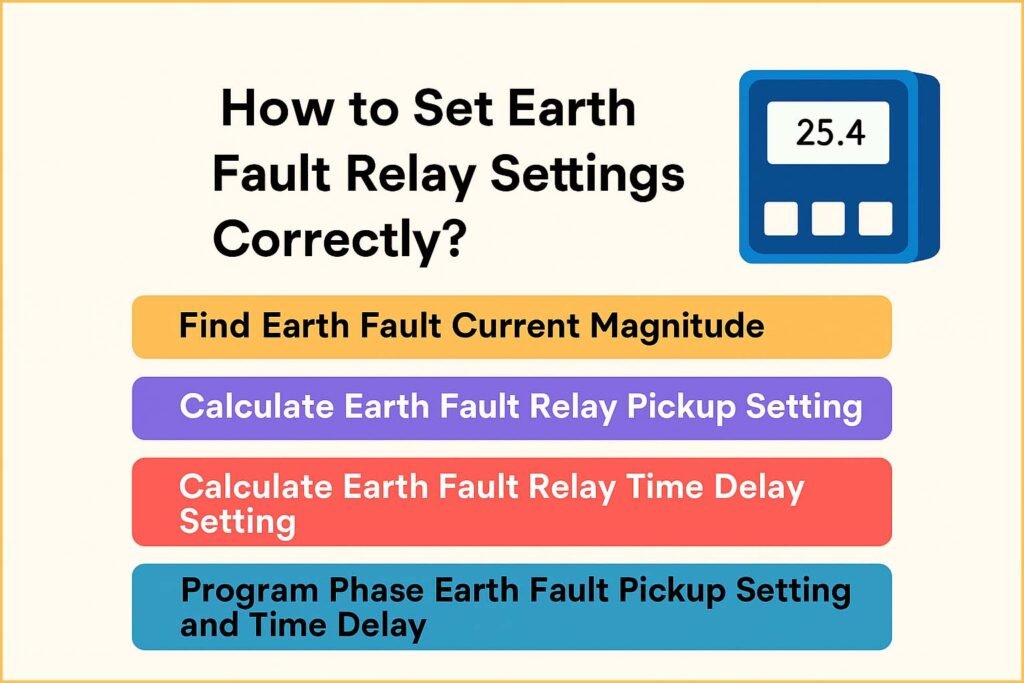
Table of Contents
What Are Earth Fault Relay Settings?
Earth fault relay settings determine how a protection relay detects and clears ground faults. The relay monitors the imbalance in current caused by a fault between a phase and earth. When this imbalance exceeds a set value, the relay trips the breaker. Correct settings make sure the relay is neither too sensitive nor too slow.
The most important parameters include:
- Pickup current
- Time delay
- CT ratio
- System earthing arrangement
- Expected load leakage current
- Coordination with upstream and downstream devices
Each of these affects how quickly and accurately the relay responds.
Dive deeper into differential protection of alternator
Why Correct Settings Matter
Ground faults are common in electrical networks. They cause insulation breakdown, cable heating, arc flashes, and voltage instability. If the relay is not calibrated properly, two main problems occur:
- Nuisance tripping – Relay trips even when there is no fault
- Delayed or missed trips – Relay fails to isolate the fault, causing damage
A well-configured relay provides selective, reliable, and fast protection. It also supports proper system coordination so only the faulty section trips while the rest stays energized.
Key Factors Before Setting the Relay
Before adjusting settings, collect some essential information. This ensures accuracy and avoids trial-and-error methods.
System earthing type
The type of earthing directly affects fault current level.
Common types include:
- Solid earthing
- Resistance earthing
- Reactance earthing
- Unearthed or isolated systems
Solid-earthed systems produce higher fault currents, so settings are higher. Resistance-earthed networks produce lower fault currents, so the relay must be more sensitive.
Learn more about types of generator protection relays
Maximum load current
Load imbalance and harmonic currents can cause relay misoperation. Pickup value must be above normal leakage and imbalance levels.
CT ratio and accuracy
Choose a proper CT ratio such as 100/1, 200/1, 400/5, etc. The CT secondary current affects pickup settings.
Cable length and leakage
Long cables cause natural leakage currents. This affects the minimum pickup. Know more about Best Rotor Earth Fault Protection for Brushless Generator | Working, Types & Settings Explained
Coordination requirements
Your relay must coordinate with:
- Main incomer relays
- Feeder relays
- Downstream MCC relays
- Fuses or MCBs
Coordination ensures selective tripping.
Get complete information about protection of alternator
Step-by-Step Method to Set Earth Fault Relay Settings
Below is a clear, easy method that works for most industrial and commercial systems.
Step 1: Determine the Pickup Current
Pickup current is the minimum current at which the relay operates.
General formula:
Pickup (Iₚ) = 0.2 × to 0.4 × CT primary / CT ratio for LV systems
For MV systems, use 10% to 40% of the expected earth fault current.
For example:
- CT ratio = 200/1
- Recommended pickup = 20% to 40% of 200 A = 40 A to 80 A
Convert to CT secondary:
- 40 A / 200 = 0.2 A
- 80 A / 200 = 0.4 A
So the pickup setting becomes 0.2 A to 0.4 A on the relay.
Know more about alternator protection scheme
Recommended pickup values for different systems
| System Type | Typical Pickup Setting | Notes |
|---|---|---|
| LV solid-earthed | 20% to 40% of CT primary | High fault levels |
| MV resistance-earthed | 10% to 20% of CT primary | Lower fault currents |
| Motor feeders | 15% to 30% | Avoid tripping on inrush |
| Transformer feeders | 20% to 40% | Consider inrush and leakage |
| Cable circuits | 10% to 30% | Long cables need lower pickup |
Step 2: Set the Time Delay
The time delay avoids nuisance trips and helps coordination.
General rule:
Upstream devices must have more delay than downstream ones. Know more about IEC Standard for Generator Protection – Key Guidelines and Compliance Requirements
Typical delays:
| Equipment Type | Suggested Time Delay |
|---|---|
| Final feeders | 0.1–0.2 sec |
| Distribution boards | 0.2–0.3 sec |
| Main incomer | 0.3–0.5 sec |
| Transformer HV side | 0.5–1.0 sec |
Do not set too long delays, as earth faults escalate quickly.
Explore details on IEC Standard for Differential Protection
Step 3: Verify CT Polarity and Wiring
Many relay issues come from CT wiring errors. Ensure:
- Correct polarity P1-P2
- Correct secondary S1-S2 orientation
- Tight terminal connections
- Correct star or summation wiring for residual connection
Test with primary injection if possible.
Step 4: Check System Coordination
Your pickup and time settings must align with upstream and downstream relays. If two relays have similar pickup values, ensure time grading is maintained.
Typical grading margin:
- 0.2–0.3 seconds
This ensures only the nearest protection trips.
Step 5: Consider Load Leakage and Harmonics
Some systems naturally produce leakage current such as:
- VFD circuits
- UPS systems
- Long cable runs
- Capacitor banks
Increase pickup slightly above leakage levels. A typical safety margin is 150% of maximum leakage.
Find out more about transformer differential protection
Step 6: Perform Testing Before Finalization
After settings are applied:
- Inject test current
- Verify pickup accuracy
- Check relay operation time
- Validate trip contacts
- Test breaker operation
Record all results as part of preventive maintenance.
Example Earth Fault Relay Setting Calculation
A practical example helps clarify the process.
System data
- CT ratio: 300/1
- Maximum balanced load leakage: 0.1 A
- Earthing: Solid
- Required grading: 0.2 sec
Calculation
- Pickup setting
20% of 300 A = 60 A
Secondary = 60/300 = 0.2 A Since leakage is 0.1 A, choose 0.2 A pickup. - Time delay
If downstream feeder uses 0.15 sec, set this relay to 0.35 sec.
Final settings:
Pickup = 0.2 A
Delay = 0.35 sec
These are safe, coordinated, and practical values.
Uncover insights on high impedance protection
Tips to Optimize Earth Fault Relay Settings
Perform regular thermal checks
Heat affects CT accuracy. Verify and align settings annually.
Monitor fault records
Relay event logs help refine settings over time.
Review system changes
New cables, loads, or motors may require new settings.
Avoid unbalanced loads
Unbalanced phases create circulating currents that can trigger relays.
Use neutral grounding resistors where needed
They reduce fault current and allow better sensitivity.
Read in detail about types of transformer protection relays
Common Mistakes to Avoid
- Setting pickup too low, causing false trips
- Using same delay for all relays
- Ignoring CT saturation
- Not checking earthing type
- Failing to perform injection testing
- Overlooking natural leakage in large cable networks
Avoiding these pitfalls ensures stable and reliable protection.
Final Thoughts
Correct earth fault relay settings are essential for safe, reliable, and selective protection of electrical networks. By understanding pickup current, time delay, system earthing, load characteristics, and coordination rules, you can configure the relay with confidence. A well-set relay prevents nuisance tripping, protects equipment from damage, and maintains continuity of service. With careful calculation, proper testing, and routine review, your earth fault protection will remain accurate and dependable throughout the system’s life cycle.
Know more about How to Measure Contact Resistance of Circuit Breaker: Step by Step
Follow Us on Social:
Subscribe our Newsletter on Electrical Insights for latest updates from Electrical Engineering Hub
#earthfaultrelay, #relaysettings, #protectionrelay, #earthfaultprotection, #electricalsafety, #powersystemprotection, #distributionprotection, #relaycoordination, #electricalengineering, #faultcurrent