DIN Standard vs ISO: Key Differences, Comparison Guide & Global Compliance Insights
Understanding din standard vs iso is essential for manufacturers, engineers, and businesses working in global markets. Standards define quality, safety, and compatibility, and choosing the right one can directly impact product acceptance, compliance, and scalability. While both DIN and ISO aim to standardize processes and products, they differ in scope, origin, and application.
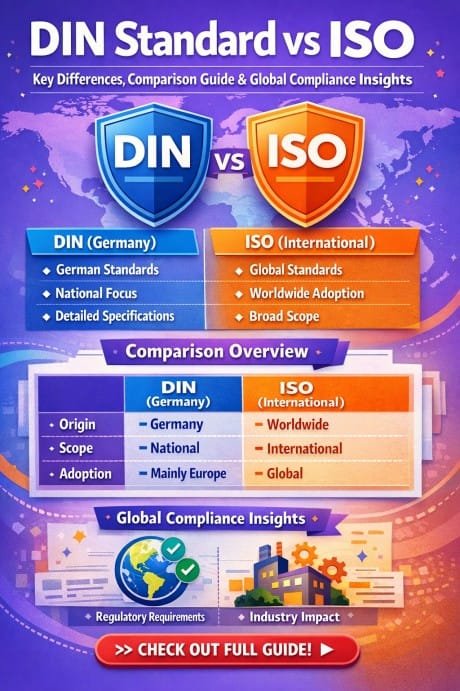
Table of Contents
This article explores the differences, similarities, and practical implications of din standard vs iso, helping you make informed decisions for global compliance.
What is DIN Standard?
DIN stands for Deutsches Institut für Normung, the German Institute for Standardization. It develops technical standards primarily used in Germany and parts of Europe. DIN standards cover a wide range of industries, including mechanical engineering, construction, automotive, and manufacturing.
DIN standards are known for their precision and strong engineering focus. Many of them originated to support Germany’s industrial growth and have since gained recognition beyond national borders.
Learn more about earthing cable size as per iec
Key characteristics of DIN standards include:
- Developed by German experts and committees
- Focused on technical accuracy and engineering practices
- Widely used in European manufacturing
- Often serve as the basis for international standards
What is ISO?
ISO stands for the International Organization for Standardization. It is a global body that develops standards accepted across multiple countries. ISO standards aim to unify practices worldwide, making international trade smoother and more efficient.
ISO standards apply to nearly every sector, including quality management, environmental systems, information security, and product specifications.
Important features of ISO standards include:
- Developed through international collaboration
- Accepted in over 160 countries
- Focused on global compatibility and consistency
- Cover both technical and management systems
Discover everything about cable bending radius iec standard
DIN Standard vs ISO: Core Differences
When comparing din standard vs iso, the primary distinction lies in their scope and reach. DIN is more region-specific, while ISO is globally recognized.
Below is a detailed comparison:
| Feature | DIN Standard | ISO Standard |
|---|---|---|
| Origin | Germany | International |
| Scope | National / European | Global |
| Governing Body | DIN Institute | ISO Organization |
| Acceptance | Mainly Europe | Worldwide |
| Language | German (often translated) | English (primary) |
| Focus | Engineering and technical specs | Broad, including management systems |
| Adoption | Limited global adoption | Widely adopted globally |
This table clearly highlights how din standard vs iso differs in terms of application and influence.
Similarities Between DIN and ISO
Despite their differences, DIN and ISO share several similarities. Both aim to improve quality, safety, and efficiency across industries.
Common ground includes:
- Standardization of products and processes
- Enhancement of safety and reliability
- Support for international trade
- Continuous updates and revisions
Explore details on iec standard for underground cable laying
In many cases, DIN standards are harmonized with ISO standards. For example, a DIN standard may be adopted as DIN EN ISO, combining German, European, and international frameworks.
When to Use DIN Standards
Choosing between din standard vs iso depends on your target market and industry requirements.
DIN standards are suitable when:
- You are operating primarily in Germany or the EU
- Your clients specifically require DIN compliance
- You are dealing with highly technical engineering products
- Local regulations mandate DIN specifications
DIN standards often provide more detailed engineering guidelines, making them valuable for precision manufacturing. Understand better about nec 430.32
When to Use ISO Standards
ISO standards are the preferred choice in global markets. If your business operates internationally, ISO compliance is usually essential.
Use ISO standards when:
- Exporting products to multiple countries
- Working with international clients
- Seeking global certification (e.g., ISO 9001, ISO 14001)
- Ensuring compatibility across different regions
In the debate of din standard vs iso, ISO offers broader acceptance and easier market entry worldwide.
DIN and ISO Integration
One important aspect often overlooked in din standard vs iso discussions is their integration. Many DIN standards have been aligned with ISO to avoid duplication and improve global consistency.
Dive deeper into instrument earthing iec standard
Examples include:
- DIN EN ISO standards (German adoption of European and ISO standards)
- Replacement of older DIN-only standards with ISO equivalents
- Harmonization in sectors like fasteners, materials, and quality systems
This integration allows companies to meet both local and international requirements with a single framework.
Practical Comparison for Businesses
For decision-makers, the choice between DIN and ISO should be strategic rather than technical alone.
Here is a practical comparison:
| Business Need | Recommended Standard |
|---|---|
| Local German manufacturing | DIN |
| Export-oriented production | ISO |
| Engineering-specific projects | DIN or DIN EN |
| Global certification | ISO |
| Compliance with EU norms | DIN EN ISO |
Understanding din standard vs iso in this context helps businesses avoid compliance issues and unnecessary costs.
Impact on Product Design and Manufacturing
Standards directly influence product design, materials, dimensions, and testing procedures. DIN standards often provide stricter and more detailed engineering specifications, while ISO focuses on compatibility and interoperability.
For example:
- DIN fasteners may have precise dimensional tolerances
- ISO fasteners ensure global interchangeability
This distinction is critical in industries like automotive and machinery, where even minor deviations can affect performance.
Uncover insights on iec standard for lighting lux level
Compliance and Certification Insights
Compliance with standards is not just about meeting technical requirements. It also impacts brand reputation, legal approval, and market trust.
ISO certifications, such as ISO 9001, are widely recognized and often required for international tenders. DIN compliance, while respected, may not carry the same global weight.
In din standard vs iso, ISO clearly leads in terms of certification value and recognition.
Common Challenges
Businesses often face challenges when navigating standards:
- Confusion between similar DIN and ISO codes
- Cost of certification and audits
- Adapting existing processes to new standards
- Maintaining compliance with updates
To overcome these issues, companies should invest in proper documentation, training, and consultation.
Learn more about Arc Flash Risk Assessment According to NFPA 70E
Future of DIN and ISO Standards
The future of din standard vs iso is moving toward greater harmonization. As globalization continues, the gap between national and international standards is narrowing.
Trends include:
- Increased adoption of ISO standards worldwide
- Conversion of DIN standards into ISO formats
- Digital standardization and smart manufacturing integration
This evolution benefits businesses by reducing complexity and improving global consistency.
Conclusion
The comparison of din standard vs iso reveals a clear distinction between regional precision and global applicability. DIN standards offer strong technical depth, especially for engineering applications, while ISO standards provide universal acceptance and ease of international trade.
Know more about OSHA Electrical Safety Standard 1910 – Workplace Electrical Safety | Safety Experts
For most businesses aiming to scale globally, ISO is the practical choice. However, DIN remains highly relevant in specialized industries and regional markets.
Follow Us on Social:
Subscribe our Newsletter on Electrical Insights for latest updates from Electrical Engineering Hub
#DINStandard, #ISOStandards, #DINvsISO, #EngineeringStandards, #QualityCompliance, #IndustrialStandards, #ISOCertification, #DINNorms, #GlobalStandards, #ManufacturingQuality