
Wire Bending Radius NEC | Important NEC Code Requirements, Calculations & Installation Guide
Proper cable installation is one of the most important aspects of electrical system reliability. Among the many installation requirements, understanding Wire Bending Radius NEC rules is essential for electricians, engineers, inspectors, and contractors. Incorrect bending of conductors can damage insulation, reduce cable life, create pulling difficulties, and even lead to electrical failures.
The National Electrical Code (NEC) provides specific requirements for conductor bending space, cable installation, and cabinet dimensions to ensure safe and compliant installations. Whether you are working on residential, commercial, or industrial projects, knowing the correct bending radius requirements helps prevent costly mistakes and code violations.
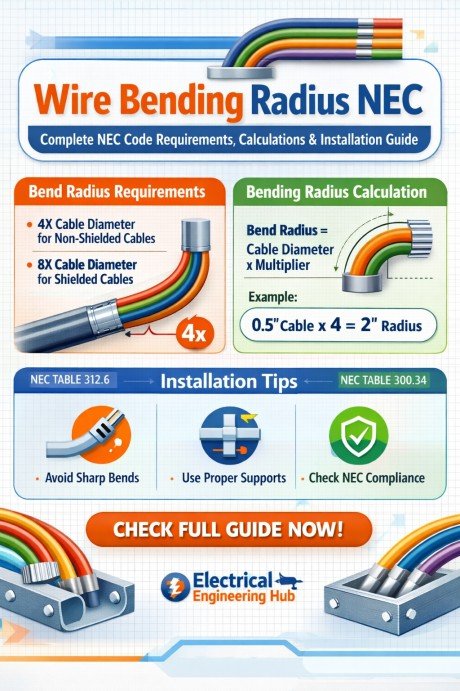
Table of Contents
In this guide, you will learn NEC bending radius requirements, calculation methods, practical examples, installation best practices, and common mistakes to avoid.
Use our online tool for free Wire Size Calculator for Subpanels and Feeders – NEC Guidelines Included
What Is Wire Bending Radius?
Wire bending radius refers to the minimum radius that a conductor or cable can be bent without causing damage to the conductor strands or insulation.
A bend radius is measured from the centerline of the cable to the inside curvature of the bend. When conductors are bent too sharply, excessive stress can occur, which may result in:
- Insulation cracking
- Conductor deformation
- Reduced current-carrying capability
- Increased maintenance costs
- Premature cable failure
This is why Wire Bending Radius NEC requirements are critical for safe electrical installations.
Why Wire Bending Radius Matters
Electrical conductors are designed to operate within specific mechanical limits. Exceeding those limits during installation can compromise both safety and performance.
Some key benefits of maintaining the proper bend radius include:
- Preserving insulation integrity
- Preventing conductor damage
- Simplifying cable pulling operations
- Improving system reliability
- Ensuring NEC compliance
- Extending cable service life
Large conductors and medium-voltage cables are particularly sensitive to improper bending.
Know more about NEC Grounding Table 250.122 Explained: Correct Equipment Grounding Conductor Size
Wire Bending Radius NEC
The NEC addresses conductor bending requirements in several sections, including:
| NEC Section | Description |
|---|---|
| NEC 312.6 | Bending space at terminals and enclosures |
| NEC 314.28 | Pull and junction box sizing |
| NEC 300.34 | Minimum bending radius for conductors rated over 1000 volts |
| NEC Chapter 9 | Raceway and conduit considerations |
The exact requirement depends on conductor size, voltage level, and installation type.
NEC 312.6 – Bending Space at Terminals
NEC 312.6 specifies the minimum distance required between terminals and enclosure walls to allow conductors to bend safely.
The code provides minimum bending space dimensions based on conductor size.
Read in detail about nec 392.22
Minimum Wire Bending Space Table
| Conductor Size | Minimum Distance |
|---|---|
| 4 AWG or smaller | Not specified by table |
| 3 AWG to 500 kcmil | Based on NEC Table 312.6(A) |
| Over 500 kcmil | Larger bending space required |
For conductors entering switchboards, panelboards, and similar equipment, installers must ensure sufficient room for conductor bending.
Following Wire Bending Radius NEC guidelines reduces stress on termination points and improves connection reliability.
NEC 314.28 Pull Box and Junction Box Requirements
Large conductors often require pull boxes or junction boxes. NEC 314.28 provides sizing requirements to accommodate proper conductor bends.
Straight Pulls
For straight pulls:
Box Length = 8 × Largest Raceway Diameter
Example:
| Raceway Size | Minimum Box Length |
|---|---|
| 2 inches | 16 inches |
| 3 inches | 24 inches |
| 4 inches | 32 inches |
Understand better about nec 430.32
Angle Pulls and U Pulls
For angle pulls:
Distance = 6 × Largest Raceway Diameter + Sum of Remaining Raceway Diameters
This ensures adequate bending space and prevents conductor damage.
NEC 300.34 for Conductors Over 1000 Volts
For medium-voltage installations, NEC 300.34 specifies minimum bending radii.
The minimum bending radius depends on cable type and shielding construction.
Common NEC Bend Radius Requirements
| Cable Type | Minimum Bend Radius |
|---|---|
| Shielded Cable | 12 × Overall Diameter |
| Non-Shielded Cable | 8 × Overall Diameter |
| Manufacturer-Specified Cable | Follow Manufacturer Data |
In many cases, manufacturer recommendations may exceed NEC minimum requirements.
Explore everything about NEC Article 220
How to Calculate Wire Bending Radius
Calculating the bending radius is straightforward once the cable diameter is known.
Formula
Bending Radius = Cable Diameter × Required Multiplier
Example 1
Cable Diameter = 1 inch
Required Multiplier = 8
Bending Radius =
1 × 8 = 8 inches
Example 2
Cable Diameter = 1.5 inches
Required Multiplier = 12
Bending Radius =
1.5 × 12 = 18 inches
These calculations help installers maintain compliance with Wire Bending Radius NEC requirements during cable routing.
Learn more about Demand Factor as Per NEC
Practical Installation Example
Consider a 500 kcmil conductor installed inside a switchboard.
Installation parameters:
| Item | Value |
|---|---|
| Conductor Size | 500 kcmil |
| Enclosure Type | Switchboard |
| Voltage | 480 V |
| Termination | Mechanical Lug |
The installer must verify:
- Adequate bending space per NEC 312.6
- Proper enclosure dimensions
- Sufficient conductor slack
- No excessive stress on terminals
Failure to provide enough bending space may result in failed inspections and equipment modification costs.
Know everything about NEC Article 310 which include Ampacity Rules, Wire Sizing & Code Secrets Electricians Must Know
NEC vs IEC Cable Bending Standards
Many engineers work with both NEC and IEC requirements, especially in international projects.
The NEC primarily focuses on installation safety and enclosure space requirements, while IEC standards often specify cable bend radius requirements directly.
For a detailed comparison and international design guidance, see our comprehensive guide on cable bending radius iec standard.
Understanding both standards helps engineers design systems that meet global installation requirements.
Common Mistakes During Cable Installation
Many field problems occur because installers underestimate cable bending requirements.
Explore all about NEC Article 344: Best Guide on Rigid Metal Conduit Installation & Code Compliance
Common Errors
- Using undersized pull boxes
- Forcing large conductors into tight spaces
- Ignoring manufacturer bend radius recommendations
- Applying excessive pulling tension
- Installing cables with sharp bends near terminals
- Violating NEC enclosure spacing requirements
Avoiding these mistakes improves installation quality and long-term system reliability.
Best Practices for NEC-Compliant Cable Bending
To ensure compliance and reliability, follow these best practices:
Before Installation
- Review NEC requirements
- Check manufacturer specifications
- Verify enclosure dimensions
- Plan cable routing paths
During Installation
- Use proper cable pulling equipment
- Maintain minimum bend radius
- Avoid twisting conductors
- Support cables adequately
Know more about NEC Article 440: HVAC Equipment Rules Most Electricians Miss
After Installation
- Inspect all bends visually
- Verify termination integrity
- Confirm pull box sizing
- Document compliance records
These practices help maintain compliance with Wire Bending Radius NEC requirements while protecting cable insulation and conductor integrity.
How Inspectors Verify Bending Radius Compliance
Electrical inspectors typically review:
| Inspection Item | Verification Method |
|---|---|
| Pull box size | NEC 314.28 calculation |
| Panel bending space | NEC 312.6 dimensions |
| Cable condition | Visual inspection |
| Terminations | Proper conductor routing |
| Medium-voltage cables | Radius measurement |
Having accurate installation drawings and manufacturer documentation can simplify the inspection process.
Discover how this tool works and why it’s worth using NEC Wire Size Calculator – Voltage Drop Compliant Sizing for 120V & 240V Circuits
Conclusion
Understanding Wire Bending Radius NEC requirements is essential for safe and compliant electrical installations. The NEC provides clear guidance for conductor bending space, pull box sizing, and medium-voltage cable installations. Proper bend radius protects conductor insulation, prevents mechanical damage, and improves overall system reliability.
Whether you are designing a new electrical system or performing field installations, always verify NEC requirements, manufacturer recommendations, and enclosure dimensions before routing conductors. Following these practices helps ensure long-lasting electrical performance while avoiding costly code violations.
Use our online tool Conduit Fill Calculator for Multi Conductor Cable which measures accurate NEC Based Cable conduit Sizing
Frequently Asked Questions
What is the minimum wire bending radius according to NEC?
The NEC does not provide one universal bend radius for all conductors. Requirements depend on conductor size, voltage level, enclosure type, and installation conditions. Sections 312.6, 314.28, and 300.34 contain the primary requirements.
Does NEC specify bend radius for low-voltage cables?
For many low-voltage installations, the NEC focuses more on bending space and enclosure dimensions rather than a fixed bend radius. Manufacturer instructions should always be followed.
How is wire bending radius calculated?
The bending radius is calculated by multiplying the cable diameter by the required bend radius factor. For example, a 1-inch cable with an 8× requirement has an 8-inch minimum bending radius.
Which NEC section covers pull box sizing?
NEC 314.28 covers pull box and junction box sizing requirements for conductors 4 AWG and larger.
Can manufacturer bend radius requirements exceed NEC requirements?
Yes. Manufacturers often specify larger bend radii than NEC minimums. When this occurs, the manufacturer’s requirements should be followed to maintain warranty coverage and cable performance.
Follow Us on Social:
Subscribe our Newsletter on Electrical Insights for latest updates from Electrical Engineering Hub
#WireBendingRadiusNEC,#NECCode,#ElectricalWiring,#ConduitBending,#ElectricalEngineering,#NECRequirements,#WireInstallation,#ElectricalSafety,#CableManagement,#ElectricianGuide