How To Read Oscilloscopes: Complete Beginner’s Guide to Accurate Signal Analysis
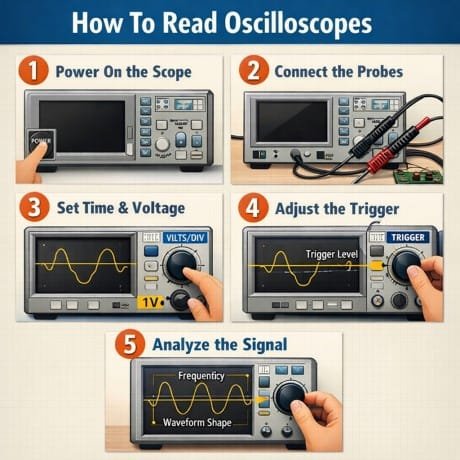
Oscilloscopes are among the most important tools in electronics, electrical engineering, and circuit troubleshooting. Whether you are testing a power supply, checking audio signals, or diagnosing communication circuits, understanding how to read waveforms correctly is essential. Many beginners feel overwhelmed when they first look at an oscilloscope screen filled with lines, grids, and settings. However, learning How To Read Oscilloscopes becomes much easier once you understand the basic controls and waveform behavior.
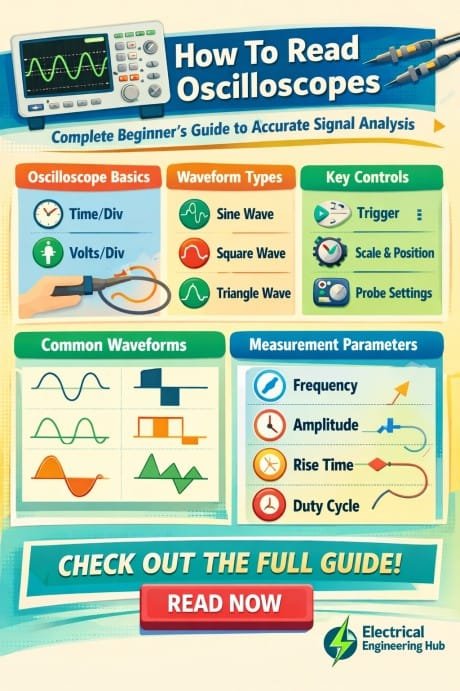
Table of Contents
An oscilloscope displays electrical signals in graphical form. The screen shows how voltage changes over time, allowing users to analyze signal strength, frequency, timing issues, and electrical noise. With the right approach, even beginners can perform accurate signal analysis and identify common circuit problems quickly.
What Is an Oscilloscope?
An oscilloscope is an electronic test instrument used to visualize electrical signals. It converts voltage signals into waveforms displayed on a screen. These waveforms help users understand how a circuit behaves in real time.
Know more about cathode ray oscilloscope
Modern digital oscilloscopes are widely used in:
- Electronics repair
- Automotive diagnostics
- Solar system troubleshooting
- Industrial automation
- Communication systems
- Audio equipment testing
- Educational laboratories
The horizontal axis represents time, while the vertical axis represents voltage. By studying waveform patterns, engineers and technicians can detect faults, measure signal quality, and verify circuit performance.
Understanding the Oscilloscope Display
Before learning How To Read Oscilloscopes, it is important to understand the screen layout. The display is divided into small squares called divisions. These divisions help measure voltage and time accurately.
| Oscilloscope Component | Function |
|---|---|
| Vertical Axis | Displays voltage level |
| Horizontal Axis | Displays time |
| Grid Divisions | Help calculate measurements |
| Trigger Point | Stabilizes waveform |
| Probe | Connects oscilloscope to circuit |
| Channel Controls | Manage multiple signals |
The waveform moves from left to right across the screen. A stable waveform means the trigger settings are adjusted correctly.
Know more about How To Choose An Oscilloscope
Key Oscilloscope Controls Beginners Must Learn
Understanding the main controls makes signal analysis much easier. Most oscilloscopes have similar controls regardless of brand.
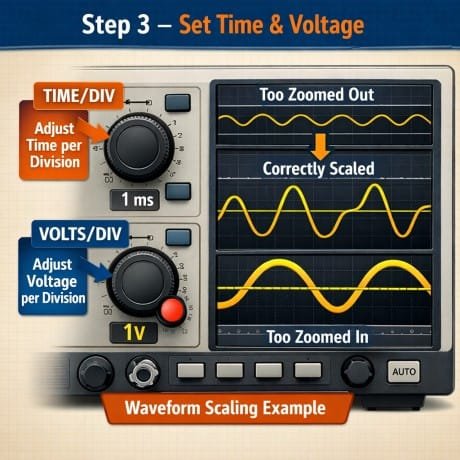
Vertical Scale Control
This setting adjusts the voltage scale. It determines how much voltage each vertical division represents.
For example:
- 1V/div means each vertical square equals 1 volt
- 5V/div means each square equals 5 volts
If the waveform appears too small or too large, adjust the vertical scale for better visibility.
Horizontal Scale Control
The horizontal scale controls the time base.
Examples include:
- 1ms/div for milliseconds
- 10µs/div for microseconds
This setting allows users to analyze signal timing and frequency.
Explore Top 25 Questions Regarding Usage Of Oscilloscope
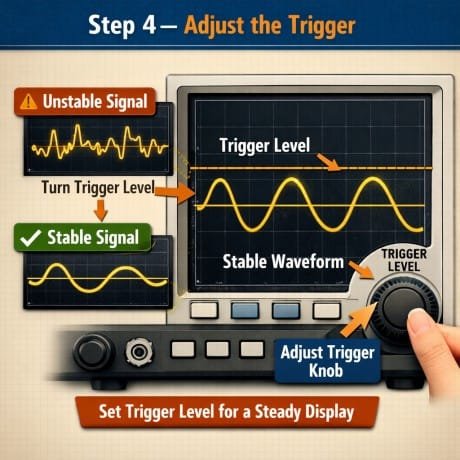
Trigger Control
The trigger stabilizes the waveform on the screen. Without proper triggering, the waveform may drift continuously.
Common trigger modes include:
- Auto Trigger
- Normal Trigger
- Single Trigger
Beginners usually start with Auto Trigger for stable viewing.
Probe Compensation
Oscilloscope probes must be calibrated correctly. Poor probe compensation can distort measurements and create inaccurate waveforms.
How To Read Oscilloscopes Correctly
Learning How To Read Oscilloscopes involves interpreting waveform characteristics accurately. Several key measurements help determine signal behavior.
Reading Voltage
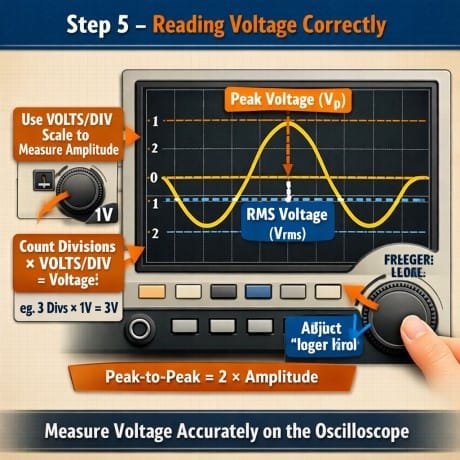
Voltage is measured vertically. Count the waveform divisions from peak to peak and multiply by the voltage scale.
Example:
- Waveform height = 4 divisions
- Scale = 2V/div
Voltage = 4 × 2 = 8V peak-to-peak
Find the Best 12 Budget Oscilloscope For Beginners
Reading Time Period
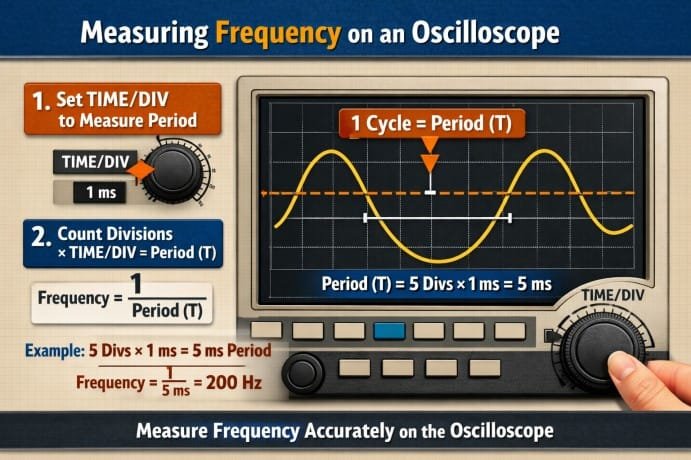
The horizontal divisions determine the signal period.
Example:
- One cycle occupies 5 divisions
- Time scale = 1ms/div
Time period = 5ms
Measuring Frequency
Frequency is the inverse of the time period.
Formula:
Frequency = 1 / Time Period
If the period is 5ms:
Frequency = 1 / 0.005 = 200Hz
This method is commonly used in electronic signal analysis and troubleshooting.
Know more about AC Hipot Test Acceptable Leakage Current
Common Waveforms You Should Recognize
Different circuits produce different waveform patterns. Understanding them is essential for accurate diagnostics.
| Waveform Type | Description | Common Usage |
|---|---|---|
| Sine Wave | Smooth periodic signal | AC power systems |
| Square Wave | Rapid switching signal | Digital circuits |
| Triangle Wave | Linear rise and fall | Signal generators |
| Pulse Wave | Short duration signal | Communication systems |
| Noise Signal | Random waveform | Fault detection |
Recognizing waveform shapes helps technicians diagnose faulty components quickly.
Using Oscilloscopes for Circuit Troubleshooting
Oscilloscopes are extremely useful for detecting electrical faults. They can identify:
- Voltage fluctuations
- Signal distortion
- Frequency instability
- Power supply ripple
- Communication errors
For example, if a power supply produces excessive ripple voltage, the oscilloscope waveform will show irregular fluctuations instead of a smooth DC line.
Similarly, damaged sensors in automotive systems often produce unstable signals visible on the oscilloscope display.
Find all about Top 15 Partial Discharge Tester Suppliers in United States
Digital vs Analog Oscilloscopes
Modern digital oscilloscopes are more common due to advanced measurement features. However, analog models are still useful for understanding waveform behavior.
| Feature | Digital Oscilloscope | Analog Oscilloscope |
|---|---|---|
| Signal Storage | Yes | No |
| Measurement Accuracy | High | Moderate |
| Advanced Analysis | Available | Limited |
| Portability | Compact | Larger |
| Ease of Use | Beginner Friendly | Manual Adjustment |
For beginners learning How To Read Oscilloscopes, digital models are usually easier because they provide automatic measurements and waveform storage.
Tips for Accurate Signal Analysis
Accurate readings depend on proper setup and measurement techniques. Beginners should follow these best practices:
Use Proper Grounding
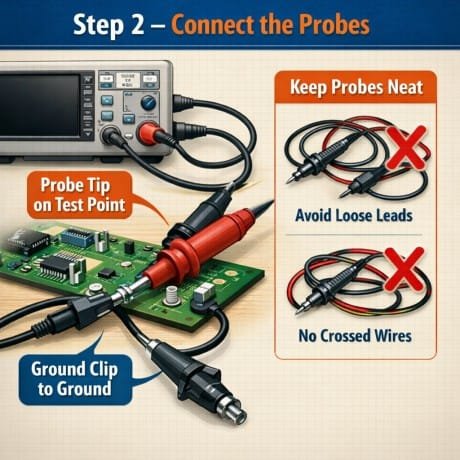
Always connect the oscilloscope ground clip correctly. Poor grounding can introduce noise and inaccurate signals.
Find all about High Voltage Cable Testing Standards
Select Correct Probe Attenuation
Most probes support:
- 1X mode
- 10X mode
The 10X setting reduces circuit loading and improves high-frequency performance.
Avoid Incorrect Time Settings
If the time base is too fast or too slow, waveforms become difficult to interpret.
Check Signal Stability
Use trigger adjustments to stabilize moving waveforms before taking measurements.
Minimize Electrical Noise
Keep probes away from high-power cables and electromagnetic interference sources.
Common Mistakes Beginners Make
When learning How To Read Oscilloscopes, beginners often make several avoidable mistakes.
Know more about Power Quality Analyzer Buying Guide
Incorrect Voltage Scale
A wrong voltage scale can clip or compress the waveform, making measurements inaccurate.
Ignoring Probe Calibration
Uncalibrated probes distort waveform shape and create misleading results.
Misreading Frequency
Incorrect division counting often causes frequency calculation errors.
Poor Trigger Setup
Improper triggering leads to unstable waveforms that are difficult to analyze.
Avoiding these mistakes improves diagnostic accuracy and confidence.
Best Applications of Oscilloscopes
Oscilloscopes are widely used in many industries due to their versatility.
Popular applications include:
- PCB testing
- Solar inverter diagnostics
- Audio amplifier repair
- Motor controller analysis
- RF communication testing
- Embedded systems debugging
- Industrial automation monitoring
Know more about Top 12 Electrical Testing Equipment Suppliers in USA
They are especially important in modern electronics where signal timing and waveform integrity are critical.
Final Thoughts
Learning How To Read Oscilloscopes is one of the most valuable skills for anyone working with electronics and electrical systems. Once you understand voltage scales, time settings, triggering, and waveform interpretation, signal analysis becomes much easier and more accurate.
Beginners should focus on understanding basic controls first before moving toward advanced measurements. With regular practice, reading waveforms becomes a natural process that helps diagnose faults quickly and improve circuit performance.
Know more about Top 20 Electrical Testing Tools Which You Must Have
An oscilloscope is more than just a testing device. It is a powerful diagnostic tool that reveals the hidden behavior of electrical signals in real time. Mastering its operation opens the door to better troubleshooting, safer testing, and professional-level electronics analysis.
Follow Us on Social:
Subscribe our Newsletter on Electrical Insights for latest updates from Electrical Engineering Hub
#HowToReadOscilloscopes,#OscilloscopeGuide,#ElectronicsForBeginners,#DigitalOscilloscope,#OscilloscopeTutorial,#ElectronicsTesting,#SignalAnalysis,#CircuitDebugging,#EEETutorials,#OscilloscopeBasics