IEEE Standard for Neutral to Earth Voltage: Best Guide to Safe Limits, Measurement & Compliance
The ieee standard for neutral to earth voltage is an important topic for electrical engineers, technicians, and facility managers who deal with power distribution systems. Neutral-to-earth voltage (NEV) may appear small, but it plays a critical role in system safety, equipment performance, and human protection. Understanding how it works, what limits are acceptable, and how to measure it correctly can prevent serious operational issues.
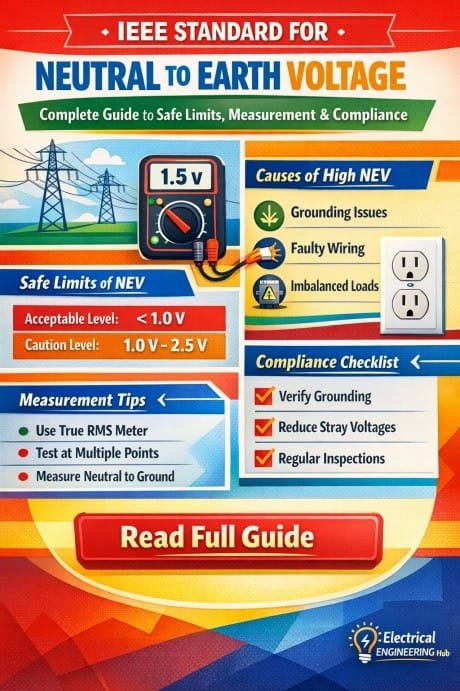
Table of Contents
This guide explains the concept in a practical way, covering safe limits, IEEE recommendations, measurement techniques, and compliance practices used in real-world installations.
What is Neutral to Earth Voltage
Neutral to earth voltage is the potential difference between the neutral conductor and the earth (ground). In an ideal electrical system, this value should be zero. However, in practical systems, a small voltage always exists due to load current, conductor impedance, and system imbalance.
Learn more about earthing cable size as per iec
This voltage is often seen in:
- Residential electrical wiring
- Industrial power systems
- Commercial distribution panels
Even though the neutral is grounded at the source, current flowing through it creates a voltage drop. This results in a measurable difference between neutral and earth.
Why Neutral to Earth Voltage Matters
The ieee standard for neutral to earth voltage emphasizes safety and system reliability. High NEV can lead to multiple problems:
- Electric shock risks
- Equipment malfunction
- Noise in sensitive electronics
- Overheating of conductors
- False tripping of protection devices
Maintaining acceptable NEV levels is critical in hospitals, data centers, and industrial environments where precision equipment is used.
IEEE Perspective on Neutral to Earth Voltage
IEEE does not define a single universal limit for all systems, but several electrical standards provide guidance related to grounding, system design, and voltage tolerances. These include:
- IEEE 142 (Green Book) – Grounding of Industrial and Commercial Power Systems
- IEEE 1100 (Emerald Book) – Powering and Grounding Sensitive Electronic Equipment
- IEEE 1159 – Power Quality Monitoring
According to the ieee standard for neutral to earth voltage, the focus is on minimizing voltage differences through proper grounding and balanced system design rather than just enforcing a fixed number.
Discover everything about cable bending radius iec standard
Acceptable Neutral to Earth Voltage Limits
In practice, engineers follow widely accepted safe ranges derived from IEEE recommendations and field experience.
| Condition | Typical NEV Range |
|---|---|
| Ideal system | 0 – 0.5 V |
| Acceptable range | 0.5 – 2 V |
| Needs attention | 2 – 5 V |
| Unsafe / critical condition | Above 5 V |
These values may vary depending on system size and load conditions. However, staying within 2 volts is generally considered good practice.
Causes of High Neutral to Earth Voltage
Understanding the root causes helps in maintaining compliance with the ieee standard for neutral to earth voltage.
Common causes include:
- Overloaded neutral conductor
- Loose or corroded connections
- Improper grounding system
- Harmonic currents from nonlinear loads
- Unbalanced three-phase loads
- Long cable runs with high impedance
Modern equipment like UPS systems, VFDs, and LED drivers often introduce harmonics, increasing neutral current and voltage.
Find all about IEEE Standard for Insulation Resistance Test
How to Measure Neutral to Earth Voltage
Accurate measurement is essential for diagnosis and compliance. The process is simple but must be done carefully.
Tools required:
- True RMS multimeter
- Clamp meter (optional)
- Power quality analyzer (for advanced analysis)
Measurement steps:
- Set the multimeter to AC voltage mode
- Place one probe on the neutral conductor
- Place the other probe on a known earth point
- Record the voltage reading
For better analysis, measurements should be taken:
- At the main distribution panel
- At sub-panels
- Near sensitive equipment
Measurement Tips
| Tip | Explanation |
|---|---|
| Measure under load | NEV increases with load |
| Check multiple points | Helps locate problem areas |
| Use true RMS meter | Ensures accuracy with harmonics |
| Repeat measurements | Confirms consistency |
Know more about IEEE Standard for Instrument Transformers
Impact on Equipment and Systems
High neutral-to-earth voltage can silently damage equipment over time. Sensitive electronics are especially vulnerable.
Effects include:
- Data errors in IT systems
- Malfunction of PLCs and control circuits
- Reduced lifespan of equipment
- Noise in communication lines
- Unexpected shutdowns
Following the ieee standard for neutral to earth voltage helps maintain stable operation and avoid costly downtime.
Role of Grounding in Controlling NEV
Grounding is the most critical factor in controlling neutral-to-earth voltage. A well-designed grounding system ensures safety and stability.
Key grounding practices:
- Single-point grounding system
- Low-resistance earth electrode
- Proper bonding between neutral and earth
- Regular inspection of grounding connections
IEEE standards recommend minimizing impedance in the grounding path to reduce voltage differences.
Explore all about IEEE Standard for Cable Insulation Resistance Test
Neutral vs Earth – Key Differences
Many people confuse neutral and earth, but their roles are different.
| Parameter | Neutral | Earth |
|---|---|---|
| Purpose | Return current path | Safety path for fault current |
| Current flow | Carries current during operation | Carries current during faults |
| Connection | Connected to transformer neutral | Connected to earth electrode |
| Voltage level | Slightly above zero | Ideally zero |
Maintaining proper separation and bonding is essential for compliance with the ieee standard for neutral to earth voltage.
How to Reduce Neutral to Earth Voltage
Reducing NEV requires a combination of design improvements and maintenance practices.
Practical solutions:
- Balance three-phase loads
- Tighten all neutral and ground connections
- Upgrade undersized neutral conductors
- Install harmonic filters
- Improve grounding system resistance
- Use dedicated grounding for sensitive equipment
These steps align with IEEE recommendations and improve overall power quality.
Compliance and Best Practices
To meet the ieee standard for neutral to earth voltage, organizations should follow structured practices.
Recommended actions:
- Conduct periodic electrical audits
- Monitor power quality continuously
- Maintain grounding resistance below recommended limits
- Document NEV readings for compliance records
- Train technical staff on grounding practices
Know more about IEEE Standard for Contact Resistance
Compliance Checklist
| Item | Status Check |
|---|---|
| Ground resistance tested | Yes / No |
| Neutral connections inspected | Yes / No |
| Load balancing verified | Yes / No |
| Harmonics analyzed | Yes / No |
| NEV within acceptable range | Yes / No |
Real-World Example
In an industrial facility, NEV was recorded at 6 volts, causing frequent PLC failures. After investigation, engineers found:
- Loose neutral connections
- High harmonic distortion
- Poor grounding system
By tightening connections, installing filters, and improving grounding, NEV was reduced to below 1 volt. This restored system stability and eliminated downtime.
Common Mistakes to Avoid
Many installations fail to meet the ieee standard for neutral to earth voltage due to avoidable mistakes:
- Ignoring small voltage differences
- Using poor-quality grounding materials
- Not considering harmonics
- Overloading neutral conductors
- Skipping regular maintenance
Attention to detail is key in electrical systems.
Find all about IEEE Standard for Short Circuit Calculation
Final Thoughts
The ieee standard for neutral to earth voltage is not just a theoretical concept but a practical guideline for ensuring electrical safety and performance. While a perfectly zero voltage is not achievable, keeping NEV within acceptable limits is essential.
By understanding its causes, measuring it correctly, and applying proper grounding techniques, engineers can maintain safe and efficient systems. Whether in residential setups or complex industrial networks, controlling neutral-to-earth voltage is a fundamental aspect of modern electrical engineering.
Know more about IEC Standard for Neutral to Earth Voltage – Limits, Measurement & Safety Guidelines
Follow Us on Social:
Subscribe our Newsletter on Electrical Insights for latest updates from Electrical Engineering Hub
#IEEENeutralToEarthVoltage, #NeutralToEarthVoltage, #IEEESafetyStandards, #ElectricalGrounding, #PowerSystemSafety, #VoltageStandards, #EarthingSystem, #ElectricalProtection, #IndustrialSafetyStandards, #PowerQuality