
Demand Factor for Transformer Sizing – Accurate Load Calculation & Optimal kVA Selection Guide
Selecting the right transformer capacity is one of the most critical decisions in any power distribution system. Oversizing increases capital cost and no-load losses, while undersizing leads to overheating, voltage drop, and reduced equipment life. The most practical way to strike the right balance is by applying the demand factor for transformer sizing correctly.
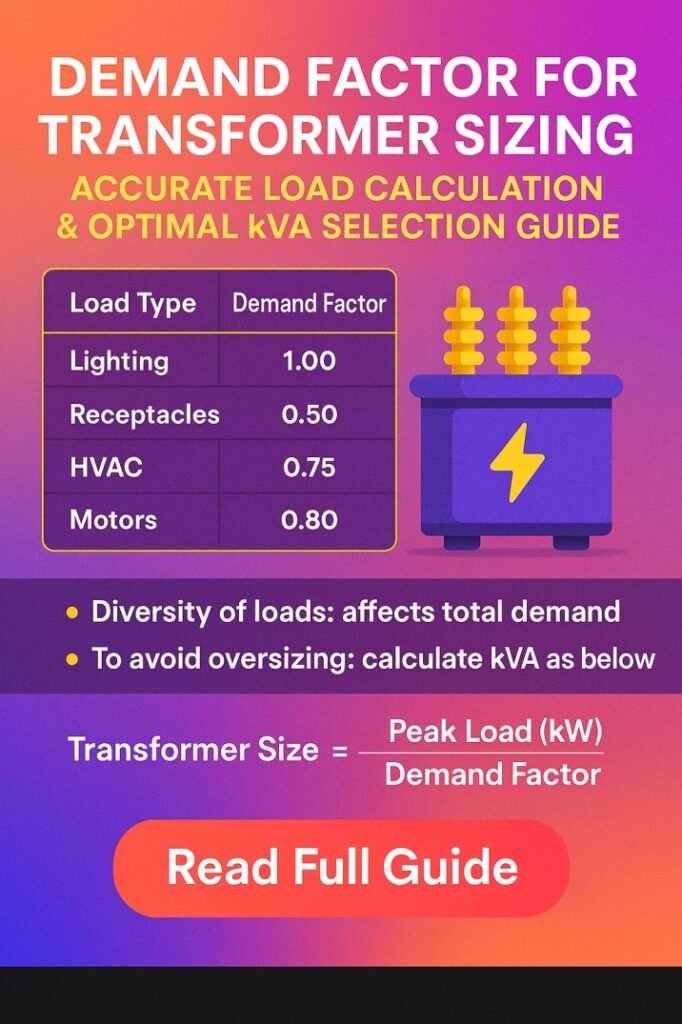
Table of Contents
Many engineers confuse connected load with actual operating load. In real installations, not all equipment runs at full capacity at the same time. This is where demand factor becomes essential. When applied properly, demand factor for transformer sizing ensures accurate load calculation and optimal kVA selection without compromising reliability or efficiency.
Know more about NEC NFPA 70 2026 — Complete Guide to Code Updates, Compliance Requirements, and Electrical Safety Standards
Understanding Demand Factor in Electrical Systems
Demand factor is defined as the ratio of maximum demand to total connected load.
Demand Factor = Maximum Demand / Connected Load
Connected load is the sum of rated capacities of all electrical equipment installed. Maximum demand is the highest load observed during a specific period under normal operating conditions.
Since not all loads operate simultaneously, demand factor is always less than 1.
For transformer engineers, demand factor for transformer sizing provides a realistic estimation of actual power requirement. It prevents unnecessary oversizing and helps maintain economical system design.
Why Demand Factor Matters in Transformer Sizing
Transformers are rated in kVA, not kW. Therefore, load estimation must account for:
- Real power (kW)
- Reactive power (kVAR)
- Power factor
- Diversity of loads
- Load growth margin
Using only connected load can inflate transformer rating by 20 to 50 percent. Proper application of demand factor for transformer sizing results in:
- Reduced capital cost
- Lower core losses
- Improved voltage regulation
- Better efficiency at operating load
- Optimized cable and breaker sizing
In industrial, commercial, and residential projects, this approach is considered standard engineering practice.
Know more about Best Universities for Electrical Engineering in Ontario | Top Programs, Rankings & Career Outcomes
Step-by-Step Method for Accurate Load Calculation
Accurate transformer selection requires a structured method. Below is a practical approach used in EPC projects and distribution planning.
Step 1: Prepare Connected Load List
Create a detailed load schedule including:
- Motors
- HVAC systems
- Lighting circuits
- Socket outlets
- Process equipment
- Future spare loads
Example table:
| Load Description | Quantity | Rating (kW) | Total kW |
|---|---|---|---|
| 15 kW Motors | 6 | 15 | 90 |
| HVAC Units | 4 | 12 | 48 |
| Lighting | – | – | 20 |
| Socket Circuits | – | – | 15 |
| Misc Equipment | – | – | 27 |
| Total Connected Load | 200 kW |
Total connected load = 200 kW
Know more about Electrical Engineer Salary in Botswana: Latest Pay Scale, Benefits, and Career Outlook (2026)
Step 2: Apply Demand Factor
Demand factor varies depending on facility type.
| Installation Type | Typical Demand Factor |
|---|---|
| Residential | 0.4 – 0.6 |
| Commercial Building | 0.6 – 0.8 |
| Industrial Plant | 0.7 – 0.9 |
| Data Center | 0.9 – 1.0 |
Assume industrial plant demand factor = 0.75
Maximum Demand = 200 × 0.75 = 150 kW
This shows how demand factor for transformer sizing significantly reduces design load to realistic operating value.
Step 3: Convert kW to kVA
Transformers are rated in kVA, so power factor must be considered.
kVA = kW / Power Factor
Assume power factor = 0.85
- kVA = 150 / 0.85
- kVA = 176.47 kVA
Use our online tool for free KW to KVA and KVA to Amps Calculator
Step 4: Add Future Expansion Margin
Good engineering practice recommends adding 10 to 25 percent spare capacity.
Assume 20 percent growth margin:
- Required kVA = 176.47 × 1.2 = 211.76 kVA
- Nearest standard transformer size = 250 kVA
This is how demand factor for transformer sizing ensures optimal kVA selection without unnecessary oversizing.
Know more about Best Electrical Engineering Schools in the World | Top Global Universities for EE Programs
Demand Factor vs Diversity Factor
Engineers often confuse demand factor with diversity factor.
| Parameter | Demand Factor | Diversity Factor |
|---|---|---|
| Definition | Max Demand / Connected Load | Sum of Individual Max Demands / System Max Demand |
| Value Range | Less than 1 | Greater than 1 |
| Usage | Transformer sizing | Feeder and substation design |
| Purpose | Load reduction | System optimization |
For transformer capacity calculation, demand factor for transformer sizing is the primary tool, while diversity factor is used in multi-feeder systems.
Typical Demand Factors for Common Loads
Accurate values depend on real data or utility guidelines. Below are practical engineering estimates:
| Load Type | Demand Factor |
|---|---|
| General Lighting | 0.9 |
| Power Sockets | 0.5 – 0.6 |
| Motors (grouped) | 0.75 – 0.85 |
| Elevators | 0.6 |
| HVAC Systems | 0.8 |
| Welding Machines | 0.5 |
When calculating demand factor for transformer sizing, group loads logically rather than applying one single value blindly.
Know more about Top 12 Switchgear Training Courses in USA: Professional Certification & Career Advancement
Impact on Transformer Efficiency and Losses
Transformer efficiency depends on loading percentage. Core losses remain constant, while copper losses vary with load current.
If transformer loading is too low due to oversizing:
- Core losses dominate
- Efficiency drops
- Investment cost increases
- Power factor correction becomes less effective
If undersized:
- Overheating occurs
- Insulation life reduces
- Voltage regulation deteriorates
- Protection devices trip frequently
Applying demand factor for transformer sizing keeps transformer loading within 60 to 80 percent of rated capacity during peak demand. This is considered optimal for long-term performance. Know more about Transformer Sizing for Residential Building
Practical Example for Commercial Building
Let us consider a commercial building with:
- Connected load = 350 kW
- Demand factor = 0.7
- Power factor = 0.9
- Maximum Demand = 350 × 0.7 = 245 kW
- Required kVA = 245 / 0.9 = 272 kVA
Adding 15 percent future margin:
272 × 1.15 = 312.8 kVA
Nearest standard rating = 315 kVA or 400 kVA depending on utility availability.
Using demand factor for transformer sizing avoids selecting a 500 kVA transformer unnecessarily.
Know more about Transformer Oil Testing: 9 Important Tests for Healthiness
Role of Load Profile and Smart Meter Data
Modern installations use smart meters and energy analyzers to record:
- Peak demand
- Load curves
- Seasonal variation
- Harmonic distortion
- Reactive power demand
Instead of theoretical assumptions, engineers can now apply real measured maximum demand. This makes demand factor for transformer sizing even more accurate. Know more about Transformer Cooling Methods: ONAN, ONAF, OFAF & More
For critical facilities such as hospitals or data centers, measured demand data over at least 12 months is recommended before final transformer capacity selection.
Common Mistakes in Transformer Sizing
Avoid these frequent errors:
- Using connected load directly without demand factor
- Ignoring power factor correction
- Not considering starting current of large motors
- Applying unrealistic future expansion margin
- Selecting transformer based only on availability
Correct use of demand factor for transformer sizing eliminates most of these design flaws.
Know all about Transformer Sizing for EV Charger
Integration with Power Factor Correction
When capacitor banks are installed, system power factor improves. This reduces kVA demand for same kW load.
For example:
If power factor improves from 0.8 to 0.95:
kVA reduces by nearly 16 percent.
Therefore, transformer sizing should consider final corrected power factor. This ensures economic selection and better voltage stability. Find more Transformer calculators here
Final Guidelines for Optimal kVA Selection
For professional and reliable results:
- Prepare detailed connected load schedule
- Apply realistic demand factor based on load type
- Convert kW to kVA using expected power factor
- Add reasonable growth margin
- Verify transformer loading percentage
- Cross-check with utility standards
When properly applied, demand factor for transformer sizing provides a balanced solution between cost, efficiency, and reliability.
Conclusion
Transformer selection is not just about adding all loads and choosing the next larger size. It requires careful evaluation of actual operating conditions. The demand factor for transformer sizing plays a central role in accurate load calculation and optimal kVA selection.
Explore all about Transformer Bond Sizing
By understanding connected load, maximum demand, power factor, and future expansion requirements, engineers can design efficient and cost-effective power distribution systems. Whether for industrial plants, commercial complexes, or residential developments, applying demand factor for transformer sizing ensures technical accuracy, financial savings, and long-term system stability.
Follow Us on Social:
Subscribe our Newsletter on Electrical Insights for latest updates from Electrical Engineering Hub
#DemandFactor, #TransformerSizing, #ElectricalLoadCalculation, #PowerDistributionDesign, #MaximumDemand, #LoadFactor, #DiversityFactor, #ElectricalEngineering, #SubstationDesign, #kVACalculation