ESP12F vs ESP32: Comprehensive Comparison for IoT & Embedded Projects
In the world of IoT and embedded systems, choosing the right microcontroller is critical for project success. Two popular options in this domain are the ESP12F and ESP32 modules. While both are widely used in hobbyist and professional applications, they have distinct differences that make each suitable for specific use cases. In this article, we will provide a thorough comparison of ESP12F vs ESP32, covering performance, connectivity, power consumption, and practical applications to help engineers, developers, and enthusiasts make an informed choice.
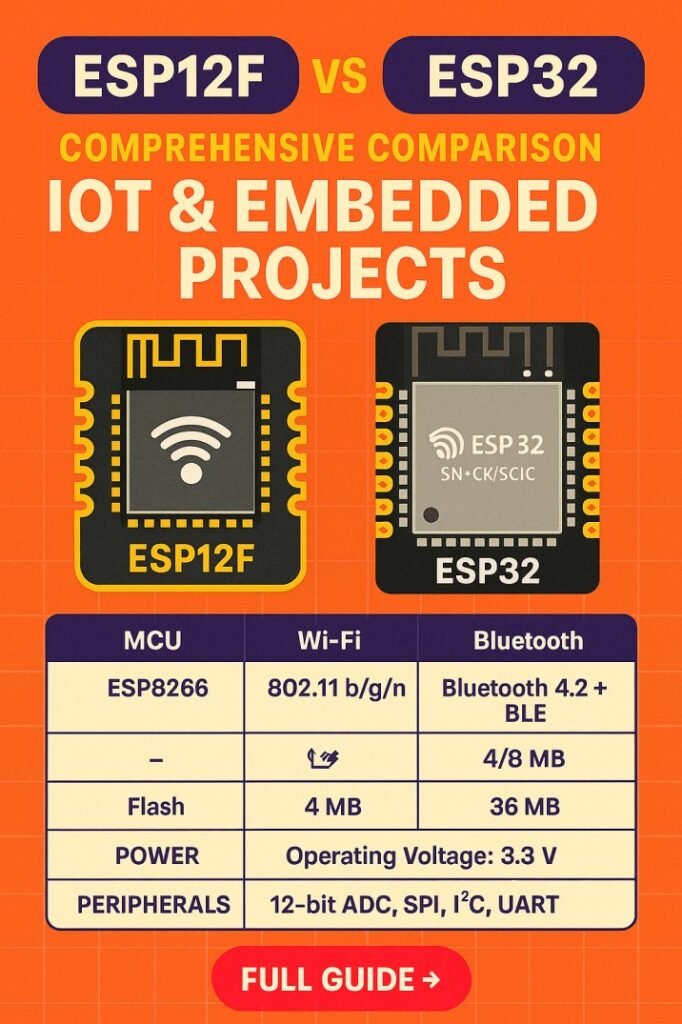
Table of Contents
Overview of ESP12F
The ESP12F is part of the ESP8266 family and is a highly integrated Wi-Fi module. It has gained popularity due to its low cost, compact size, and ease of integration into IoT projects. With a 32-bit processor and sufficient GPIO pins, ESP12F is ideal for small-scale smart home devices, sensors, and lightweight automation systems. The module supports 802.11 b/g/n Wi-Fi, making it suitable for internet-connected applications where low power and minimal processing are required. Explore details on a4988 esp32
ESP12F’s advantages include its affordability, ease of programming with the Arduino IDE, and a large online community that provides libraries and project tutorials. However, its limited processing power and absence of Bluetooth make it less ideal for projects requiring complex computations or dual-mode connectivity.
Know more about ESP12F vs ESP8266: Comprehensive Comparison for IoT Projects and Smart Applications
Overview of ESP32
The ESP32 is an advanced successor to the ESP8266 series, featuring a dual-core processor and integrated Wi-Fi and Bluetooth capabilities. This module is designed for more demanding IoT and embedded applications. With support for both Wi-Fi and Bluetooth Classic/BLE, ESP32 can serve as a hub for smart devices, wearable technology, and industrial IoT applications. It offers higher RAM, more GPIOs, and additional interfaces like I2C, SPI, UART, and ADC/DAC channels.
ESP32 excels in performance, multitasking, and connectivity options. It also supports low-power modes for battery-operated projects. While it comes at a slightly higher cost than ESP12F, the ESP32’s flexibility and enhanced features justify the investment for complex projects. Know more about esp8266 pinout
Key Differences Between ESP12F and ESP32
Understanding the differences between ESP12F vs ESP32 is crucial for selecting the right module. The table below summarizes the main specifications and features:
| Feature | ESP12F | ESP32 |
|---|---|---|
| Processor | 32-bit Tensilica L106 | Dual-core 32-bit Tensilica LX6 |
| Clock Speed | 80 MHz | Up to 240 MHz |
| Wi-Fi | 802.11 b/g/n | 802.11 b/g/n |
| Bluetooth | Not available | Bluetooth Classic & BLE |
| Flash Memory | 4 MB | 4 MB to 16 MB |
| RAM | 160 KB | 520 KB SRAM |
| GPIO Pins | 11 usable | 34 programmable pins |
| ADC Channels | 1 (10-bit) | 18 (12-bit) |
| DAC Channels | None | 2 (8-bit) |
| PWM Channels | 8 | 16 |
| Power Consumption | 70 mA active | 160 mA active (depends on mode) |
| Cost | Low | Moderate |
The table highlights that ESP32 offers superior performance, more GPIOs, and dual-mode connectivity, while ESP12F is simpler and more cost-effective.
Know more about Programmable Logic Controller vs Arduino
Performance and Processing
When comparing ESP12F vs ESP32 in terms of performance, the difference is significant. ESP32’s dual-core processor allows for multitasking, enabling simultaneous Wi-Fi communication, sensor data processing, and control logic. ESP12F, with a single-core processor, handles tasks sequentially, which may result in slower response times in complex applications.
For instance, in a home automation scenario with multiple sensors and devices, ESP32 can process sensor inputs while maintaining stable Wi-Fi communication. On the other hand, ESP12F may face delays if multiple tasks are running concurrently.
Know more about Best WiFi Modules for Smart Home Projects (ESP8266, ESP32, ESP12F)
Connectivity Options
Connectivity is another important factor in the ESP12F vs ESP32 comparison. Both modules support Wi-Fi, but ESP32 adds Bluetooth connectivity, making it ideal for projects requiring mobile device integration or mesh networking. ESP12F is suitable for Wi-Fi-only applications like smart plugs, temperature sensors, or IoT light controllers. For projects where Bluetooth is required, ESP32 is the clear choice.
Power Consumption Considerations
Power efficiency is critical in battery-operated IoT devices. ESP12F consumes less power in active mode compared to ESP32, making it suitable for low-power applications. ESP32 supports deep sleep and ultra-low-power modes, but the overall consumption is higher during active operation. When selecting a module, it’s essential to consider whether power efficiency or processing capability is more important for your project.
Development and Community Support
Both ESP12F and ESP32 are compatible with Arduino IDE, PlatformIO, and ESP-IDF, offering flexible programming options. ESP32 benefits from a more extensive set of libraries due to its advanced features. ESP12F, being older and widely used, also has a large community and numerous tutorials, making it easier for beginners to start projects. Know more about Top 10 ESP Based Smart Home Projects for Beginners
Practical Applications
The choice between ESP12F vs ESP32 often depends on project complexity. Typical use cases include:
- ESP12F: Wi-Fi sensors, smart plugs, LED controllers, simple IoT nodes.
- ESP32: Smart home hubs, wearable devices, industrial IoT, audio streaming, robotics, and projects requiring multiple sensors or Bluetooth connectivity. Explore all about arduino touch sensor
Conclusion
Choosing between ESP12F vs ESP32 requires evaluating project requirements, performance needs, connectivity options, and power consumption. ESP12F is perfect for simple, cost-sensitive IoT projects, while ESP32 offers enhanced capabilities for complex and multifunctional applications. By understanding their differences, developers can select the right module to optimize performance, reduce development time, and ensure project success.
Here is a detailed guide on esp12f pinout
Follow Us on Social:
Subscribe our Newsletter on Electrical Insights for latest updates from Electrical Engineering Hub
#ESP12FvsESP32, #ESP32, #ESP12F, #IoTDevelopment, #Microcontrollers, #EmbeddedSystems, #ESPComparison, #Arduino, #WirelessModules, #SmartProjects