IEC Standard for Medium Voltage Switchgear: Important Compliance Guide for Engineers
Medium voltage switchgear plays a critical role in the distribution of electrical energy, ensuring reliable operation and safety in industrial, commercial, and utility applications. For engineers, understanding the IEC standard for medium voltage switchgear is essential to ensure compliance, operational efficiency, and personnel safety.
This guide provides a detailed overview of the relevant IEC standards, design requirements, testing procedures, and best practices for engineers involved in medium voltage switchgear projects.
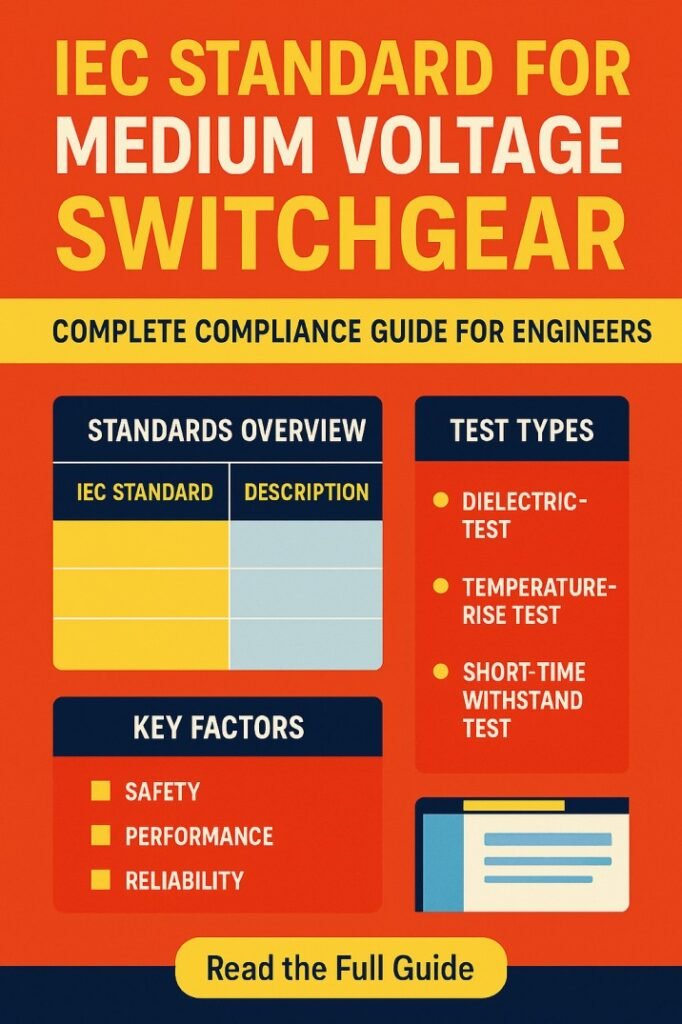
Table of Contents
What is Medium Voltage Switchgear?
Medium voltage (MV) switchgear is electrical equipment used to control, protect, and isolate electrical circuits in the range of 1 kV to 36 kV. These devices are essential for the safe operation of electrical networks and prevent equipment damage, electrical faults, and fire hazards. Typical components of medium voltage switchgear include circuit breakers, disconnectors, fuses, current transformers, and busbars.
Understanding IEC standard for medium voltage switchgear ensures that these components meet international safety, performance, and durability criteria.
Know more about IEC Standard for Busbar Clearance
Overview of IEC Standards for Medium Voltage Switchgear
The International Electrotechnical Commission (IEC) has defined a series of standards specifically for medium voltage switchgear. The primary standard is IEC 62271, which covers high-voltage and medium-voltage switchgear and controlgear. Key parts of this standard include:
- IEC 62271-1: General requirements
- IEC 62271-100: Alternating-current circuit breakers
- IEC 62271-200: AC metal-enclosed switchgear and controlgear
- IEC 62271-203: Gas-insulated metal-enclosed switchgear
These standards define mechanical, electrical, and thermal performance requirements, ensuring that medium voltage switchgear operates safely under normal and fault conditions. Engineers must reference the correct IEC standard depending on the type of equipment and application.
Key Compliance Requirements
Adhering to the IEC standard for medium voltage switchgear involves meeting several critical compliance requirements. These include:
- Insulation and dielectric strength: Switchgear must withstand overvoltages without breakdown. Insulation testing is performed under specific conditions defined by IEC 62271.
- Short circuit withstand capability: Switchgear should safely interrupt fault currents and prevent damage to the system.
- Temperature rise limits: Components should operate within thermal limits to prevent overheating and ensure long-term reliability.
- Mechanical endurance: Switchgear must withstand repeated operation without mechanical failure.
- Protection against electric shock: Proper grounding, interlocks, and isolation mechanisms are required to safeguard personnel.
Know more about IEC Standard for Earthing System
Types of Medium Voltage Switchgear
Medium voltage switchgear can be classified based on design, insulation type, and mounting arrangement. Common types include:
- Air-insulated switchgear (AIS): Uses air as the primary insulation medium, suitable for indoor and outdoor applications.
- Gas-insulated switchgear (GIS): Uses SF6 gas for insulation, offering compact design and higher reliability in urban areas.
- Hybrid switchgear: Combines features of AIS and GIS to optimize cost, space, and performance.
| Type | Advantages | Typical Applications |
|---|---|---|
| Air-Insulated Switchgear | Cost-effective, easy to maintain | Industrial plants, substations |
| Gas-Insulated Switchgear | Compact, high reliability, low maintenance | Urban substations, airports |
| Hybrid Switchgear | Space-saving, optimized performance | Medium-sized utility substations |
Know more about 7 Common Mistakes in Electrical Outlet Height
Design Considerations for Compliance
Engineers must carefully consider several design aspects to ensure medium voltage switchgear complies with IEC standards. These considerations include:
- Component quality: Only certified circuit breakers, fuses, and transformers should be used to meet IEC performance criteria.
- Protection relays: Relays must be compatible with switchgear ratings and capable of detecting overcurrent, earth faults, and differential faults.
- Switchgear layout: Proper separation of compartments for busbars, cable connections, and control units reduces fault propagation.
- Environmental conditions: Humidity, temperature, and corrosive environments can affect insulation performance and operational life. Design should account for local climate conditions.
Testing and Certification
Compliance with IEC standard for medium voltage switchgear requires rigorous testing to verify performance and safety. Common tests include:
- Type tests: Conducted on prototype units to validate design and performance. Includes dielectric tests, temperature rise tests, and mechanical operation tests.
- Routine tests: Performed on each manufactured unit to ensure consistency. Includes insulation resistance measurement, contact resistance, and operational checks.
- Special tests: Performed when required by customer specifications, such as seismic tests or electromagnetic compatibility tests.
Use our online tool Creepage Distance Calculator – Calculate Safe Insulation & Clearance for PCB and High Voltage Design
| Test Type | Purpose | Frequency |
|---|---|---|
| Type Test | Validate design and IEC compliance | Prototype level |
| Routine Test | Ensure each unit meets standards | Every unit manufactured |
| Special Test | Address special project requirements | As specified |
Installation Guidelines
Proper installation is critical for compliance and safe operation. Engineers should follow these guidelines:
- Foundation and support: Medium voltage switchgear must be installed on a stable foundation to prevent vibration and misalignment.
- Earthing: Correct grounding ensures safety and limits overvoltages.
- Clearances: Minimum clearances defined in IEC 62271 must be maintained between phases, earth, and accessible parts.
- Cable management: Proper cable entry, termination, and labeling reduce the risk of faults and simplify maintenance.
Know more about Phase to Phase Clearance as per IEC 61439: Best Guide
Maintenance Best Practices
Regular maintenance ensures switchgear longevity and operational safety. Recommended practices include:
- Visual inspection: Check for corrosion, loose connections, and physical damage.
- Functional testing: Operate circuit breakers and relays to verify proper functionality.
- Cleaning: Remove dust, dirt, and moisture from compartments and insulation surfaces.
- Lubrication: Apply suitable lubricants to moving parts to reduce wear.
- Thermal imaging: Detect hot spots that may indicate poor connections or overloads.
Common Challenges in Compliance
Even experienced engineers may face challenges in ensuring IEC compliance for medium voltage switchgear:
- Environmental influences: High humidity or salt-laden air can degrade insulation.
- Component mismatches: Using components with different ratings may cause failures.
- Improper testing: Skipping routine or type tests can compromise safety.
- Documentation gaps: IEC standards require detailed records of design, tests, and maintenance, which must be maintained accurately.
Know more about How to Comply with OSHA Electrical Standards in detail
Benefits of IEC Compliance
Following the IEC standard for medium voltage switchgear offers numerous advantages:
- Safety: Reduces the risk of electrical accidents and fire hazards.
- Reliability: Ensures uninterrupted power supply and equipment protection.
- Standardization: Simplifies design, manufacturing, and maintenance processes across projects.
- Regulatory approval: Meets international and national regulatory requirements, facilitating project approvals.
Conclusion
Understanding and implementing the IEC standard for medium voltage switchgear is indispensable for engineers involved in electrical distribution and industrial applications. From design and installation to testing and maintenance, strict adherence to IEC requirements guarantees safety, reliability, and operational efficiency. By following the guidelines outlined in this comprehensive compliance guide, engineers can ensure that medium voltage switchgear systems perform optimally, protect assets, and comply with international standards.
Know more about Electrical Standards USA – National Electrical Code | Electrical Safety Foundation
Follow Us on Social:
Subscribe our Newsletter on Electrical Insights for latest updates from Electrical Engineering Hub
#IECStandard,#MediumVoltageSwitchgear,#IECSwitchgear,#PowerSystemStandards,#ElectricalSafety,#MVSwitchgear,#IEC62271,#SubstationDesign,#ElectricalEngineering,#GridReliability