What Are the Different Types of Earth Fault Relays?
Earth faults are among the most common and dangerous issues in electrical systems. They occur when current flows directly to the ground due to insulation failure, damaged cables, or equipment breakdown. These faults can lead to fire, electric shock, power outages, and severe equipment damage. This is why earth fault relays play an essential role in electrical protection. They monitor leakage current, detect abnormal conditions, and isolate the fault to keep the system safe.
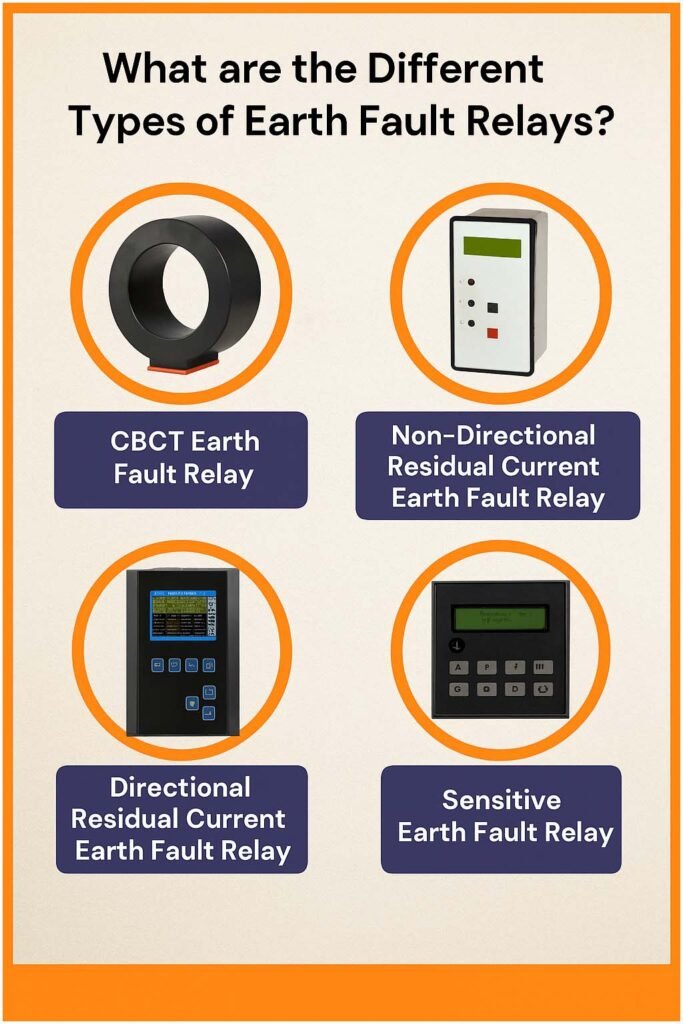
Table of Contents
Understanding the types of earth fault relays is important for engineers, technicians, and even facility owners. Each relay works differently, and selecting the right one ensures better protection, reliability, and system stability. Read in detail about types of transformer protection relays
This guide explains all major earth fault relay types, how they work, and where they are used.
What Is an Earth Fault Relay?
An earth fault relay is a protection device that senses current flowing to earth and initiates a trip if the leakage exceeds a set threshold. The relay compares the detected current with a preset value and operates the breaker to isolate the affected section. This helps prevent overheating, fires, equipment burnout, and operational downtime.
Why Different Types of Earth Fault Relays Exist
Different electrical networks operate under different voltage levels, load patterns, earthing arrangements, and safety requirements. Because no single relay type fits every application, manufacturers have designed various relays with unique sensing methods, response times, and protection characteristics.
Choosing the right relay improves:
- Fault detection accuracy
- Tripping speed
- Equipment protection
- System selectivity
- Operational safety
Below are the main types you will find in modern installations. Uncover insights on high impedance protection
Main Types of Earth Fault Relays
1. Instantaneous Earth Fault Relay (50N or 50G)
This relay detects ground faults and trips the circuit immediately without intentional delay. It is ideal for low-impedance networks where quick action is needed.
How it works:
It operates as soon as the measured earth fault current exceeds the preset threshold.
Applications:
- Industrial switchgear
- Transformers
- Cables in low-voltage systems
Advantages:
- Very fast response
- Simple settings
- Prevents equipment damage
2. Time-Delayed Earth Fault Relay (51N or 51G)
Also known as a definite time earth fault relay, it operates after a pre-set time delay. This helps maintain selectivity between upstream and downstream protection devices. Find out more about transformer differential protection
How it works:
It senses leakage current but waits for the set delay before activating the trip command.
Applications:
- Distribution feeders
- Ring main units
- Large facilities with multiple protection levels
Advantages:
- Better coordination
- Reduces nuisance tripping
- Ideal for layered systems
3. Inverse Time Earth Fault Relay
This relay uses an inverse time-current characteristic. The higher the fault current, the faster it operates.
How it works:
It relies on a time curve that decreases as the fault current increases. This helps clear severe faults quickly while providing a delay for smaller faults.
Applications:
- Radial distribution systems
- Overhead lines
- Industrial networks
Advantages:
- High fault-current sensitivity
- Improved coordination with upstream relays
Explore details on IEC Standard for Differential Protection
4. Restricted Earth Fault Relay (REF)
Restricted earth fault relays provide protection for a particular zone, usually the winding section of a transformer or generator.
How it works:
It detects internal earth faults within a defined “restricted” region using differential current measurement.
Applications:
- Power transformers
- Generators
- Large motors
Advantages:
- Extremely sensitive
- Fast operation
- High security against external faults
5. Sensitive Earth Fault Relay (SEF)
Sensitive earth fault relays detect very low leakage currents. These are used where even minor insulation failures can be dangerous.
How it works:
It monitors very small residual currents using core balance CTs.
Applications:
- Long cable feeders
- Streetlights
- Rural distribution lines
Advantages:
- Detects high-impedance faults
- Protects long-distance networks
Know more about alternator protection scheme
6. High-Resistance Earth Fault Relay
This relay is designed for networks with high-resistance grounding. It detects low-level ground faults without causing system shutdowns.
How it works:
It measures voltage or current rise across grounding resistors.
Applications:
- High-voltage industrial networks
- Generator grounding systems
Advantages:
- Prevents unnecessary tripping
- Allows continuous operation during low-level faults
Get complete information about protection of alternator
7. Numerical or Digital Earth Fault Relay
Modern networks use microprocessor-based earth fault relays. They offer advanced features such as fault recording, diagnostics, and communication.
How it works:
They digitally analyze the input signals and apply protection logic through algorithms.
Applications:
- Smart grids
- Substations
- Industrial automation systems
Advantages:
- High accuracy
- Remote monitoring
- Programmable settings
8. Ground Fault Monitoring Relay
These relays continuously track insulation health and provide warnings before a major fault occurs.
How it works:
Instead of tripping instantly, they alert operators to rising leakage levels.
Applications:
- Hospitals
- Data centers
- Critical load environments
Advantages:
- Prevents downtime
- Early detection of insulation failure
Learn more about types of generator protection relays
Comparison Table: Types of Earth Fault Relays
| Relay Type | Operating Principle | Best Application | Key Strength |
|---|---|---|---|
| Instantaneous Earth Fault Relay | Trips immediately on fault | Transformers, LV panels | Fastest response |
| Time-Delayed Earth Fault Relay | Delayed tripping | Distribution networks | Coordination |
| Inverse Time Earth Fault Relay | Time decreases as current rises | Radial feeders | Selective protection |
| Restricted Earth Fault Relay | Differential zone protection | Transformers, generators | High sensitivity |
| Sensitive Earth Fault Relay | Detects very small leakage | Long feeders, street lighting | High impedance fault detection |
| High-Resistance Earth Fault Relay | Protects HRG networks | HV industrial plants | Stability against low-level faults |
| Numerical Earth Fault Relay | Digital signal analysis | Smart grids | Advanced features |
| Ground Fault Monitoring Relay | Monitors insulation | Critical operations | Predictive protection |
Choosing the Right Earth Fault Relay
The ideal relay depends on the nature of the electrical system. Key factors to consider include:
- Type of earthing system
- Fault current levels
- Equipment sensitivity
- Required selectivity
- Coordination with existing protection devices
- Level of automation or monitoring needed
A modern electrical network often uses more than one type of earth fault relay to achieve layered and reliable protection.
Dive deeper into differential protection of alternator
Conclusion
Understanding the types of earth fault relays is essential for designing safe and reliable power systems. From instantaneous relays to advanced numerical relays, each type offers unique advantages based on the application. Selecting the right relay ensures faster fault detection, better system coordination, reduced equipment stress, and improved operational safety.
By implementing appropriate earth fault protection, facilities can minimize downtime, prevent hazardous situations, and maintain a stable electrical network.
Follow Us on Social:
Subscribe our Newsletter on Electrical Insights for latest updates from Electrical Engineering Hub
#earthfaultrelay, #protectionrelay, #electricalsafety, #powerdistribution, #efelectrical, #relaytypes, #faultprotection, #industrialpower, #electricalengineering, #earthingprotection