Underground Cable Testing Methods: 9 Professional Techniques for Accurate Power Cable Fault Detection
Underground power cables are widely used in modern electrical networks because they provide better safety, aesthetics, and protection from environmental damage compared with overhead lines. However, when a fault occurs in buried cables, locating and diagnosing the issue becomes more complex. Engineers therefore rely on several professional underground cable testing methods to ensure system reliability, detect insulation failures, and prevent costly downtime.
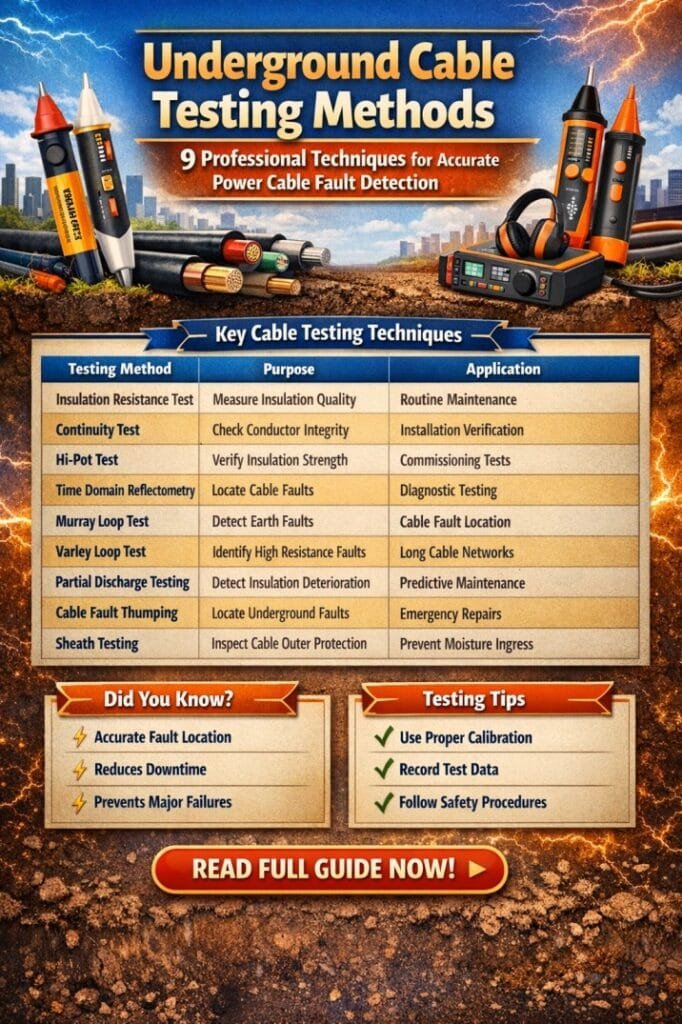
Table of Contents
Understanding the most effective underground cable testing methods is essential for electrical engineers, maintenance teams, and power utility professionals. Proper testing helps verify insulation integrity, detect partial discharge activity, identify conductor faults, and ensure that cables operate safely under load conditions. With the correct testing approach, technicians can quickly locate faults and restore power systems efficiently.
This article explains nine widely used underground cable testing methods that professionals apply for accurate power cable fault detection and maintenance. Know more about Top 20 Electrical Testing Tools Which You Must Have
Importance of Underground Cable Testing
Regular testing of underground cables ensures that electrical systems remain safe, efficient, and reliable. Power cables installed underground are exposed to moisture, thermal stress, mechanical damage, and aging insulation. These factors can gradually reduce insulation resistance and eventually lead to cable failure.
Using reliable underground cable testing methods helps engineers achieve several important objectives.
• Detect insulation deterioration before failure occurs
• Identify short circuits, open circuits, and sheath faults
• Confirm proper installation of new cables
• Prevent unexpected power outages
• Improve the lifespan of power cable systems
Utilities, industrial facilities, and renewable energy plants all rely on periodic cable testing to maintain uninterrupted electrical supply.
Common Types of Underground Cable Faults
Before applying underground cable testing methods, engineers must understand the types of faults that commonly occur in buried cables.
| Fault Type | Description | Common Cause |
|---|---|---|
| Open Circuit Fault | Conductor breaks and current flow stops | Mechanical damage or joint failure |
| Short Circuit Fault | Two conductors come into contact | Insulation breakdown |
| Earth Fault | Conductor touches ground or cable sheath | Moisture or insulation damage |
| Sheath Fault | Damage to outer cable sheath | Corrosion or digging activities |
| High Resistance Fault | Fault with partial current flow | Insulation degradation |
Accurate testing methods help identify these issues quickly and allow engineers to take corrective action.
Find more about Best Megger Insulation Tester for Industrial Motors
1. Insulation Resistance Test (Megger Test)
The insulation resistance test is one of the most widely used underground cable testing methods. It measures the resistance between cable conductors and earth using a device known as a Megger.
A high resistance value indicates good insulation, while a low value suggests insulation deterioration or moisture ingress.
Typical testing procedure includes:
• Disconnecting the cable from power sources
• Applying DC voltage through a Megger
• Measuring insulation resistance between conductors and ground
| Voltage Rating | Recommended Test Voltage |
|---|---|
| Low Voltage Cables | 500 V – 1000 V |
| Medium Voltage Cables | 2.5 kV – 5 kV |
| High Voltage Cables | Up to 10 kV |
The Megger test is commonly used during cable installation, maintenance inspections, and troubleshooting procedures.
Explore all about How to Use Megger BM5200 Insulation Tester 5kV
2. Continuity Test
The continuity test verifies whether the conductor path inside the cable is complete. It helps detect open circuit faults in underground cables.
Technicians perform this test by connecting a low-voltage source or multimeter across the cable conductors. If the conductor is intact, the meter shows low resistance or continuity.
Key benefits of this testing method include:
• Quick verification of cable integrity
• Identification of broken conductors
• Simple testing procedure with basic tools
Although basic, continuity testing is an essential step before applying advanced underground cable testing methods.
3. High Voltage Withstand Test (Hi-Pot Test)
The High Potential Test, commonly known as the Hi-Pot test, checks the ability of cable insulation to withstand high voltage stress.
In this method, a high voltage greater than the operating voltage is applied to the cable for a specified duration. If the insulation is weak, breakdown occurs during testing.
Typical Hi-Pot testing characteristics:
| Parameter | Description |
|---|---|
| Test Voltage | Higher than rated voltage |
| Test Duration | 5 to 60 minutes |
| Purpose | Verify insulation strength |
This test is commonly performed on newly installed underground power cables before commissioning.
Find more about Fluke 1507 Insulation Tester Megger Working
4. Time Domain Reflectometry (TDR)
Time Domain Reflectometry is an advanced diagnostic technique used to locate faults in underground cables.
A pulse signal is transmitted through the cable, and reflections from faults or impedance changes are analyzed. By measuring the time taken for the reflected signal to return, engineers can estimate the fault location.
Advantages of TDR testing include:
• Non-destructive testing method
• Accurate fault distance measurement
• Quick troubleshooting of cable systems
TDR equipment is widely used in power utilities and telecommunications networks.
5. Murray Loop Test
The Murray Loop Test is a bridge-based method used to locate earth faults or short circuits in underground cables.
This technique requires one healthy conductor and one faulty conductor. The method works by balancing a Wheatstone bridge circuit to determine the fault location.
| Component | Function |
|---|---|
| Galvanometer | Detects bridge balance |
| Ratio Arms | Adjust circuit resistance |
| Battery Source | Provides testing voltage |
Once the bridge is balanced, engineers calculate the distance to the fault using the cable length and resistance ratio.
Know more about How to Use Megger Insulation Tester MIT2500
6. Varley Loop Test
The Varley Loop Test is another bridge method used to detect faults in underground cables, particularly when fault resistance is high.
Unlike the Murray Loop Test, this technique allows adjustment of variable resistance to obtain accurate readings even when the fault resistance is significant.
Key advantages include:
• Accurate measurement of high resistance faults
• Improved fault location precision
• Suitable for long cable routes
Varley loop testing remains one of the reliable underground cable testing methods used in electrical utilities.
7. Partial Discharge Testing
Partial discharge testing detects tiny electrical discharges within cable insulation. These discharges occur when insulation begins to degrade but has not yet completely failed.
Detecting partial discharge early helps prevent catastrophic cable breakdown.
| Feature | Description |
|---|---|
| Detection Method | Electrical pulse measurement |
| Application | Medium and high voltage cables |
| Benefit | Early insulation failure detection |
This technique is widely used for predictive maintenance of underground power cable systems.
Know more about Difference Between VLF and Megger
8. Cable Fault Thumping
Cable fault thumping is a specialized method used to locate underground cable faults acoustically.
In this technique, high-energy pulses are sent through the cable. When the pulse reaches the fault point, it creates a loud sound or vibration in the ground.
Technicians then use acoustic listening devices to identify the exact location of the fault.
Advantages include:
• Fast fault location in buried cables
• Effective for high resistance faults
• Useful for long underground cable routes
Although effective, this method must be used carefully to avoid additional insulation damage.
9. Sheath Testing
Sheath testing focuses on the outer protective layer of underground cables. The cable sheath protects the internal insulation from moisture, corrosion, and mechanical damage.
A sheath test checks whether the outer covering is intact and properly insulated from ground.
Common steps include:
• Applying DC voltage to the cable sheath
• Monitoring leakage current
• Detecting sheath punctures or corrosion damage
Explore all about How to Test a 3 Phase Motor With a Megger
Maintaining a healthy cable sheath is critical for the long-term reliability of underground cable systems.
Comparison of Underground Cable Testing Methods
The table below summarizes the most important underground cable testing methods and their typical applications.
| Testing Method | Purpose | Application |
|---|---|---|
| Insulation Resistance Test | Measure insulation quality | Routine maintenance |
| Continuity Test | Check conductor integrity | Installation verification |
| Hi-Pot Test | Verify insulation strength | Commissioning tests |
| Time Domain Reflectometry | Locate cable faults | Diagnostic testing |
| Murray Loop Test | Detect earth faults | Cable fault location |
| Varley Loop Test | Identify high resistance faults | Long cable networks |
| Partial Discharge Testing | Detect insulation deterioration | Predictive maintenance |
| Cable Fault Thumping | Locate underground faults | Emergency repairs |
| Sheath Testing | Inspect cable outer protection | Prevent moisture ingress |
Know more about How to Use Megger Insulation Tester 1000V
Best Practices for Cable Testing
When performing underground cable testing methods, engineers should follow professional testing procedures to ensure accurate results.
Important guidelines include:
• Always isolate cables from the power supply before testing
• Use calibrated and properly rated testing equipment
• Follow safety standards for high voltage testing
• Record test results for future comparison
• Perform periodic inspections to detect early faults
Implementing these practices improves the reliability and lifespan of underground power cables.
Conclusion
Modern electrical infrastructure depends heavily on underground power cables for reliable and safe electricity distribution. However, faults in buried cables can cause significant power interruptions and expensive repairs. This is why professional underground cable testing methods are essential for maintaining system reliability.
Techniques such as insulation resistance testing, Hi-Pot testing, time domain reflectometry, bridge methods, and partial discharge analysis allow engineers to detect faults accurately and maintain cable performance. By applying the correct testing strategy, electrical professionals can identify problems early, reduce downtime, and extend the operational life of underground cable networks.
Know more about Best Megger Testers for Industrial Use
Understanding and applying these underground cable testing methods ensures that power distribution systems remain efficient, safe, and dependable for years to come.
Follow Us on Social:
Subscribe our Newsletter on Electrical Insights for latest updates from Electrical Engineering Hub
#UndergroundCableTesting, #CableTestingMethods, #ElectricalCableTesting, #HighVoltageTesting, #CableFaultTesting, #ElectricalEngineeringGuide, #PowerCableTesting, #CableDiagnostics, #ElectricalMaintenance, #ElectricalSafety

Wow, this blogger is seriously impressive!
Your blog post was fantastic, thanks for the great content!