Transformer Sizing for Solar Power Plant: Expert Guide for Optimal Efficiency and Safety
Transformer sizing for solar power plant is a critical step in designing efficient and safe photovoltaic (PV) systems. Choosing the right transformer ensures minimal losses, stable voltage regulation, and protection for both the solar plant and the utility grid. Improper sizing can cause overheating, reduced efficiency, and even equipment failure. This expert guide explains how to select transformers accurately, optimize solar plant performance, and maintain operational safety.
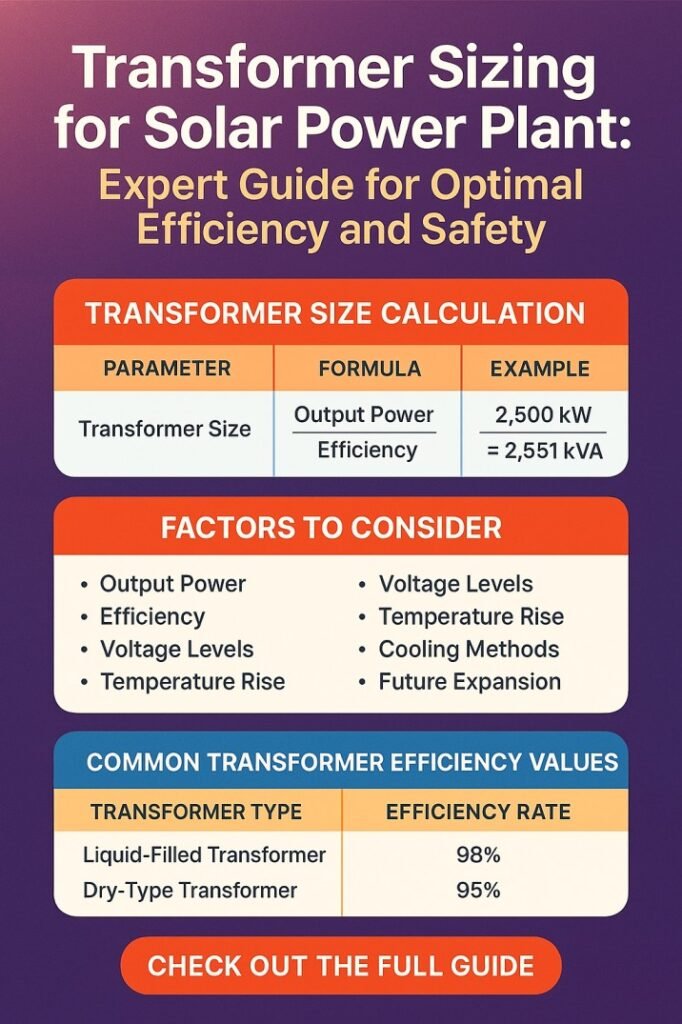
Table of Contents
Understanding Transformer Sizing for Solar Power Plants
Transformer sizing in solar power plants determines the appropriate transformer capacity to handle generated electricity without overloading. Solar PV systems produce DC electricity, which is converted to AC using inverters. The AC output then passes through transformers to match grid voltage. Proper transformer sizing ensures smooth power transfer from solar arrays to the grid or local distribution network.
The ideal transformer capacity depends on maximum power output, voltage levels, reactive power requirements, and ambient temperature. Oversizing increases capital costs, while undersizing reduces efficiency and risks equipment damage.
Read more about solar inverter selection
Key Factors Affecting Transformer Sizing for Solar Power Plant
Several factors influence transformer sizing for solar power plant projects:
- Plant Capacity – The total megawatt (MW) output of the plant sets the baseline for sizing. For example, a 50 MW solar PV plant requires a transformer that can handle peak output with a margin.
- Voltage Levels – Transformer input and output voltages must match inverter output and grid connection standards. Step-up transformers are commonly used to raise voltage from medium voltage (MV) to high voltage (HV).
- Load Characteristics – Solar generation is variable due to sunlight conditions. Transformers must accommodate peak loads while maintaining efficiency during lower generation.
- Ambient Temperature – Transformers produce heat during operation. High ambient temperatures require derating to prevent insulation damage.
- Losses and Efficiency – Core and copper losses affect overall plant performance. Low-loss transformers improve annual energy output.
- Short-Circuit Impedance – Proper impedance ensures fault protection and limits voltage drops.
Find all about Renewable Energy Grid Compliance UK
Calculating Transformer Capacity
The apparent power requirement (kVA) is the starting point for transformer sizing:
Transformer kVA = (P × 1000) / (√3 × V × PF)
Where:
- P = Rated power in kW
- V = Line-to-line voltage in volts
- PF = Power factor (typically 0.9–1.0 for solar inverters)
Example: A 10 MW solar plant with 0.9 power factor connected to a 33 kV grid:
Transformer kVA = (10,000 × 1000) / (√3 × 33,000 × 0.9) ≈ 195 kVA
Engineers often add a 10–15% margin to account for safety and future expansion.
Find more about Anti Islanding Protection in Solar Inverter
Types of Transformers for Solar Power Plants
Selecting the right transformer type affects efficiency, reliability, and cost.
| Transformer Type | Application in Solar Plant | Advantages | Typical Rating |
|---|---|---|---|
| Step-Up Transformer | Raises inverter voltage to grid level | Efficient for transmission | 5–200 MVA |
| Pad-Mounted Transformer | Connects MV inverters to low-voltage grid | Compact, easy maintenance | 500 kVA–5 MVA |
| Dry-Type Transformer | Indoor installations, small solar plants | Safe, low fire risk | 100 kVA–5 MVA |
| Oil-Immersed Transformer | Large utility-scale solar projects | High efficiency, better cooling | 1–200 MVA |
Transformer Losses and Efficiency Considerations
Efficiency is crucial for transformer sizing in solar plants. Transformers experience two main types of losses:
- No-load losses – Constant losses due to core magnetization.
- Load losses – Vary with the current passing through windings.
Low-loss transformers improve plant efficiency. For instance, a 1% loss on a 50 MW solar plant can reduce annual energy production significantly.
Know more about Hybrid Solar Inverter Working Principle with Circuit Diagram
Safety and Protection in Transformer Selection
Proper sizing directly impacts safety. Recommended protective measures include:
- Overcurrent Protection – Prevents damage during load surges.
- Temperature Monitoring – Avoids overheating, particularly in hot climates.
- Lightning and Surge Protection – Shields transformers and inverters from grid surges.
Correct sizing ensures protections operate reliably without nuisance tripping.
Transformer Sizing for Multi-Megawatt Solar Plants
Large solar plants often require multiple transformers operating in parallel. Key considerations include:
| Factor | Recommendation |
|---|---|
| Load Sharing | Ensure proportional load distribution |
| Neutral Grounding | Maintain safe grounding for all transformers |
| Impedance Matching | Prevent circulating currents and voltage imbalance |
| Redundancy | Provide backup to maintain grid stability |
Parallel operation increases reliability and allows maintenance without downtime.
Learn about solar plant efficiency optimization tips
Practical Tips for Optimal Transformer Selection
- Consider Future Expansion – Slight oversizing can accommodate growth.
- Evaluate Local Climate – Hot regions require higher-rated transformers.
- Select Low-Loss Transformers – Minimizes energy waste and improves ROI.
- Check Grid Codes – Ensure voltage and protection standards compliance.
- Regular Monitoring – Track temperature, oil quality, and load profiles to extend transformer life.
Use our online tool for free Solar Performance Ratio Calculator – Measure Solar System Efficiency Accurately
Conclusion
Transformer sizing for solar power plant is a balance of efficiency, safety, and cost-effectiveness. By carefully evaluating plant capacity, voltage levels, losses, protection, and expansion potential, engineers can select transformers that ensure smooth integration with the grid, minimize downtime, and maximize energy yield. Accurate transformer sizing protects equipment and optimizes the long-term performance of solar power plants, making it a vital aspect of PV system design. Use our online tool for free Solar Panels kWh Calculator UK
Follow Us on Social:
Subscribe our Newsletter on Electrical Insights for latest updates from Electrical Engineering Hub
#TransformerSizing, #SolarPowerPlant, #ElectricalEngineering, #PowerSystemDesign, #RenewableEnergy, #SolarEngineering, #EnergyEfficiency, #PowerDistribution, #EngineeringGuide, #SolarInfrastructure