
Transformer Sizing for Residential Building: Important Load Calculation & Selection Guide
Transformer sizing for residential building is a critical step in electrical system design. A properly selected transformer ensures safe operation, voltage stability, and long service life of electrical equipment. If the transformer is undersized, it may overheat and fail. If it is oversized, it increases capital cost and reduces efficiency. That is why transformer sizing for residential building must follow a structured load calculation and technical evaluation process.
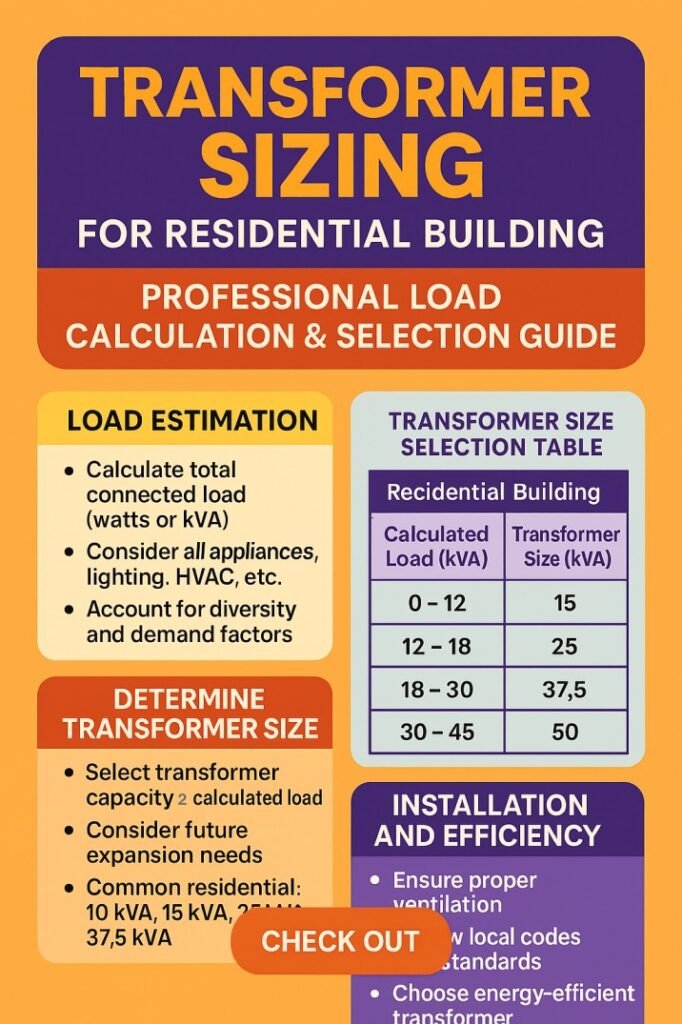
Table of Contents
In modern housing projects, electrical demand is increasing due to air conditioners, induction cooking, elevators, water pumps, and smart home systems. A professional approach to transformer sizing for residential building helps maintain voltage regulation, reduce power losses, and ensure compliance with utility standards.
Know more about Transformer Oil Testing: 9 Important Tests for Healthiness
Understanding the Importance of Proper Transformer Selection
Transformer sizing for residential building affects reliability, safety, and future expansion capability. Residential complexes often experience varying load patterns throughout the day. Evening peak loads are usually higher due to lighting and appliance usage.
A well-sized distribution transformer offers:
- Stable secondary voltage under load
- Acceptable temperature rise
- Lower technical losses
- Reduced maintenance issues
- Better power quality for sensitive appliances
In apartment buildings and housing societies, selecting the correct kVA rating prevents nuisance tripping and overheating of cables and switchgear. Find all about Top 15 Medium Voltage Switchgear Manufacturers in UAE
Step 1: Residential Load Calculation
The foundation of transformer sizing for residential building is accurate load estimation. The connected load must be calculated first, followed by demand factor application.
Find all about Transformer Disconnect Sizing
Typical Residential Load Components
Below is a general reference table for common residential loads.
| Load Type | Typical Rating (kW) | Quantity (Example) | Total Load (kW) |
|---|---|---|---|
| Lighting | 0.01–0.02 per point | 40 | 0.6 |
| Socket Outlets | 0.2 per circuit | 6 | 1.2 |
| Air Conditioners | 1.5 – 2.0 | 4 | 7.0 |
| Electric Geyser | 2.0 – 3.0 | 2 | 5.0 |
| Water Pump | 1.5 | 1 | 1.5 |
| Refrigerator | 0.3 – 0.5 | 1 | 0.4 |
| Miscellaneous Loads | — | — | 2.0 |
| Total Connected Load | 17.7 kW |
This example represents a single large residential unit. For apartment buildings, multiply by number of flats and include common area loads such as lifts, corridor lighting, and firefighting pumps.
Step 2: Apply Demand Factor
Connected load does not operate at full capacity simultaneously. Therefore, transformer sizing for residential building requires applying a demand factor or diversity factor.
Know more about Transformers Earthspark Size Chart
For residential buildings:
- Individual house demand factor: 0.6 to 0.8
- Apartment buildings: 0.5 to 0.7
- Common services: 0.9 to 1.0
If we assume a demand factor of 0.7:
Demand Load = 17.7 × 0.7 = 12.39 kW
For multiple flats, calculate diversity across all units rather than per unit.
Step 3: Convert kW to kVA
Transformers are rated in kVA, not kW. So, convert real power into apparent power using power factor.
kVA = kW / Power Factor
Assuming a residential power factor of 0.9:
kVA = 12.39 / 0.9 = 13.77 kVA
For safety margin and future expansion, add 20–25%.
Final Required Capacity ≈ 17 kVA
In practice, you would select the next standard rating, such as 25 kVA.
This structured method ensures accurate transformer sizing for residential building without overloading risk.
Know all about Transformer Sizing for EV Charger
Load Calculation for Apartment Building Example
Consider a building with 10 identical flats and common area loads.
| Description | Value |
|---|---|
| Load per Flat (Demand) | 12.39 kW |
| Total for 10 Flats | 123.9 kW |
| Common Area Load | 20 kW |
| Total Demand Load | 143.9 kW |
| Power Factor | 0.9 |
| Required kVA | 160 kVA |
After adding 20% future margin:
160 × 1.2 = 192 kVA
Nearest standard transformer size: 200 kVA
This example demonstrates professional transformer sizing for residential building in multi-unit housing.
Find more Transformer calculators here
Selecting the Transformer Type
Transformer sizing for residential building also includes selecting the right type:
Oil-Immersed Transformer
- Suitable for outdoor installation
- Better heat dissipation
- Lower initial cost
- Requires oil maintenance
Find more about Best Medium Voltage Transformers for Solar Plants
Dry Type Transformer
- Suitable for indoor installation
- Safer in fire-prone areas
- Lower maintenance
- Higher initial cost
For housing societies, oil-immersed transformers are commonly installed in outdoor substations. For basement installations, dry type transformers are preferred.
Voltage Level Considerations
Most residential transformers operate between:
- Primary voltage: 11 kV or 13.8 kV
- Secondary voltage: 400/230 V
Correct voltage selection is essential in transformer sizing for residential building to match local utility supply standards.
Explore all about Transformer Bond Sizing
Temperature Rise and Cooling
Transformer loading should not exceed recommended temperature limits. Excessive heating reduces insulation life.
Standard temperature rise classes:
| Cooling Method | Description | Application |
|---|---|---|
| ONAN | Oil Natural Air Natural | Small residential transformers |
| ONAF | Oil Natural Air Forced | Medium size housing projects |
| Dry Type AN | Air Natural | Indoor buildings |
Proper cooling ensures long operational life.
Voltage Regulation and Impedance
Voltage drop must remain within acceptable limits, typically less than 5% at full load. Transformer impedance affects fault current levels and voltage regulation.
Higher impedance:
- Reduces short circuit current
- Increases voltage drop
Lower impedance:
- Improves voltage regulation
- Increases fault current
Transformer sizing for residential building must balance both factors.
Know more about Transformer Cooling Methods: ONAN, ONAF, OFAF & More
Short Circuit and Protection Coordination
The selected transformer must withstand prospective short circuit current. Protection devices include:
- LV circuit breakers
- HV fuses or VCB
- Surge arresters
- Earthing system
Protection coordination ensures safe isolation during faults.
Future Expansion Planning
Residential projects often expand. Additional air conditioners, EV chargers, and rooftop solar systems increase demand.
During transformer sizing for residential building, it is wise to consider:
- 20–30% spare capacity
- Provision for parallel transformer operation
- Space for future feeder panels
This prevents costly transformer replacement later.
Energy Efficiency and Loss Evaluation
Modern transformers have lower no-load and load losses. Efficiency improves long-term operating cost.
Two main losses:
- Core loss (constant)
- Copper loss (load dependent)
Selecting a transformer with optimized loss characteristics supports energy efficiency and reduces utility penalties.
Know more about Best Transformer Testing Companies in Canada | Trusted Electrical Testing Experts & Utility Service Providers
Example of Standard Transformer Ratings
| Standard Rating (kVA) | Typical Application |
|---|---|
| 25 kVA | Large house |
| 50 kVA | Small apartment block |
| 100 kVA | Medium building |
| 200 kVA | Multi-storey apartments |
| 315 kVA | Large housing society |
Selecting the nearest higher standard rating ensures reliability.
Earthing and Neutral System
Proper earthing is essential in transformer sizing for residential building. The neutral must be solidly grounded to ensure safety and fault clearing.
Common earthing practices:
- Separate body and neutral earth
- Earth resistance below 5 ohms
- Multiple earth pits for large installations
Good earthing enhances protection performance.
Read in detail about transformer manufacturers in egypt
Integration with Solar Systems
Many residential buildings now include rooftop solar systems. Transformer sizing for residential building must account for reverse power flow in grid-connected systems.
Important checks:
- Transformer backfeeding capability
- Voltage rise during solar generation
- Net metering compliance
Oversizing slightly may help accommodate distributed generation.
Practical Checklist Before Final Selection
Before finalizing transformer sizing for residential building, verify:
- Accurate load survey
- Demand factor validation
- Power factor correction availability
- Fault level study
- Voltage drop analysis
- Future expansion margin
- Compliance with local utility standards
A structured engineering approach avoids oversizing and underperformance.
Explore details on largest transformer manufacturer in usa
Conclusion
Transformer sizing for residential building is not just about selecting a kVA rating. It requires professional load calculation, demand assessment, voltage regulation evaluation, and protection coordination. A correctly sized transformer ensures stable voltage, longer equipment life, and safe operation of the electrical distribution system.
By following systematic load estimation, applying diversity factor, converting kW to kVA properly, and selecting the nearest higher standard rating with future margin, engineers can achieve optimal transformer sizing for residential building. This method improves efficiency, reduces maintenance issues, and supports reliable power supply for modern residential infrastructure.
Follow Us on Social:
Subscribe our Newsletter on Electrical Insights for latest updates from Electrical Engineering Hub
#TransformerSizing, #ResidentialElectrical, #ElectricalDesign, #PowerDistribution, #LoadCalculation, #ElectricalEngineering, #BuildingElectrification, #EnergyPlanning, #ElectricalSafety, #EngineeringGuide