Motor Starter Heater Sizing Chart – Accurate Selection Guide for Safe Motor Protection
Motor protection is one of the most critical aspects of any electrical installation. A properly protected motor runs efficiently, lasts longer, and avoids unexpected downtime. Among the most important protection components is the thermal overload relay heater. This is where a motor starter heater sizing chart becomes essential, helping engineers and technicians select the correct heater size for safe and reliable motor operation.
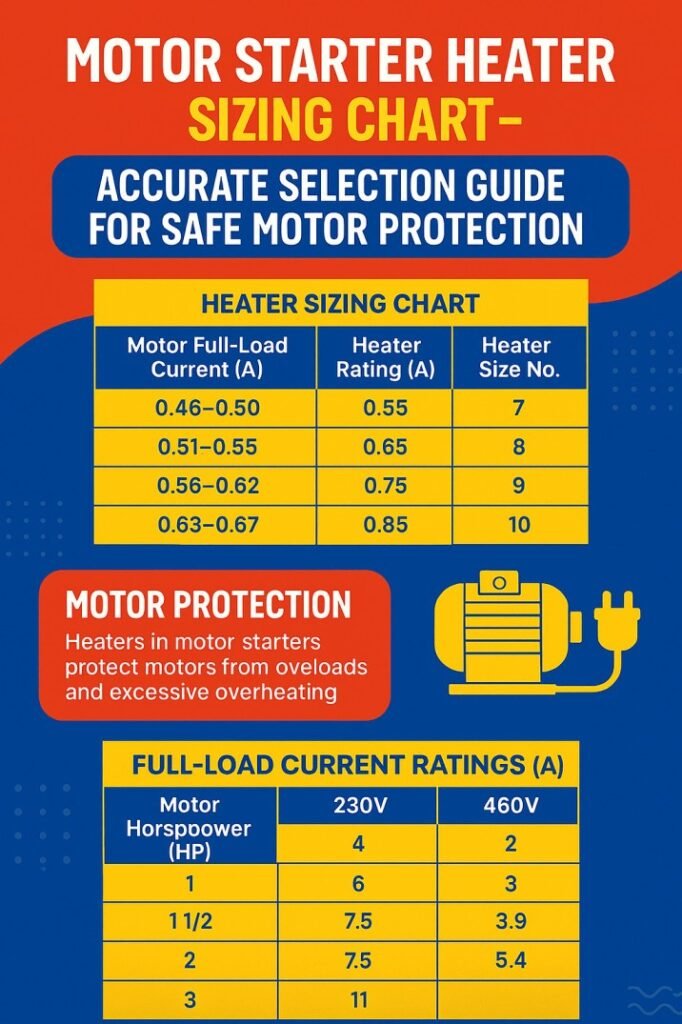
Table of Contents
This guide explains heater sizing in a practical and professional manner, using real-world logic rather than textbook language. By the end of this article, you will understand how to read a motor starter heater sizing chart, how to apply it correctly, and how to avoid common mistakes that lead to motor failures.
What Is a Motor Starter Heater and Why It Matters
A motor starter heater is a thermal element installed inside an overload relay. Its primary function is to protect the motor from overheating due to overload conditions. When the motor draws more current than its rated full load current for a sustained period, the heater warms up and triggers the overload mechanism, disconnecting the motor supply.
Unlike fuses or circuit breakers, heaters are not designed to protect against short circuits. Their role is strictly thermal protection, which is why correct sizing is so important. This is where the motor starter heater sizing chart plays a central role in proper selection.
Know everything about 3 Phase Motor Overload Relay Setting – Accurate Protection for Your Motor
Understanding the Motor Starter Heater Sizing Chart
A motor starter heater sizing chart is a reference table provided by manufacturers. It correlates motor full load current with the appropriate heater number or rating. These charts are specific to the starter brand, overload relay type, and motor service factor.
The chart typically includes:
- Motor full load current range
- Corresponding heater number
- Heater current rating
- Application notes for continuous or intermittent duty
Using the wrong chart or misreading it can result in frequent nuisance trips or, worse, no protection at all.
Key Factors That Affect Heater Selection
Before using a motor starter heater sizing chart, several parameters must be confirmed. Heater sizing is not guesswork; it depends on precise motor data.
Important factors include:
- Motor full load current from the nameplate
- Motor service factor
- Ambient temperature
- Duty cycle of the motor
- Type of load (constant torque or variable torque)
Ignoring any of these can compromise motor safety even if the chart is followed mechanically.
Use our online tool Motor Overload Setting Calculator for Single and Three Phase Motors
Typical Motor Starter Heater Sizing Chart Example
Below is a simplified example of a motor starter heater sizing chart for a standard three-phase motor starter. Actual values may vary by manufacturer, but the logic remains the same.
| Motor Full Load Current (A) | Heater Number | Heater Rating (A) |
|---|---|---|
| 4.0 – 4.5 | H12 | 4.3 |
| 4.6 – 5.2 | H13 | 5.0 |
| 5.3 – 6.0 | H14 | 5.8 |
| 6.1 – 6.8 | H15 | 6.5 |
| 6.9 – 7.6 | H16 | 7.3 |
This type of motor starter heater sizing chart allows quick and accurate selection once the motor full load current is known.
Step-by-Step Guide to Using the Chart Correctly
Using a motor starter heater sizing chart correctly requires a structured approach.
Follow these steps:
- Read the motor nameplate full load current
- Confirm the motor voltage and phase
- Check the service factor value
- Locate the matching current range in the chart
- Select the recommended heater number
- Verify ambient temperature correction if required
This method ensures the heater will trip under overload conditions without unnecessary interruptions during normal operation.
Know more about What Are Different Types of Overcurrent Relays? Best Guide
Service Factor and Its Impact on Heater Sizing
Service factor indicates how much overload a motor can handle safely. Motors with a service factor of 1.15 can tolerate higher current for short durations. Many motor starter heater sizing chart tables account for this by offering different heater ranges for motors with higher service factors.
If the motor has a service factor above 1.0, the heater may be selected closer to the upper end of the current range. However, this must always follow manufacturer guidelines to avoid unsafe operation.
Ambient Temperature Considerations
Ambient temperature significantly affects thermal overload performance. Most motor starter heater sizing chart values are based on a standard ambient temperature, typically 40°C.
In hotter environments:
- Heaters may trip earlier than expected
- Derating may be required
- Manufacturer correction factors should be applied
In cooler environments:
- Tripping may be delayed
- Motor protection may be compromised if oversized heaters are used
Always verify whether the chart assumes standard ambient conditions.
Know more about What Are the Applications of Overcurrent Relays in Power Systems?
Common Heater Sizing Mistakes to Avoid
Even experienced technicians sometimes misuse a motor starter heater sizing chart. These errors can be costly.
Common mistakes include:
- Using motor horsepower instead of full load current
- Ignoring service factor information
- Selecting heaters based on starting current
- Using charts from a different starter brand
- Oversizing heaters to avoid nuisance trips
Avoiding these mistakes ensures reliable motor protection and compliance with electrical standards.
Single-Phase vs Three-Phase Motor Heater Selection
Heater sizing differs between single-phase and three-phase motors due to current imbalance and heating characteristics. A motor starter heater sizing chart for single-phase motors often requires special consideration, such as higher sensitivity or different heater elements.
Always confirm that the chart applies to the motor type being protected.
Coordination with Other Protection Devices
A heater is only one part of a complete motor protection system. Proper coordination with circuit breakers, fuses, and contactors is essential.
A correctly selected heater using a motor starter heater sizing chart should:
- Trip before conductor insulation is damaged
- Coordinate with upstream protective devices
- Protect the motor windings from sustained overload
This layered protection approach improves system reliability.
Know more about low cost servomotors
Practical Example of Heater Selection
Consider a three-phase motor with a full load current of 6.2 A and a service factor of 1.15. Referring to the motor starter heater sizing chart, the appropriate range is 6.1 to 6.8 A, leading to the selection of heater H15.
This ensures the motor remains protected while allowing normal load variations without unnecessary tripping.
Importance of Manufacturer-Specific Charts
Each manufacturer designs heaters with different thermal characteristics. A motor starter heater sizing chart from one brand must never be used for another. Even if current ratings appear similar, trip curves and heating rates differ.
Always use the official chart provided for the exact overload relay model.
Final Thoughts on Accurate Heater Sizing
Accurate heater sizing is not optional; it is a requirement for safe motor operation. A properly applied motor starter heater sizing chart protects equipment, reduces downtime, and ensures compliance with electrical standards.
By understanding how the chart works, considering motor parameters, and avoiding common errors, engineers and technicians can ensure reliable motor protection in any industrial or commercial installation.
Learn more about difference between servo motor and induction motor
Follow Us on Social:
Subscribe our Newsletter on Electrical Insights for latest updates from Electrical Engineering Hub
#MotorStarterHeaterSizingChart, #HeaterSizingChart, #MotorProtection, #OverloadRelaySizing, #ElectricalEngineering, #MotorControl, #IndustrialAutomation, #MotorStarter, #ElectricalDesign, #ControlPanel