
Load Calculation for Commercial Building: Pro Guide to Accurate Sizing & Cost-Smart Design
Load calculation for commercial building projects is one of the most critical steps in electrical design. It directly affects safety, equipment life, energy efficiency, and long-term operating costs. When loads are estimated correctly, systems run reliably. When they are oversized or undersized, problems show up fast in the form of overheating, nuisance tripping, voltage drop, and wasted capital.
Many commercial facilities suffer from either conservative overdesign or risky underestimation. Both hurt the project in different ways. Accurate load calculation for commercial building applications creates the balance between performance and cost. It ensures switchgear, transformers, feeders, and backup systems are selected with confidence.
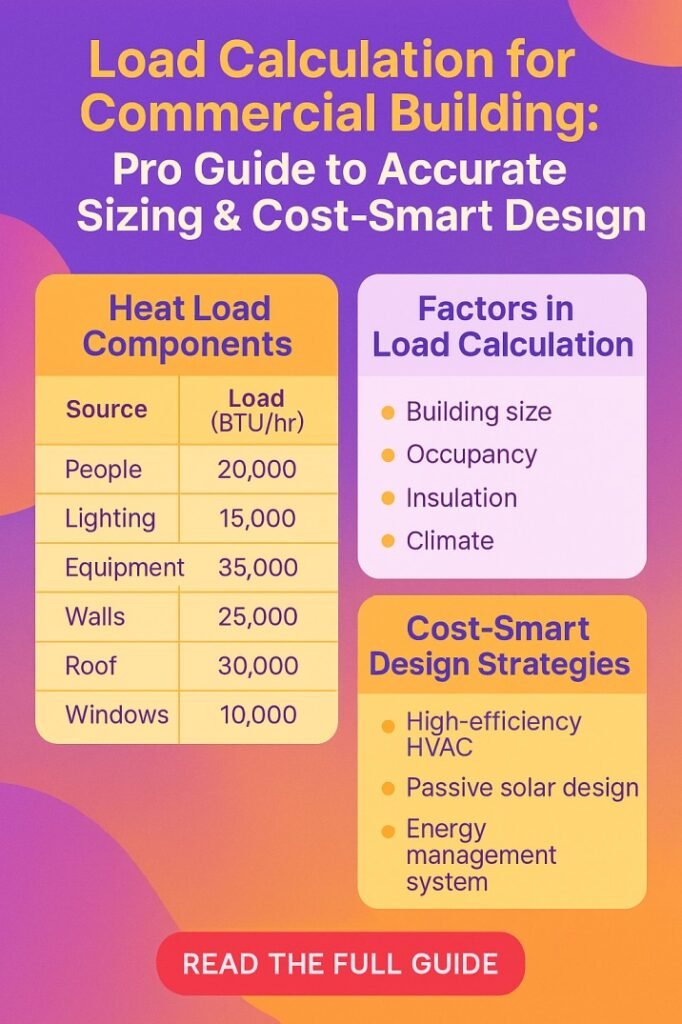
Table of Contents
This guide explains the practical process used by professionals. It focuses on real design considerations, demand behavior, diversity, and future expansion so your system is not only code-compliant but also financially smart.
Use our online tool Electrical Feeder Size Calculator: Best Tool for Accurate Feeder & Load Calculations
Why Load Calculation Matters in Commercial Projects
Commercial buildings have complex electrical profiles. Unlike homes, they include lighting networks, HVAC systems, elevators, IT equipment, kitchen loads, and sometimes industrial machinery. Each load behaves differently during the day.
Proper load calculation for commercial building design helps engineers:
- Prevent overloading of feeders and transformers
- Reduce unnecessary capital cost from oversizing
- Improve power quality and voltage stability
- Plan generator and UPS capacity correctly
- Meet code and utility interconnection requirements
When calculations are rushed, designers often add excessive safety margins. This leads to higher equipment ratings, larger cable sizes, and inflated project budgets.
Types of Loads in a Commercial Building
Understanding load categories is the foundation of accurate estimation. Each type has different demand characteristics.
| Load Type | Examples | Load Behavior | Design Consideration |
|---|---|---|---|
| Lighting Load | LED panels, outdoor lighting | Fairly steady during occupancy | Apply lighting demand factors |
| HVAC Load | Chillers, AHUs, VRF systems | Cyclical and seasonal | Consider diversity and motor starting |
| Receptacle Load | Office plugs, workstations | Highly diversified | Use demand factors, not full connected load |
| Mechanical Load | Pumps, fans, compressors | Motor starting impact | Include inrush current |
| Vertical Transport | Elevators, escalators | Intermittent heavy load | Apply diversity rules |
| Special Equipment | Kitchens, labs, data rooms | May be continuous | Check nameplate and duty cycle |
Each category contributes differently to the total load calculation for commercial building systems.
Use our online tool EV Charger Load Calculation Tool – Accurate Power Estimation for Home and Commercial EV Chargers
Connected Load vs Demand Load
One of the most common mistakes is using total connected load as the design load. In reality, not all equipment runs at full capacity at the same time.
Connected Load is the sum of all nameplate ratings.
Demand Load is the expected maximum load after applying demand and diversity factors.
| Term | Meaning | Impact on Design |
|---|---|---|
| Connected Load | Total installed capacity | Used as a base reference |
| Demand Factor | Ratio of actual demand to connected load | Reduces oversizing |
| Diversity Factor | Accounts for non-simultaneous operation | Optimizes feeder sizing |
A realistic load calculation for commercial building design always relies on demand load, not just connected load.
Step-by-Step Method Professionals Use
Electrical engineers follow a structured process to avoid errors and omissions.
Step 1: Gather Architectural and MEP Data
Obtain floor area, occupancy type, equipment schedules, HVAC design data, and lighting layouts.
Step 2: Calculate Lighting Load
Lighting power density (LPD) is used when exact fixture data is not available.
| Space Type | Typical LPD (W/m²) |
|---|---|
| Office | 8–12 |
| Retail | 12–18 |
| Parking | 2–5 |
| Corridor | 4–8 |
Multiply LPD by area to estimate connected lighting load.
Use our online tool Lighting Load Calculation per Square Foot: Download Excel Sheet
Step 3: Receptacle Load Estimation
Office buildings often use a watts-per-square-meter method.
Typical range: 20–30 W/m² before demand factors.
Step 4: HVAC Load Inclusion
HVAC is usually the largest contributor to load calculation for commercial building systems.
Use mechanical schedules to include:
- Chillers or condensing units
- Air handling units
- Pumps and cooling towers
Motor loads must include full load current and starting considerations.
Step 5: Motor Load Adjustment
Motors are treated differently from resistive loads.
- Largest motor is taken at 125%
- Remaining motors at 100%
- Apply demand factors where allowed
Step 6: Apply Demand Factors
Codes provide demand factor tables based on occupancy type.
| Load Category | Typical Demand Factor |
|---|---|
| Lighting | 90–100% |
| Receptacles | 50–70% |
| HVAC | 100% of largest + diversity |
| Elevators | 75% or per manufacturer data |
This step refines the load calculation for commercial building feeders and transformers.
Use our online tool Electrical Panel Heat Load Calculation: Best Guide
Example Calculation for an Office Building
Let’s consider a 5,000 m² office building.
| Load Component | Calculation | Load (kW) |
|---|---|---|
| Lighting | 10 W/m² × 5000 | 50 |
| Receptacles | 25 W/m² × 5000 | 125 |
| HVAC | From schedule | 180 |
| Elevators | 2 × 15 kW | 30 |
| Pumps & Fans | Estimated | 40 |
| Total Connected Load | 425 |
Applying demand factors:
| Load Component | Demand Factor | Demand Load (kW) |
|---|---|---|
| Lighting | 0.9 | 45 |
| Receptacles | 0.6 | 75 |
| HVAC | 1.0 diversified | 160 |
| Elevators | 0.75 | 22.5 |
| Pumps & Fans | 1.0 | 40 |
| Total Demand Load | 342.5 |
This demand value becomes the base for transformer and service sizing in the load calculation for commercial building design.
Use our online tool EV Charger Load Calculation: A Comprehensive Guide
Transformer and Service Sizing
After calculating demand load, convert kW to kVA using power factor.
Formula
kVA = kW / Power Factor
Assume PF = 0.9
342.5 / 0.9 = 380.5 kVA
Next standard transformer size would be 400 kVA. This approach avoids jumping to 500 kVA unnecessarily, which would increase cost and no-load losses.
Accurate load calculation for commercial building transformers prevents overspending while maintaining reliability.
Feeder and Cable Sizing
Feeder current is calculated using:
I = (kVA × 1000) / (√3 × Voltage)
For a 400 kVA transformer at 415 V:
I = 400,000 / (1.732 × 415) ≈ 556 A
Cable size selection must also consider:
- Voltage drop
- Installation method
- Ambient temperature
- Future load growth
Role of Diversity in Cost Savings
Diversity is the reason why commercial buildings do not need service capacity equal to the sum of all loads.
| System | Diversity Behavior |
|---|---|
| Office Plugs | Not all equipment runs at once |
| HVAC | Cycles based on thermostat demand |
| Elevators | Intermittent operation |
| Lighting | Varies by occupancy zones |
Applying diversity correctly during load calculation for commercial building systems can reduce transformer size by 15–30%.
Use our online tool for free Sub Panel Breaker Size Calculator – Find the Right Breaker for Your Electrical Sub Panel
Planning for Future Expansion
Design should not only cover present demand. It should allow practical growth without major retrofits.
Common practices include:
- Adding 15–20% spare capacity in panels
- Leaving space in switchboards for future breakers
- Selecting transformers with moderate spare margin
Oversizing excessively “just in case” defeats cost-smart design. Balanced planning is key in load calculation for commercial building projects.
Common Mistakes to Avoid
Even experienced designers make errors when data is incomplete.
- Using connected load instead of demand load
- Ignoring motor starting current
- Forgetting continuous load adjustments
- Not coordinating with mechanical engineers
- Skipping voltage drop checks on long feeders
Each of these can lead to overheating, poor efficiency, or equipment failure.
Impact on Backup Power Systems
Generators and UPS systems rely heavily on the same calculations. Emergency systems must prioritize critical loads only.
| Load Type | Backup Priority |
|---|---|
| Fire Pumps | Mandatory |
| Emergency Lighting | Mandatory |
| Elevators | Selective |
| HVAC | Limited or none |
| Office Equipment | Usually excluded |
A precise load calculation for commercial building emergency systems prevents undersized generators and fuel waste from oversized units.
Make your task simple with our online tool electrical cable size calculator
Energy Efficiency Considerations
Load calculations also influence energy performance.
- Lower transformer oversizing reduces no-load losses
- Right-sized cables reduce I²R losses
- Accurate motor loading improves efficiency
Modern designs integrate smart metering to validate assumptions used in load calculation for commercial building planning.
Documentation and Software Tools
Professional engineers rely on both manual checks and software.
Popular tools help with:
- Panel schedules
- Demand factor application
- Short circuit estimation
- Load balancing across phases
However, software is only as accurate as the data entered. Engineering judgment remains essential.
Use our online tool for free Wire Size Calculator for Motors – Accurate Motor Cable Sizing Tool for Electric Loads
Final Thoughts on Smart Electrical Sizing
Electrical systems in commercial facilities must balance reliability, efficiency, and budget. The foundation of that balance is a well-executed load calculation for commercial building design. It transforms raw equipment lists into a safe, optimized power distribution system.
When demand factors, diversity, and realistic operating patterns are considered, designers avoid the trap of oversizing. At the same time, they protect the system from overload and voltage instability. The result is lower capital cost, reduced energy loss, and longer equipment life.
In every commercial project, from office towers to shopping centers, accurate load calculation for commercial building infrastructure is not just a design step. It is the financial and technical backbone of the entire electrical system.
You might find this tool useful for tackling similar tasks Sub Panel Wire Size Calculator – Accurate Wire Gauge & Load Sizing Tool
Follow Us on Social:
Subscribe our Newsletter on Electrical Insights for latest updates from Electrical Engineering Hub
#LoadCalculation, #CommercialBuildingDesign, #ElectricalEngineering, #PowerSystemDesign, #BuildingLoad, #ElectricalDesign, #MEPDesign, #EnergyDemand, #ElectricalPlanning, #EngineeringStandards