IEEE Standard for Neutral Grounding Resistor: Design, Sizing, Protection & Compliance Guide
The ieee standard for neutral grounding resistor plays a critical role in modern power systems where safety, reliability, and equipment protection are essential. Neutral grounding resistors (NGRs) are widely used in industrial and utility networks to limit fault current, reduce equipment damage, and improve system stability. Understanding how to design, size, and protect these systems in line with IEEE practices is essential for engineers, consultants, and plant operators.
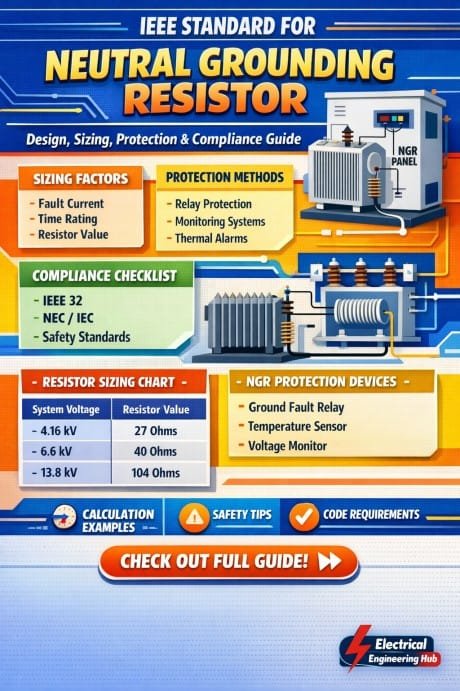
Table of Contents
This guide explains the key concepts, design considerations, and compliance requirements based on the ieee standard for neutral grounding resistor, while also covering practical implementation insights.
Understanding Neutral Grounding Resistors
A neutral grounding resistor is connected between the neutral point of a transformer or generator and the ground. Its main purpose is to limit ground fault current to a safe value.
Find all about IEEE Standard for Insulation Resistance Test
In an ungrounded system, a single line-to-ground fault may not trip protection immediately, which increases the risk of overvoltage. On the other hand, solid grounding can lead to very high fault currents. The ieee standard for neutral grounding resistor recommends resistance grounding as a balanced approach.
Key Functions of NGR
- Limits ground fault current
- Reduces arc flash hazards
- Protects generators and transformers
- Minimizes transient overvoltages
- Enhances system stability
Types of Neutral Grounding as per IEEE Practice
The ieee standard for neutral grounding resistor generally classifies grounding methods into different categories depending on system requirements.
| Grounding Type | Description | Typical Application |
|---|---|---|
| Solid Grounding | Direct connection to ground | Low voltage systems |
| Resistance Grounding | Uses NGR to limit fault current | Industrial and medium voltage |
| Reactance Grounding | Uses reactor instead of resistor | Specialized systems |
| Ungrounded System | No intentional grounding | Rare, legacy installations |
Among these, resistance grounding is widely preferred in industrial plants, especially where continuity of service is important.
Know more about IEEE Standard for Instrument Transformers
IEEE Standards Governing Neutral Grounding Resistors
The ieee standard for neutral grounding resistor is primarily guided by several IEEE publications. The most relevant include:
- IEEE Std 142 (Green Book) – Grounding of Industrial and Commercial Power Systems
- IEEE Std 32 – Requirements for Neutral Grounding Devices
- IEEE Std C62 series – Surge protection considerations
These standards define performance, construction, testing, and application guidelines.
Key Compliance Requirements
- Thermal withstand capability
- Short-time current rating
- Insulation coordination
- Environmental protection (IP rating)
- Monitoring and alarm systems
Explore all about IEEE Standard for Cable Insulation Resistance Test
Design Considerations for NGR Systems
Designing an NGR system requires careful analysis of system voltage, fault current, and operational requirements. The ieee standard for neutral grounding resistor provides a structured approach.
Important Design Parameters
- System voltage (line-to-line and line-to-neutral)
- Desired ground fault current
- Duration of fault (typically 10 seconds or continuous)
- System capacitance
- Protection coordination
Typical Design Formula
The resistance value is calculated as:
Resistance (R) = Line-to-neutral voltage / Desired fault current
For example:
| Parameter | Value |
|---|---|
| System Voltage | 11 kV |
| Line-to-Neutral Voltage | 6.35 kV |
| Desired Fault Current | 100 A |
| Required Resistance | 63.5 ohms |
This calculation aligns with the recommendations in the ieee standard for neutral grounding resistor.
Know more about IEEE Standard for Contact Resistance
Sizing of Neutral Grounding Resistor
Proper sizing ensures the resistor can handle thermal and electrical stresses during a fault condition.
Sizing Criteria
- Fault current magnitude
- Duration (short-time or continuous duty)
- Energy dissipation capability
- Cooling method (air-cooled or liquid-cooled)
Standard Ratings
| NGR Type | Current Range | Duration | Application |
|---|---|---|---|
| Low Resistance | 50A – 1000A | 10 seconds | Medium voltage systems |
| High Resistance | 5A – 10A | Continuous | Sensitive equipment systems |
The ieee standard for neutral grounding resistor emphasizes that incorrect sizing can lead to overheating or ineffective fault limitation.
Find all about IEEE Standard for Short Circuit Calculation
Protection Schemes for NGR Systems
Protection is a critical aspect of NGR installation. The ieee standard for neutral grounding resistor recommends integrating protection systems to detect and isolate faults quickly.
Common Protection Methods
- Ground fault relays
- Neutral displacement relays
- Overvoltage protection
- NGR monitoring relays
Protection Scheme Overview
| Protection Device | Function |
|---|---|
| Ground Fault Relay | Detects fault current in grounding path |
| NGR Monitor | Detects resistor failure or disconnection |
| Overvoltage Relay | Protects against transient voltages |
A failure in the grounding resistor can expose the system to severe overvoltage, which is why continuous monitoring is essential under the ieee standard for neutral grounding resistor.
Know more about IEC Standard for Neutral to Earth Voltage – Limits, Measurement & Safety Guidelines
Installation and Practical Considerations
Correct installation ensures the NGR performs as intended. Even a well-designed system can fail if installation practices are poor.
Installation Best Practices
- Place NGR close to transformer or generator neutral
- Ensure proper earthing connections
- Use weatherproof enclosures for outdoor installations
- Maintain adequate clearance and ventilation
Environmental Factors
| Factor | Impact on NGR Performance |
|---|---|
| Temperature | Affects resistance stability |
| Humidity | Risk of insulation failure |
| Dust | Can cause overheating |
The ieee standard for neutral grounding resistor also highlights the importance of periodic inspection and maintenance.
Know all about ieee and iec standards
Testing and Maintenance
Routine testing ensures long-term reliability of the NGR system. According to the ieee standard for neutral grounding resistor, both initial and periodic tests are required.
Recommended Tests
- مقاومت (Resistance) measurement
- Insulation resistance test
- Visual inspection
- Functional testing of protection relays
Maintenance Schedule
| Activity | Frequency |
|---|---|
| Visual Inspection | Monthly |
| Resistance Measurement | Annually |
| Relay Testing | Annually |
Regular maintenance reduces the risk of unexpected failures and improves system safety.
Advantages of Using NGR as per IEEE Standards
Following the ieee standard for neutral grounding resistor provides several operational benefits.
- Reduced damage during ground faults
- Improved personnel safety
- Lower arc flash energy
- Better system reliability
- Compliance with international practices
Know more about IEC Standard for MV Cable Testing: Complete Acceptance, Routine & Type Test Guide
These benefits make NGR systems a preferred choice in industries such as oil and gas, cement, power generation, and manufacturing.
Common Mistakes to Avoid
Even experienced engineers sometimes overlook critical aspects when working with grounding systems.
Frequent Errors
- Incorrect fault current selection
- Ignoring system capacitance
- Lack of monitoring system
- Improper installation location
The ieee standard for neutral grounding resistor clearly advises validating design assumptions before implementation.
Compliance Checklist
To ensure your system aligns with the ieee standard for neutral grounding resistor, use the following checklist:
| Requirement | Status Check |
|---|---|
| Correct resistance value calculated | Yes/No |
| Proper thermal rating selected | Yes/No |
| Protection system installed | Yes/No |
| Monitoring relay included | Yes/No |
| Installation verified | Yes/No |
This checklist helps maintain consistency and ensures regulatory compliance.
Know more about IEC Standard for Insulation Resistance Test – Procedures, Limits & Best Practices Explained
Final Thoughts
The ieee standard for neutral grounding resistor provides a structured and reliable framework for designing and operating grounding systems in modern power networks. From selecting the correct resistance value to implementing protection and maintenance strategies, every step must align with IEEE guidelines.
A properly designed and maintained NGR system not only protects equipment but also enhances operational continuity and safety. Engineers who follow these electrical standards can significantly reduce risks associated with ground faults while ensuring compliance with global best practices.
Know more about IEC Standard for Earthing System
Follow Us on Social:
Subscribe our Newsletter on Electrical Insights for latest updates from Electrical Engineering Hub
#NeutralGroundingResistor, #IEEEStandard, #PowerSystemProtection, #ElectricalEngineering, #GroundingSystem, #NGRDesign, #SubstationEngineering, #FaultProtection, #IndustrialPower, #ElectricalSafety