IEEE Standard for Motor Testing: Complete Professional Guide for Accurate Electrical Motor Performance & Safety Testing
Electrical motors are the backbone of modern industry, powering everything from manufacturing lines to irrigation systems. Ensuring their performance, efficiency, and safety is critical, and this is where the ieee standard for motor testing plays a vital role. These standards provide a structured and reliable framework for evaluating motor characteristics under controlled conditions.
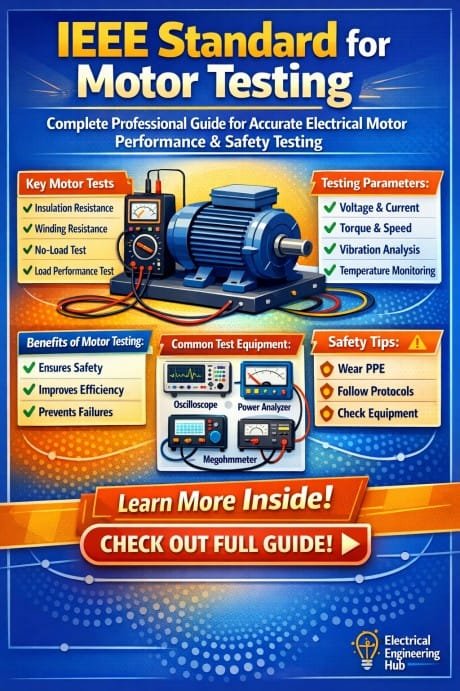
Table of Contents
Understanding and applying the ieee standard for motor testing helps engineers, technicians, and business owners make informed decisions about motor selection, maintenance, and compliance. This guide explains the key principles, methods, and best practices in a clear and practical way.
What is the IEEE Standard for Motor Testing
The ieee standard for motor testing is a set of guidelines developed by the Institute of Electrical and Electronics Engineers. It defines procedures for testing electric motors to measure parameters such as efficiency, losses, temperature rise, and load performance.
These standards ensure consistency and accuracy across different testing environments. Whether you are working with induction motors, synchronous motors, or special-purpose machines, following the ieee standard for motor testing ensures that results are comparable and trustworthy.
Find all about IEEE Standard for Insulation Resistance Test
Why Motor Testing is Important
Motor testing is not just about compliance. It directly impacts operational efficiency, energy consumption, and equipment lifespan. By following the ieee standard for motor testing, organizations can:
- Identify performance issues early
- Improve energy efficiency
- Ensure operational safety
- Reduce downtime and maintenance costs
- Meet regulatory and industry requirements
In industries where motors run continuously, even a small improvement in efficiency can result in significant cost savings.
Key Parameters Measured in Motor Testing
The ieee standard for motor testing focuses on several critical performance indicators. These parameters help determine whether a motor is functioning within acceptable limits.
| Parameter | Description | Importance |
|---|---|---|
| Efficiency | Ratio of output power to input power | Reduces energy losses |
| Power Factor | Measure of electrical efficiency | Improves system performance |
| Temperature Rise | Increase in motor temperature during operation | Prevents insulation damage |
| Torque | Rotational force produced by the motor | Ensures load handling capability |
| Speed | Rotational speed under load | Maintains process consistency |
| Losses | Includes copper, core, and mechanical losses | Helps optimize performance |
Applying the ieee standard for motor testing ensures these parameters are measured accurately and consistently.
Know more about IEEE Standard for Instrument Transformers
Types of Motor Tests Defined by IEEE
The ieee standard for motor testing includes different types of tests depending on the purpose and application. Each test provides specific insights into motor performance.
Routine Tests
Routine tests are conducted on every motor before delivery. These tests confirm basic functionality and compliance.
- Insulation resistance test
- No-load test
- High-voltage test
- Winding resistance measurement
Type Tests
Type tests are more detailed and are performed on sample motors to validate design performance.
- Efficiency measurement
- Temperature rise test
- Locked rotor test
- Load test
Special Tests
Special tests are conducted for specific applications or customer requirements.
- Vibration analysis
- Noise level measurement
- Environmental testing
- Performance under variable frequency drives
By following the ieee standard for motor testing, each test is carried out using defined procedures, ensuring accuracy and repeatability.
Testing Methods and Procedures
The ieee standard for motor testing outlines different methods for evaluating motor performance. These methods vary based on motor type and testing objectives.
Direct Method
In the direct method, input and output power are measured directly. This method is simple and widely used for smaller motors.
Explore all about IEEE Standard for Cable Insulation Resistance Test
Indirect Method
The indirect method calculates losses separately and then determines efficiency. It is commonly used for large motors where direct measurement is difficult.
Calorimetric Method
This method measures heat losses to determine efficiency. It is highly accurate but requires specialized equipment.
| Method | Accuracy Level | Complexity | Application |
|---|---|---|---|
| Direct Method | Moderate | Low | Small motors |
| Indirect Method | High | Medium | Industrial motors |
| Calorimetric | Very High | High | Research and large units |
Using the ieee standard for motor testing ensures the correct method is selected based on the application.
Use our free online tool Generator Sizing Calculator for VFD Motors
Equipment Required for Motor Testing
Accurate testing depends on the right equipment. The ieee standard for motor testing specifies the instruments needed for reliable measurements.
Common equipment includes:
- Power analyzers
- Dynamometers
- Temperature sensors
- Tachometers
- Insulation testers
- Data acquisition systems
Each instrument must be calibrated regularly to maintain accuracy. Proper setup and alignment are also critical for reliable results.
Safety Considerations in Motor Testing
Safety is a major focus of the ieee standard for motor testing. Testing involves high voltages, rotating parts, and thermal risks, so proper precautions are essential.
Uncover insights on motor generator transformer manufacturers
Important safety practices include:
- Proper grounding of equipment
- Use of protective gear
- Emergency shutdown systems
- Adequate ventilation
- Clear safety protocols
Following the ieee standard for motor testing minimizes risks and ensures a safe working environment.
Common Challenges in Motor Testing
Even with standards in place, motor testing can present challenges. Understanding these issues helps improve testing accuracy.
Some common challenges include:
- Measurement errors due to poor calibration
- Environmental variations affecting results
- Improper load conditions
- Inaccurate data interpretation
By adhering to the ieee standard for motor testing, these challenges can be minimized through standardized procedures and checks.
Best Practices for Accurate Results
To get the most reliable results, it is important to follow best practices alongside the ieee standard for motor testing.
- Ensure proper calibration of all instruments
- Maintain stable environmental conditions
- Use appropriate testing methods
- Record data systematically
- Train personnel regularly
Access our powerful online calculator now star delta motor cable size calculator
Consistency is key. When testing procedures are followed carefully, the results become more meaningful and actionable.
Role of IEEE Standards in Energy Efficiency
Energy efficiency is a growing concern worldwide. The ieee standard for motor testing plays a crucial role in identifying energy losses and improving motor performance.
Efficient motors consume less power, reduce operational costs, and lower environmental impact. By applying the ieee standard for motor testing, organizations can meet energy regulations and sustainability goals.
Applications Across Industries
The ieee standard for motor testing is used across a wide range of industries.
| Industry القطاع | Application |
|---|---|
| Manufacturing | Conveyor systems and machinery |
| Agriculture | Water pumps and irrigation systems |
| Oil and Gas | Compressors and drilling equipment |
| Power Generation | Turbines and auxiliary systems |
| HVAC Systems | Fans and compressors |
These industries rely on accurate testing to maintain productivity and efficiency.
Use our online tool for free Wire Size Calculator for Motors – Accurate Motor Cable Sizing Tool for Electric Loads
Future Trends in Motor Testing
With advancements in technology, motor testing is evolving. Digital tools and automation are improving the accuracy and speed of testing processes.
Emerging trends include:
- Smart sensors for real-time monitoring
- AI-based data analysis
- Remote testing systems
- Integration with IoT platforms
Even with these advancements, the ieee standard for motor testing remains the foundation for reliable evaluation.
Conclusion
The ieee standard for motor testing provides a comprehensive framework for evaluating electrical motor performance and safety. It ensures consistency, accuracy, and reliability across different applications and industries.
Know more about Difference Between Star Delta and DOL Starter: A Comprehensive Guide
By understanding and applying the ieee standard for motor testing, professionals can improve efficiency, reduce costs, and enhance operational safety. Whether you are testing a small motor or a large industrial machine, following these standards is essential for achieving dependable results.
Follow Us on Social:
Subscribe our Newsletter on Electrical Insights for latest updates from Electrical Engineering Hub
#IEEEStandardForMotorTesting, #MotorTestingStandards, #ElectricalTesting, #InsulationResistanceTest, #MeggerTesting, #IndustrialMaintenance, #ElectricalEngineering, #MotorDiagnostics, #IEEEStandards, #PowerSystems