IEEE Standard for Hipot Test: Complete Guide for High Voltage Testing, Safety Compliance & Accurate Results
High voltage testing plays a critical role in ensuring the reliability and safety of electrical systems. Among these tests, the hipot test stands out as a widely accepted method for verifying insulation integrity. Understanding the ieee standard for hipot test is essential for engineers, technicians, and quality inspectors who deal with electrical equipment, cables, transformers, and industrial installations.
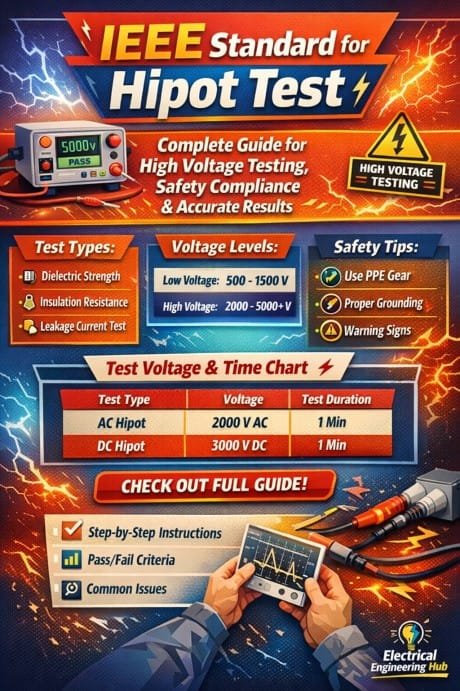
Table of Contents
This guide explains the fundamentals, standards, procedures, safety practices, and practical considerations to help you perform accurate and compliant testing.
What is a Hipot Test?
A hipot test, also known as a high potential test, is used to verify the insulation strength of electrical components. It applies a high voltage between conductors and ground to check whether insulation can withstand stress without breaking down.
The ieee standard for hipot test provides guidelines on how to perform this test safely and consistently. It ensures that electrical products meet quality and safety requirements before commissioning or delivery.
Find all about IEEE Standard for Insulation Resistance Test
Key objectives of hipot testing
- Detect insulation weaknesses
- Prevent electrical failures and short circuits
- Ensure compliance with safety regulations
- Validate manufacturing quality
- Reduce long-term maintenance risks
Understanding IEEE Standards for Hipot Testing
The ieee standard for hipot test is not a single document but a set of guidelines covered under various IEEE standards related to insulation testing and dielectric strength.
Some commonly referenced IEEE standards include:
| IEEE Standard | Description |
|---|---|
| IEEE 43 | Insulation resistance testing for rotating machinery |
| IEEE 95 | Dielectric testing of electrical insulation |
| IEEE 400 | Field testing of shielded power cables |
| IEEE 62 | Testing of power transformers |
These standards define voltage levels, testing duration, acceptance criteria, and safety practices. Following the ieee standard for hipot test ensures consistency across industries and improves testing reliability.
Know more about IEEE Standard for Instrument Transformers
Types of Hipot Tests
Different types of hipot tests are used depending on equipment and application. The ieee standard for hipot test outlines when to use each method.
AC Hipot Test
- Uses alternating current voltage
- Suitable for detecting distributed insulation defects
- Common in cable and transformer testing
DC Hipot Test
- Uses direct current voltage
- Preferred for long cables due to lower current requirements
- Easier to measure leakage current
Explore all about IEEE Standard for Cable Insulation Resistance Test
Step Voltage Test
- Voltage is increased gradually in steps
- Helps identify insulation degradation trends
Leakage Current Measurement
- Monitors current flowing through insulation
- Higher current indicates possible insulation failure
Standard Hipot Test Procedure
Following a proper procedure is critical for accurate results. The ieee standard for hipot test emphasizes preparation, execution, and evaluation.
Step-by-step process
- Visual inspection of equipment
- Isolation from power sources
- Grounding of all exposed conductive parts
- Connection of hipot tester
- Gradual application of test voltage
- Monitoring leakage current
- Holding voltage for specified duration
- Recording results
- Safe discharge after test
Know more about IEEE Standard for Contact Resistance
Typical test parameters
| Parameter | Typical Range |
|---|---|
| Test Voltage | 1 kV to 100 kV |
| Test Duration | 1 to 10 minutes |
| Leakage Current | Depends on equipment type |
| Frequency (AC) | 50/60 Hz |
The ieee standard for hipot test provides formulas and recommendations for determining appropriate voltage levels based on rated system voltage.
Test Voltage Calculation
Selecting the correct voltage is crucial. Over-testing can damage insulation, while under-testing may miss defects.
A commonly used formula:
- AC Test Voltage = 2 × Rated Voltage + 1000V
- DC Test Voltage = 1.7 × AC Test Voltage
The ieee standard for hipot test may adjust these values depending on equipment type, age, and application.
Find all about IEEE Standard for Short Circuit Calculation
Safety Considerations in Hipot Testing
High voltage testing involves serious risks. The ieee standard for hipot test strongly emphasizes safety procedures to protect personnel and equipment.
Essential safety practices
- Always use proper grounding
- Maintain safe distance during testing
- Use insulated tools and PPE
- Install warning signs and barriers
- Ensure emergency shutdown availability
Personal Protective Equipment (PPE)
| PPE Item | Purpose |
|---|---|
| Insulated gloves | Prevent electric shock |
| Safety shoes | Ground isolation |
| Face shield | Protection from arc flash |
| Flame-resistant clothing | Fire safety |
Ignoring safety guidelines while performing tests under the ieee standard for hipot test can lead to severe accidents or equipment damage.
Common Errors and How to Avoid Them
Even experienced technicians can make mistakes during testing. Understanding these errors helps improve accuracy.
Frequent issues
- Incorrect voltage selection
- Poor grounding
- Inadequate test duration
- Misinterpretation of leakage current
- Testing contaminated or wet equipment
Know more about IEC Standard for Neutral to Earth Voltage – Limits, Measurement & Safety Guidelines
Prevention tips
- Follow documented procedures
- Calibrate testing equipment regularly
- Maintain clean testing environment
- Cross-check readings with standards
The ieee standard for hipot test provides clear benchmarks to reduce these errors.
Applications of Hipot Testing
Hipot testing is used across multiple industries to ensure electrical safety and compliance.
Major applications
- Power cables and transmission lines
- Transformers and switchgear
- Electric motors and generators
- Consumer appliances
- Industrial control panels
The ieee standard for hipot test ensures that all these applications meet consistent performance and safety requirements.
Acceptance Criteria and Result Interpretation
Interpreting test results correctly is just as important as performing the test.
Pass conditions
- No insulation breakdown
- Leakage current within acceptable limits
- Stable readings during test duration
Fail conditions
- Sudden increase in leakage current
- Flashover or breakdown
- Inconsistent readings
Find all about IEC Standard for Relay Testing: Best Guide
Sample result table
| Test Item | Voltage Applied | Leakage Current | Result |
|---|---|---|---|
| Cable A | 10 kV | 2 mA | Pass |
| Motor B | 5 kV | 8 mA | Fail |
| Transformer C | 20 kV | 3 mA | Pass |
The ieee standard for hipot test defines acceptable leakage levels based on equipment specifications and environmental conditions.
Advantages of Following IEEE Standards
Adhering to standardized practices brings multiple benefits.
- Improved testing accuracy
- Enhanced safety compliance
- Consistent quality assurance
- Reduced equipment failure
- Better regulatory acceptance
Organizations that follow the ieee standard for hipot test gain credibility and minimize operational risks.
Maintenance and Calibration of Hipot Equipment
Testing equipment must be maintained to ensure reliable results.
Best practices
- Perform regular calibration
- Inspect cables and connectors
- Store equipment in dry conditions
- Verify output voltage accuracy
The ieee standard for hipot test recommends periodic verification to maintain testing integrity.
Know all about ieee and iec standards
Future Trends in High Voltage Testing
Technology is improving testing methods and accuracy.
Emerging trends
- Digital hipot testers with data logging
- Automated testing systems
- Remote monitoring capabilities
- Integration with asset management software
Despite technological advancements, the core principles of the ieee standard for hipot test remain essential for ensuring safety and consistency.
Conclusion
Hipot testing is a vital part of electrical safety and quality assurance. By following the ieee standard for hipot test, professionals can ensure accurate results, maintain compliance, and protect both equipment and personnel.
From understanding test types to applying correct voltage levels and interpreting results, every step matters. When performed correctly, hipot testing not only detects insulation weaknesses but also prevents costly failures and enhances system reliability.
Know more about IEC Standard for MV Cable Testing: Complete Acceptance, Routine & Type Test Guide
Whether you are working in manufacturing, power distribution, or industrial maintenance, aligning your practices with the ieee standard for hipot test will always be a smart and necessary approach.
Follow Us on Social:
Subscribe our Newsletter on Electrical Insights for latest updates from Electrical Engineering Hub
#ieeestandardforhipottest, #hipottestprocedure, #highvoltagetesting, #electricalsafetytesting, #hipottestguide, #insulationtesting, #dielectrictesting, #powerengineering, #electricalstandards, #testingandcommissioning