IEEE Standard for Dissolved Gas Analysis: Best Guide to Transformer Diagnostics & Fault Detection
The ieee standard for dissolved gas analysis plays a central role in assessing the health of power transformers. In modern power systems, transformers are high-value assets, and any unexpected failure can lead to costly outages. Dissolved Gas Analysis (DGA) provides an early warning system by identifying internal faults before they become critical.
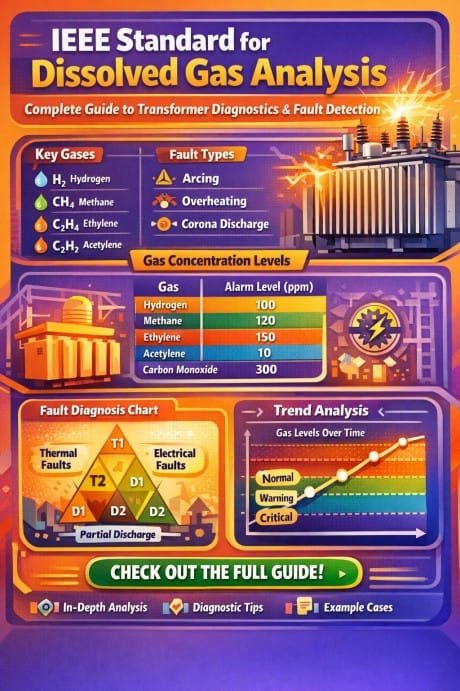
Table of Contents
This guide explains how the ieee standard for dissolved gas analysis works, why it is important, and how it helps engineers detect transformer faults with accuracy and confidence.
What is Dissolved Gas Analysis (DGA)
Dissolved Gas Analysis is a diagnostic technique used to detect gases dissolved in transformer oil. These gases are produced due to thermal and electrical stresses inside the transformer.
When insulation materials or oil degrade, they release gases such as hydrogen, methane, ethylene, and acetylene. The ieee standard for dissolved gas analysis defines how these gases should be measured, interpreted, and used for fault diagnosis.
Know more about Top 20 Electrical Testing Tools Which You Must Have
Key gases analyzed in DGA
| Gas Type | Symbol | Fault Indication |
|---|---|---|
| Hydrogen | H₂ | Partial discharge |
| Methane | CH₄ | Low-temperature overheating |
| Ethane | C₂H₆ | Moderate overheating |
| Ethylene | C₂H₄ | High-temperature overheating |
| Acetylene | C₂H₂ | Arcing or severe faults |
| Carbon Monoxide | CO | Insulation degradation |
| Carbon Dioxide | CO₂ | Cellulose insulation aging |
The interpretation of these gases is standardized under the ieee standard for dissolved gas analysis, ensuring consistent diagnostics across industries.
Importance of IEEE Standard for Dissolved Gas Analysis
The ieee standard for dissolved gas analysis provides a structured approach to transformer condition monitoring. Without a standard, interpretation of gas levels could vary significantly between engineers and organizations.
Know more about How to Use Megger Insulation Tester 1000V
Why this standard matters
- Ensures consistent fault diagnosis
- Helps in predictive maintenance
- Reduces unexpected transformer failures
- Extends equipment life
- Improves safety in power systems
Utilities and industries rely on the ieee standard for dissolved gas analysis to make informed maintenance decisions.
IEEE Standard C57.104 Overview
The primary reference for DGA is IEEE Std C57.104. This document outlines guidelines for interpreting gas concentrations in transformer oil.
Key features of IEEE C57.104
- Defines acceptable gas limits
- Provides condition assessment categories
- Includes trending and rate-of-change analysis
- Offers fault interpretation techniques
The ieee standard for dissolved gas analysis divides transformer condition into different levels based on gas concentration.
Know more about Difference Between VLF and Megger
Transformer condition classification
| Condition Level | Description | Recommended Action |
|---|---|---|
| Condition 1 | Normal | Routine monitoring |
| Condition 2 | Slight concern | Increase monitoring frequency |
| Condition 3 | High concern | Plan maintenance |
| Condition 4 | Critical | Immediate action required |
These categories help engineers prioritize actions using the ieee standard for dissolved gas analysis.
Methods of Gas Interpretation
The ieee standard for dissolved gas analysis includes multiple methods to interpret gas data. Each method helps identify specific types of faults.
1. Key Gas Method
This method focuses on dominant gases to identify fault types.
- Hydrogen → Partial discharge
- Acetylene → Arcing
- Ethylene → Thermal faults
Find more about Fluke 1507 Insulation Tester Megger Working
2. Rogers Ratio Method
This technique uses ratios of different gases to determine fault conditions.
| Ratio Used | Fault Type Identified |
|---|---|
| CH₄/H₂ | Partial discharge |
| C₂H₂/C₂H₄ | Arcing |
| C₂H₄/C₂H₆ | Thermal faults |
The ieee standard for dissolved gas analysis supports this method for detailed diagnostics.
3. Duval Triangle Method
Although originally developed by IEC, it is widely used alongside the ieee standard for dissolved gas analysis.
It plots three gases on a triangular graph to identify fault zones such as:
- PD (Partial Discharge)
- D1 (Low-energy discharge)
- D2 (High-energy discharge)
- T1, T2, T3 (Thermal faults at different temperatures)
Explore all about How to Use Megger BM5200 Insulation Tester 5kV
Fault Types Detected Using DGA
The ieee standard for dissolved gas analysis helps detect various internal transformer faults early.
Common fault categories
Electrical faults
- Partial discharge
- Low-energy discharges
- High-energy arcing
Thermal faults
- Low-temperature overheating (<300°C)
- Medium-temperature overheating (300–700°C)
- High-temperature overheating (>700°C)
Insulation degradation
- Paper insulation aging
- Cellulose decomposition
Each fault produces a unique gas signature, which is interpreted using the ieee standard for dissolved gas analysis.
Find more about Best Megger Insulation Tester for Industrial Motors
Sampling and Testing Procedures
Accurate results depend on proper oil sampling and testing methods. The ieee standard for dissolved gas analysis emphasizes correct procedures to avoid contamination.
Best practices for sampling
- Use clean, airtight sampling bottles
- Avoid exposure to air
- Label samples correctly
- Transport samples quickly to the lab
Testing methods
| Method | Description |
|---|---|
| Gas Chromatography | Most accurate method for DGA |
| Portable DGA analyzers | On-site testing |
| Online DGA monitoring | Continuous gas monitoring |
Following the ieee standard for dissolved gas analysis ensures reliable results and consistent interpretation.
Trending and Monitoring
One of the most powerful aspects of the ieee standard for dissolved gas analysis is trend analysis. Instead of relying on a single test, engineers monitor gas levels over time.
Why trending is important
- Detects gradual deterioration
- Identifies sudden fault development
- Helps in maintenance planning
Example of gas trend interpretation
| Gas Level Trend | Interpretation |
|---|---|
| Stable | Normal operation |
| Slowly rising | Aging or minor fault |
| Rapid increase | Active fault condition |
Trend analysis enhances the effectiveness of the ieee standard for dissolved gas analysis.
Know more about HT Motor Tan Delta Testing – Best Guide for High Voltage Motor Insulation Diagnostic & Preventive Maintenance
Advantages of Using IEEE Standard for DGA
The ieee standard for dissolved gas analysis offers several practical benefits in transformer maintenance.
Key advantages
- Early fault detection
- Reduced maintenance costs
- Improved transformer reliability
- Standardized diagnostics
- Better asset management
Find all about Best Megger Insulation Testers 5000V
These advantages make the ieee standard for dissolved gas analysis a preferred choice in power utilities.
Limitations and Considerations
While highly effective, the ieee standard for dissolved gas analysis has some limitations.
Important considerations
- Requires skilled interpretation
- External contamination can affect results
- Not all faults produce detectable gases
- Should be combined with other tests
Engineers often use DGA along with tests like insulation resistance and partial discharge measurements for a complete assessment. Find all about VLF Tan Delta Testing of MV Cables: Ensure Reliable High-Voltage Cable Performance
Practical Applications in Industry
The ieee standard for dissolved gas analysis is widely used across different sectors.
Common applications
- Power generation plants
- Transmission and distribution networks
- Industrial transformers
- Renewable energy systems
In each case, the ieee standard for dissolved gas analysis helps ensure uninterrupted operation and system stability.
Know more about High Voltage Testing Procedures for Electrical Panels: Step by Step
Conclusion
The ieee standard for dissolved gas analysis is a vital tool in modern transformer diagnostics. It provides a systematic approach to detecting faults, analyzing gas patterns, and making informed maintenance decisions.
By understanding gas generation mechanisms and applying standardized interpretation methods, engineers can identify problems at an early stage. This reduces downtime, improves safety, and extends transformer life.
Find all about Partial Discharge vs Tan Delta Cable Testing: Important Key Differences Every Engineer Must Know
Follow Us on Social:
Subscribe our Newsletter on Electrical Insights for latest updates from Electrical Engineering Hub
#IEEEStandardForDissolvedGasAnalysis, #DissolvedGasAnalysis, #TransformerTesting, #ElectricalMaintenance, #PowerSystemReliability, #DGAStandards, #ConditionMonitoring, #TransformerHealth, #IEEEGuidelines, #ElectricalEngineering