IEC Standard for Numerical Relays – Complete Protection, Testing & Compliance Guide
Modern power systems rely heavily on digital protection devices to ensure safety, reliability, and fast fault isolation. One of the most important frameworks governing these devices is the IEC standard for numerical relays. These standards define the design, performance, testing procedures, and communication requirements of protection relays used in substations, transmission networks, and industrial power systems.
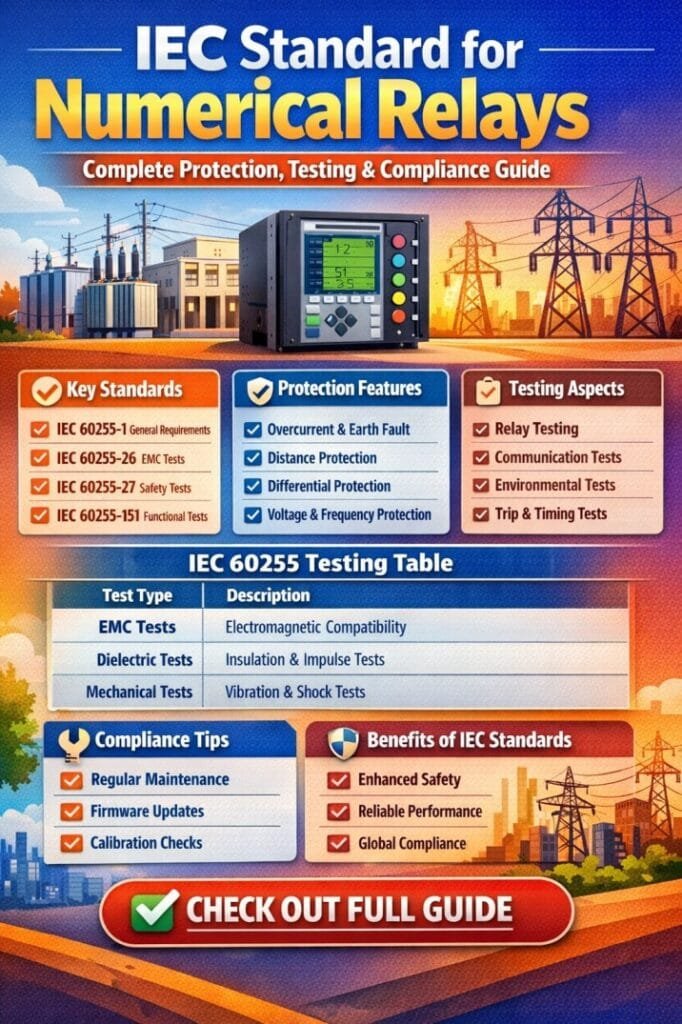
Table of Contents
Numerical relays have replaced traditional electromechanical and static relays in most applications because of their accuracy, multifunction capability, and integration with digital communication protocols. However, for these advanced devices to operate reliably across different manufacturers and systems, international standards are essential. The IEC standard for numerical relays provides the foundation for protection coordination, interoperability, and system safety.
This guide explains the relevant IEC standards, testing requirements, protection features, and compliance considerations associated with numerical relays.
Understanding Numerical Relays in Power System Protection
A numerical relay is a microprocessor-based protection device that continuously monitors electrical parameters such as current, voltage, frequency, and impedance. When abnormal conditions such as short circuits or overloads occur, the relay issues a trip signal to the circuit breaker to isolate the faulted section.
Learn more about earthing cable size as per iec
Unlike older relay technologies, numerical relays use digital signal processing and embedded algorithms to perform multiple protection functions within a single device.
Key characteristics include:
- Digital signal processing of voltage and current inputs
- Multifunction protection capabilities
- Event recording and disturbance logging
- Communication through modern protocols
- Self-diagnostics and monitoring
Because of these complex capabilities, the IEC standard for numerical relays ensures that manufacturers follow uniform guidelines for performance, safety, and compatibility.
Main IEC Standards Applicable to Numerical Relays
The International Electrotechnical Commission (IEC) publishes several standards that govern protection relays and associated equipment. These standards cover performance requirements, environmental testing, electromagnetic compatibility, and communication protocols. Discover everything about cable bending radius iec standard
The following table summarizes the most relevant IEC standards.
| IEC Standard | Title | Purpose |
|---|---|---|
| IEC 60255 | Measuring Relays and Protection Equipment | Core standard defining requirements for protection relays |
| IEC 60255-1 | Common Requirements | General performance and design guidelines |
| IEC 60255-26 | Electromagnetic Compatibility | Immunity to electromagnetic disturbances |
| IEC 60255-27 | Product Safety Requirements | Safety rules for protection equipment |
| IEC 60255-121 | Distance Protection Functions | Performance of distance relays |
| IEC 60255-151 | Overcurrent Protection | Characteristics of overcurrent relays |
| IEC 61850 | Communication Networks and Systems | Digital communication and substation automation |
Each of these documents contributes to the broader IEC standard for numerical relays framework used globally in power system protection.
Find out more about iec 61439 busbar clearance
Key Requirements Defined in IEC Standards
The IEC standard for numerical relays establishes detailed requirements to ensure protection devices operate correctly in real-world conditions. These requirements address electrical performance, environmental tolerance, and operational reliability.
Important aspects include:
Performance Requirements
Protection relays must respond accurately and within defined time limits during fault conditions.
Key parameters include:
- Operating time
- Reset characteristics
- Accuracy of measurement
- Stability under system disturbances
For example, overcurrent relays must operate according to specific inverse time curves defined by IEC.
Environmental Testing
Relays installed in substations must withstand harsh environments including temperature variation, humidity, vibration, and electrical noise.
Environmental testing typically includes:
- Temperature endurance
- Mechanical vibration tests
- Humidity exposure
- Thermal shock tests
These tests ensure numerical relays remain reliable throughout their operational life.
Explore details on iec standard for underground cable laying
Electromagnetic Compatibility
Power substations contain strong electromagnetic fields generated by switching operations and fault currents. The IEC standard for numerical relays includes EMC requirements to ensure devices remain immune to disturbances.
Common EMC tests include:
- Electrostatic discharge
- Fast transient burst
- Surge immunity
- Radiated electromagnetic fields
Compliance with these tests prevents malfunction during switching events.
Protection Functions Covered by IEC Standards
Modern numerical relays perform multiple protection functions simultaneously. IEC standards define the behavior and accuracy of these protection algorithms.
Common protection functions include:
| Protection Function | Description |
|---|---|
| Overcurrent Protection | Detects excessive current caused by faults or overloads |
| Distance Protection | Identifies faults based on impedance measurement |
| Differential Protection | Compares currents at two points to detect internal faults |
| Overvoltage Protection | Protects equipment from high voltage conditions |
| Underfrequency Protection | Prevents system collapse during frequency drops |
| Earth Fault Protection | Detects ground faults in power systems |
Each of these functions must comply with relevant parts of the IEC standard for numerical relays to ensure consistent protection performance.
Get complete information about iec standard for busbar sizing
Testing Procedures for Numerical Relays
Testing plays a critical role in verifying compliance with IEC standards. Protection engineers perform several types of tests during manufacturing, commissioning, and maintenance.
Type Testing
Type tests verify that a relay design meets IEC requirements before it is released to the market. These tests are conducted in specialized laboratories.
Examples include:
- Insulation tests
- Environmental tests
- Electromagnetic compatibility tests
- Functional performance verification
Routine Testing
Routine tests are conducted during manufacturing to ensure each relay unit meets performance specifications.
Typical routine tests include:
- Functional verification
- Calibration checks
- Communication interface testing
Understand better about nec 430.32
Commissioning Testing
Before a relay is placed in service, engineers perform commissioning tests in the substation.
These tests confirm:
- Correct wiring
- Protection settings
- Trip circuit operation
- Communication integration
Testing equipment such as relay test sets injects simulated current and voltage signals to validate protection performance.
Communication Standards for Digital Substations
Modern substations rely on high-speed communication networks to exchange protection data. The IEC standard for numerical relays works closely with IEC 61850, which defines communication protocols used in digital substations.
Important features of IEC 61850 include:
- Interoperability between different manufacturers
- High-speed GOOSE messaging for protection signals
- Standardized data models for relay information
- Ethernet-based communication architecture
Through IEC 61850 integration, numerical relays can share measurements, alarms, and trip commands across substation automation systems.
Dive deeper into instrument earthing iec standard
Benefits of IEC Standard Compliance
Following international standards provides multiple benefits for utilities, engineers, and equipment manufacturers.
Key advantages include:
Improved reliability
Standardized testing procedures
Interoperability between protection devices
Higher system safety
Simplified maintenance and upgrades
For power utilities, compliance with the IEC standard for numerical relays ensures protection equipment performs consistently under fault conditions and system disturbances.
Comparison Between Electromechanical, Static, and Numerical Relays
Protection technology has evolved significantly over time. The following comparison highlights the advantages of numerical relays.
| Feature | Electromechanical Relay | Static Relay | Numerical Relay |
|---|---|---|---|
| Technology | Mechanical components | Analog electronics | Microprocessor based |
| Accuracy | Moderate | High | Very high |
| Functions | Single protection | Limited multifunction | Multiple protection functions |
| Communication | None | Limited | Full digital communication |
| Maintenance | High | Moderate | Low |
Because of their flexibility and reliability, numerical relays have become the standard choice for modern power systems.
Read in detail about iec 61439 busbar calculation
Practical Implementation in Power Systems
Utilities implement numerical relays in a wide range of applications including transmission lines, transformers, generators, and distribution feeders.
Typical installations include:
- Transmission line protection using distance relays
- Transformer differential protection
- Feeder overcurrent protection
- Generator protection systems
When selecting relays for these applications, engineers ensure the device complies with the IEC standard for numerical relays to guarantee proper operation within the protection scheme.
Maintenance and Periodic Verification
Even though numerical relays require less maintenance compared to older technologies, periodic verification is still necessary.
Recommended maintenance activities include:
- Firmware updates
- Settings verification
- Communication testing
- Secondary injection testing
Regular testing ensures the relay continues to meet the requirements defined in the IEC standard for numerical relays throughout its operational life.
Uncover insights on iec standard for lighting lux level
Conclusion
Numerical relays play a crucial role in modern power system protection by providing fast, accurate, and intelligent fault detection. However, the complexity of these devices requires strict international guidelines to ensure safe and reliable operation.
The IEC standard for numerical relays establishes comprehensive requirements covering design, testing, environmental performance, and communication capabilities. Standards such as IEC 60255 and IEC 61850 form the backbone of protection relay technology used worldwide.
Know more about Phase to Phase Clearance as per IEC 61439: Best Guide
Follow Us on Social:
Subscribe our Newsletter on Electrical Insights for latest updates from Electrical Engineering Hub
#IECStandardForNumericalRelays, #NumericalRelays, #PowerSystemProtection, #IEC61850, #ProtectionRelays, #ElectricalEngineering, #SubstationAutomation, #RelayTesting, #PowerGridProtection, #ElectricalStandards