HVDC Transmission Projects in USA: Top High-Voltage DC Grid Solutions & Investments
High-voltage direct current (HVDC) technology is transforming the energy landscape in the United States. HVDC transmission projects are increasingly seen as a solution to efficiently transfer large amounts of electricity across vast distances with minimal losses. Unlike traditional alternating current (AC) systems, HVDC allows utilities to connect renewable energy sources, reduce congestion, and improve grid stability.
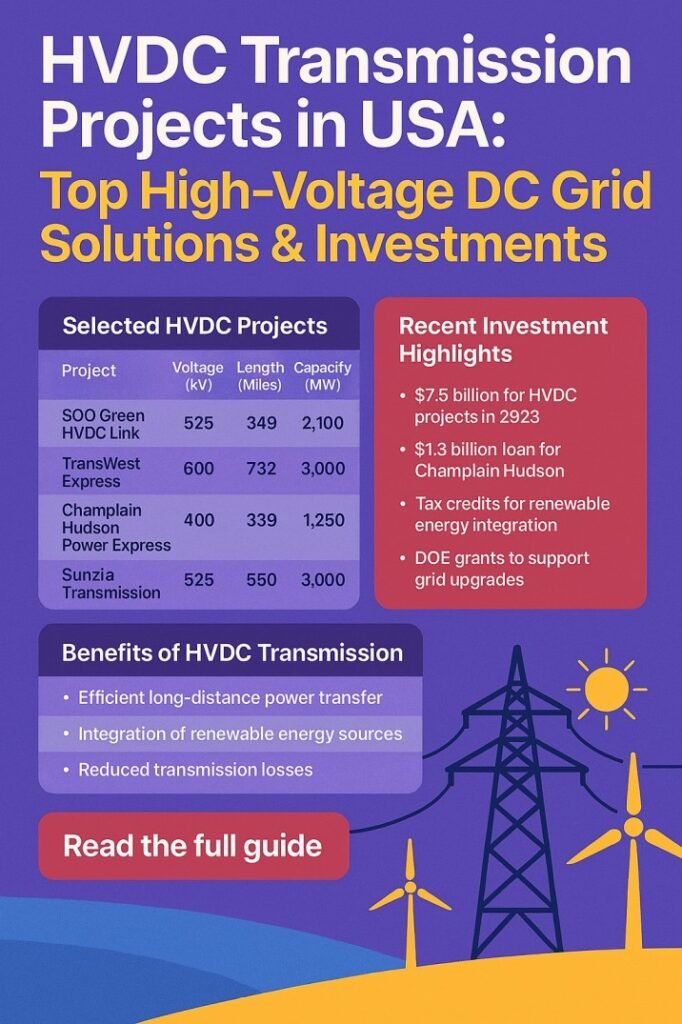
Table of Contents
In the USA, the surge in renewable integration, especially solar and wind, has fueled significant investments in HVDC transmission projects, making them a strategic priority for both public and private stakeholders.
Overview of High Voltage DC Transmission Projects in the USA
HVDC transmission projects in the USA are designed to transport electricity over long distances where conventional AC systems would face significant losses or reliability issues. These projects are particularly beneficial for linking remote renewable energy sources to urban centers where electricity demand is highest. HVDC systems reduce energy loss to nearly 3% per 1,000 kilometers, a significant improvement compared to AC systems. Additionally, they allow precise control over power flow, helping to stabilize grids that face variable renewable energy inputs.
Find more about High Voltage DC Power vs AC Power Transmission: Advantages, Efficiency & Modern Applications
Advantages of High Voltage DC Transmission Projects
The popularity of HVDC transmission projects in the United States is driven by multiple benefits. These advantages include higher efficiency, reduced right-of-way requirements, and the ability to interconnect asynchronous grids. By converting AC power to DC for long-distance transmission and then back to AC at the receiving end, HVDC lines reduce energy dissipation and operational costs.
They also enable underground and submarine transmission, which is crucial for coastal renewable projects and urban grid connections. This makes HVDC a critical tool for meeting the country’s clean energy targets while maintaining grid reliability.
Key HVDC Transmission Projects in the USA
Several major HVDC transmission projects have been proposed, approved, or completed across the United States. These projects represent both technological innovation and substantial investment in the nation’s electrical infrastructure. The table below highlights some of the top HVDC transmission projects currently shaping the American energy landscape:
| Project Name | Location | Capacity (MW) | Voltage (kV) | Status | Key Features |
|---|---|---|---|---|---|
| Pacific DC Intertie | California to Oregon | 3,100 | ±500 | Operational | Long-distance bulk power transmission, connects hydro resources to urban centers |
| Plains & Eastern Clean Line | Oklahoma to Tennessee | 3,500 | ±600 | Approved | Transmits wind energy from Midwest to Southeast, supports renewable integration |
| TransWest Express | Wyoming to Nevada | 3,000 | ±600 | Under Construction | Facilitates wind and solar export, uses overhead HVDC lines |
| Greenlink HVDC | Atlantic Coast | 2,000 | ±500 | Proposed | Submarine cable for offshore wind integration, reduces land footprint |
| SOO Green HVDC Link | Midwest | 2,100 | ±525 | Planning Stage | Connects wind-rich Midwest to New York, underground and overhead lines |
These projects exemplify how HVDC transmission projects not only improve energy efficiency but also facilitate a cleaner energy mix by integrating renewable resources across regions.
Know more about HVDC Transformer Working Principle Explained – How Converter Transformers Handle Extreme DC Power
Investment Trends in HVDC Transmission Projects
Investment in HVDC transmission projects in the USA has grown steadily over the past decade. Utilities, independent power producers, and federal agencies are recognizing the need for high-capacity, low-loss transmission networks. Capital costs for HVDC lines can be high, often ranging from $1 million to $2 million per mile for overhead lines and significantly more for underground or submarine cables.
Despite this, the long-term benefits, including reduced operational losses and enhanced renewable energy access, make HVDC projects financially attractive. Strategic public-private partnerships are emerging as a preferred model to fund these large-scale investments. Know more about HVDC Transmission Explained: Key Components, Working & Real-World Applications
Technological Innovations Supporting High Voltage DC Transmission Projects
Modern HVDC transmission projects incorporate advanced technologies that enhance efficiency and reliability. Voltage-source converters (VSC) and line-commutated converters (LCC) are commonly used to convert AC to DC and vice versa. VSC-based HVDC systems provide better control over power flow, can handle multi-terminal connections, and are suitable for connecting remote offshore wind farms.
Know more about Applications of HVDC Transmission: Where High-Voltage DC Outperforms AC in Modern Power Grids
LCC-HVDC systems, on the other hand, are ideal for very high-capacity bulk power transmission. Innovations in superconducting materials, modular converter stations, and real-time monitoring systems are further boosting the feasibility and performance of HVDC transmission projects in the USA.
Challenges Facing HVDC Transmission Projects
Despite the advantages, HVDC transmission projects face several challenges. High upfront costs, complex permitting processes, and environmental concerns can slow project development. Right-of-way acquisition for long-distance overhead HVDC lines often requires negotiation with multiple landowners and regulatory authorities. Submarine and underground HVDC lines present technical challenges related to insulation, cooling, and maintenance.
Moreover, integrating HVDC projects with existing AC infrastructure requires sophisticated control systems to ensure stability. Addressing these challenges is critical for expanding HVDC transmission projects nationwide.
Know more about HVDC Transformer Working Principle Explained – How Converter Transformers Handle Extreme DC Power
HVDC Transmission Projects and Renewable Integration
HVDC transmission projects are particularly valuable for integrating renewable energy into the U.S. grid. Wind and solar resources are often located far from consumption centers. By enabling efficient long-distance transmission, HVDC lines connect remote renewable sites to major urban areas. For example, the Plains & Eastern Clean Line and TransWest Express projects are designed to transport wind energy from the Midwest to the Southeast and West Coast, respectively.
Similarly, submarine HVDC cables like Greenlink can connect offshore wind farms to coastal cities without major land disruption. As renewable generation grows, HVDC transmission projects will play a crucial role in balancing supply and demand.
Future Outlook for HVDC Transmission Projects in the USA
The future of HVDC transmission projects in the USA is promising. Increasing renewable energy adoption, combined with aging AC infrastructure, is driving demand for high-capacity, low-loss transmission solutions. Federal initiatives, such as the Biden administration’s focus on grid modernization and clean energy, are expected to accelerate investments in HVDC technologies.
Know more about HVDC Converter: Best Guide to HVDC Transmission System
Multi-terminal HVDC grids and hybrid AC-DC systems are likely to become more common, enabling more flexible and resilient power networks. As technological costs decrease and experience grows, HVDC transmission projects will increasingly define the U.S. energy landscape.
Comparison of HVDC vs AC Transmission for Major Projects
| Feature | HVDC Transmission | AC Transmission |
|---|---|---|
| Distance Efficiency | Very high, minimal losses | Losses increase significantly with distance |
| Renewable Integration | Ideal for remote wind/solar farms | Limited by transmission losses and stability issues |
| Cost | High upfront, lower operational | Lower initial, higher operational over long distance |
| Grid Interconnection | Can connect asynchronous grids | Requires synchronized systems |
| Footprint | Smaller right-of-way, suitable for underground/submarine | Larger right-of-way, primarily overhead |
This comparison emphasizes why HVDC transmission projects are increasingly preferred for large-scale, long-distance electricity delivery in the U.S.
Know more about HVDC Converter Efficiency: 3 Important Formulas
Conclusion
HVDC transmission projects are reshaping the United States’ power infrastructure, enabling efficient long-distance electricity transport, integrating renewable resources, and enhancing grid reliability. With projects like the Pacific DC Intertie, Plains & Eastern Clean Line, and TransWest Express, the country is making significant strides toward a modern, low-carbon energy future.
Strategic investments, technological advancements, and supportive policies are paving the way for more HVDC transmission projects across the nation. For utilities, investors, and policymakers, these projects offer both a solution to energy challenges and a pathway to sustainable growth. The continued focus on HVDC transmission projects ensures that the U.S. can meet rising electricity demand while transitioning to a cleaner, more resilient energy system.
Know more about 7 Important HVDC Operating Modes
Follow Us on Social:
Subscribe our Newsletter on Electrical Insights for latest updates from Electrical Engineering Hub
#HVDCTransmission, #USAHVDCProjects, #HighVoltageDC, #PowerTransmissionUSA, #RenewableEnergyGrid, #SmartGridUSA, #ElectricalInfrastructure, #EnergyProjectsUSA, #HVDCTechnology, #CleanEnergyTransmission