How to Wire a 480/277 Lighting System: Step-By-Step Guide for Safe Commercial Installation
A 480/277 lighting system is common in large commercial and industrial buildings. It delivers efficient power distribution for high-bay lights, office lighting, exterior fixtures, and large electrical loads. Wiring this system requires a solid understanding of three-phase power, grounding, conductor identification, and safe installation practices. This guide explains the process in clear steps so you can understand how these systems work and how they are wired in real-world applications.
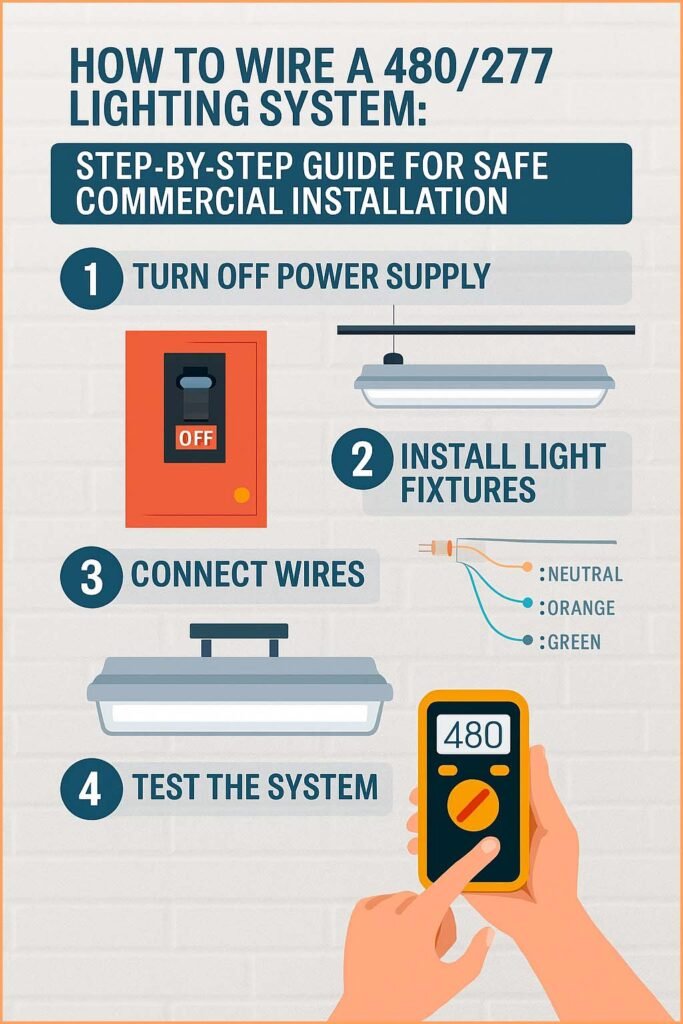
Table of Contents
Understanding a 480/277 Lighting System
A 480/277-volt system is a three-phase wye configuration. It provides 480 volts between phases and 277 volts between each phase and neutral. Most lighting fixtures use the 277-volt single-phase supply. Heavy equipment can use the 480-volt three-phase supply from the same panel.
A quick reference table below helps visualize the system:
Voltage Reference Table
| Connection Type | Voltage Level | Common Use |
|---|---|---|
| Phase to Phase | 480 V | Motors, HVAC, industrial loads |
| Phase to Neutral | 277 V | Lighting circuits, commercial fixtures |
| Neutral to Ground | 0 V | Safety grounding |
Because lighting loads are usually lighter than equipment loads, using 277 volts reduces current. This allows smaller conductors and increases efficiency across the building.
Safety Before Wiring
Always follow electrical codes, manufacturer instructions, and your local regulations. Lockout/tagout procedures must remain in place during every step. Never assume a conductor is dead. Test every line with a voltage tester before touching anything. Learn more about is 277 high voltage
Wear protective gear, including insulated gloves, arc-rated clothing, and safety glasses. Industrial systems can generate dangerous fault currents, so safety should never be skipped.
Components Required for a 480/277 Lighting System
Before wiring begins, gather the correct materials. The table below helps ensure a complete list.
Materials Checklist
| Component | Purpose |
|---|---|
| 480/277 V panelboard | Distributes power to lighting and equipment |
| Breakers (1-pole for 277 V) | Protects individual lighting circuits |
| THHN/THWN conductors | Carries current for each lighting branch |
| Lighting contactors or relays | Controls multiple fixtures from a single switch |
| Neutral bar and ground bar | Required for safe current return and fault clearing |
| Conduit and connectors | Protects and routes wiring |
| 277-volt rated fixtures | LED high bays, troffers, exterior lights |
Once these components are organized, wiring can begin in a structured way. Discover everything about Parallel Run for 300Amp 480/277
Step 1: Identify Conductors for 480/277 Systems
Correct conductor identification prevents mistakes. In most installations:
- Phase A is brown
- Phase B is orange
- Phase C is yellow
- Neutral is gray or white
- Ground is green or bare copper
These colors maintain consistency across all circuits. Use phase tape when necessary so all conductors remain clearly marked. Find out more about what is 277 voltage
Step 2: Install the Panelboard
The panel distributing the lighting circuits must be rated for 480/277 volts. Mount it securely on a wall or frame with enough clearance for maintenance. Connect the incoming service feeders to the main lugs or main breaker following torque requirements.
Terminate the neutral conductor on the neutral bus. Terminate the equipment grounding conductor on the ground bar. Do not bond neutral and ground in a sub-panel. They must remain isolated to prevent circulating currents and electrical noise.
Step 3: Plan Lighting Circuits
Lighting load calculations must follow NEC rules. Most commercial fixtures have a lower wattage thanks to LED technology. Still, circuits should be balanced across phases. Balancing reduces overloading and maintains stable voltage on the neutral. Explore details on iec and ieee standards
For example:
Circuit Planning Example
| Circuit | Phase | Number of Fixtures | Total Load (VA) |
|---|---|---|---|
| Circuit 1 | A | 8 LED fixtures | 960 VA |
| Circuit 2 | B | 8 LED fixtures | 960 VA |
| Circuit 3 | C | 8 LED fixtures | 960 VA |
Balancing each phase keeps the building more efficient and reduces overheating in conductors.
Step 4: Run Conduit and Pull Conductors
Route conduit from the panelboard to switches, contactors, and fixtures. Use appropriate fittings and support intervals. Pull conductors for phase, neutral, and ground based on your circuit plan.
Keep conductor lengths as short as possible to maintain voltage levels. Follow bend radius rules and avoid sharp pulling angles. Label each conductor at both ends for quick identification. Know more about load factor calculation formula
Step 5: Wire Branch Circuits
With conductors in place, begin wiring branch circuits.
Lighting Circuit Wiring Steps
- Connect the 277-volt hot conductor (brown, orange, or yellow) to a 1-pole breaker.
- Connect the neutral to the neutral bar.
- Connect the equipment grounding conductor to the ground bar.
- Route the conductors to the lighting relay or switch.
- From the control device, continue to the lighting fixtures.
Most 277-volt fixtures have only three wires: hot, neutral, and ground. Ensure proper tightening of all connections. Get complete information about power factor correction calculations
Step 6: Install Lighting Contactors or Relays
Large lighting systems often use contactors or relay panels. These devices allow a single switch or control signal to operate dozens or hundreds of fixtures at once.
A typical setup includes:
- Line side: 277-volt feed from the breaker
- Load side: Output to multiple fixtures
- Control terminals: Low-voltage or line-voltage signal from a switch or automation system
Modern buildings often use smart lighting panels, occupancy sensors, and daylight controls. These integrate smoothly with 480/277-volt lighting systems.
Learn more about capacity factor formula
Step 7: Connect Fixtures
Each 277-volt fixture should list its wiring on a label. In most cases:
- Connect the hot wire to the black lead on the fixture
- Connect the neutral wire to the white lead
- Connect ground to the green lead or screw
Secure all junction boxes and check that no conductor is exposed. Use proper strain reliefs and supports.
Step 8: Test the System
Before energizing the panel, check every termination. Look for loose connections, reversed polarity, missing grounds, or overfilled boxes.
Once verified:
- Energize the panel.
- Switch on each circuit one at a time.
- Check that fixtures illuminate correctly.
- Measure voltage at fixtures to ensure 277 volts is present.
- Confirm contactors function properly.
If any circuit trips the breaker, de-energize immediately and troubleshoot the wiring before proceeding.
Easily calculate kva for house using our online tool for free
Common Issues and Their Causes
A quick troubleshooting table can help during installation.
Troubleshooting Table
| Issue | Possible Cause | Action |
|---|---|---|
| Lights flicker | Loose neutral, poor connection | Tighten all terminations |
| Breaker trips | Short circuit or overload | Inspect branch wiring and fixture |
| No illumination | Incorrect phase or open neutral | Test voltage and continuity |
| Uneven lighting | Unbalanced phases | Reassign circuits evenly |
Dive deeper into off grid solar system design
Final Thoughts
Wiring a 480/277 lighting system requires careful planning, proper conductor identification, and strict adherence to safety standards. With balanced circuits, quality fixtures, and clean wiring methods, a commercial building can achieve efficient and reliable lighting for many years. This system supports both high-voltage equipment and low-current lighting loads, making it one of the most efficient choices for industrial environments.
Follow Us on Social:
Subscribe our Newsletter on Electrical Insights for latest updates from Electrical Engineering Hub
#480277LightingSystem, #ElectricalWiringGuide, #CommercialLighting, #LightingInstallation, #ElectricalSafetyTips, #HighVoltageLighting, #277VoltLighting, #ElectricalContractorGuide, #BuildingElectricalSystems, #LightingEngineering