
Full Load Amperage Calculator – Instantly Size Wires, Breakers & Motors Correctly
Introduction
The full load amperage calculator is a practical tool used to determine the current a piece of electrical equipment will draw when operating at its rated load. This value, commonly called full load current or full load amps, is essential for designing safe and reliable electrical systems.
Electricians, engineers, and contractors rely on a full load amperage calculator when selecting cables, circuit breakers, fuses, contactors, and overload protection. It is equally useful in industrial facilities, commercial buildings, and utility-related installations where motors, transformers, and heavy electrical loads are common.
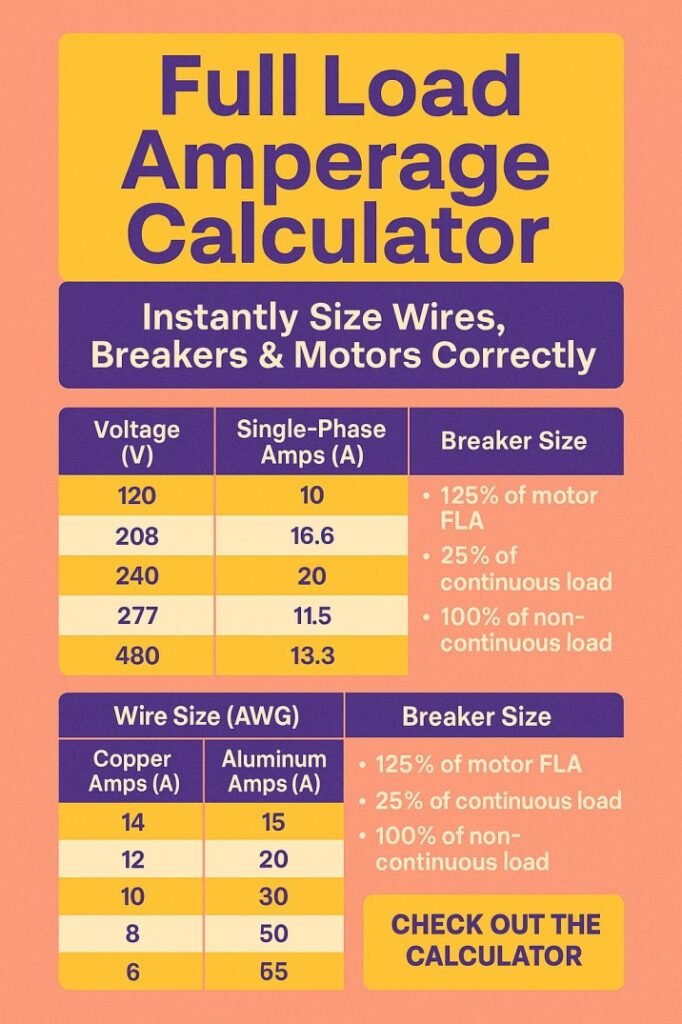
Table of Contents
Accurate current calculation directly affects equipment life, system efficiency, and electrical safety. Undersized conductors can overheat, while oversized protection devices may fail to trip under fault conditions. A dependable full load amperage calculator supports correct design decisions from the start.
Full Load Amperage Calculator
Enter the required electrical values into the full load amperage calculator and click calculate to see the load current.
Use realistic nameplate data for the most accurate result.
Full Load Amperage Calculator
IEC & NEC Reference Tool
Calculator
How to Use
Enter the motor power in kilowatts, supply voltage, efficiency, and power factor. Select whether the system is single-phase or three-phase. Click “Calculate” to get the Full Load Amperage (FLA). This tool references IEC and NEC standards for practical calculation guidance. Always verify results with applicable codes before implementation.
Find more Electrical Engineering Tools for easy electrical calculations and estimations.
How to Use Full Load Amperage Calculator (Step-by-Step)
- Select the system type
Choose whether the equipment is single-phase or three-phase. This affects how current is distributed in the circuit. - Enter the voltage
Input the operating voltage shown on the equipment nameplate or design drawings. This could be values such as 230 V, 400 V, or 480 V. - Input the power rating
Enter the rated power of the equipment. This is often given in kilowatts (kW) or horsepower (HP), depending on the device. - Provide the power factor
If the equipment is a motor or inductive load, enter the power factor. When unknown, a typical design estimate may be used. - Include efficiency if required
For motors and some industrial equipment, efficiency influences the input current. Enter the efficiency value if the field is available. - Click calculate
The full load amperage calculator will display the expected current at full load conditions.
Find out more about Busbar Size Calculator – Accurate Sizing According to IEC and NEC Standards
How the Calculation Works
The full load amperage calculator works by relating electrical power, voltage, and current. Electrical equipment consumes real power to perform useful work, and this power depends on both voltage and current.
For single-phase loads, the current depends on how much power the device uses and the supply voltage. For three-phase systems, power is shared across three conductors, which changes the relationship between voltage and current.
Power factor is also important. Many loads, especially motors and transformers, do not convert all supplied power into useful work. Some energy circulates between the source and the load. The full load amperage calculator accounts for this by adjusting the current based on the power factor.
Efficiency further affects the result. If a motor is not 100 percent efficient, it draws more electrical power than its mechanical output rating. The calculator increases the input current accordingly so the result reflects real operating conditions.
Use our online tool Heat Pump KWh Calculator UK Free – Instantly Estimate Running Costs & Savings
Practical Electrical Example
Consider a three-phase industrial motor driving a conveyor system.
Given values:
Rated mechanical power: 15 kW
Voltage: 400 V
Power factor: 0.85
Efficiency: 90 percent
Step 1: Select three-phase in the full load amperage calculator.
Step 2: Enter 400 V as the supply voltage.
Step 3: Enter 15 kW as the motor power.
Step 4: Input 0.85 for power factor.
Step 5: Enter 90 percent efficiency.
After calculation, the result shows the expected full load current for each phase conductor.
This value helps the engineer select the correct cable size, ensuring the conductor can safely carry the current without overheating. It also guides the choice of circuit breaker and overload relay settings to protect the motor during normal and abnormal conditions.
Use our online tool Power Consumption Calculator: Instantly Track & Reduce Your Energy Bills
Key Factors That Affect the Result
Several technical factors influence the output of a full load amperage calculator:
- Voltage level
Higher voltage for the same power results in lower current. Low-voltage systems generally carry higher currents. - Load type
Resistive loads such as heaters behave differently from inductive loads like motors and transformers. - Power factor
Lower power factor increases current for the same useful power, which impacts cable sizing and losses. - Efficiency
Less efficient equipment draws more input power and therefore higher current. - Operating conditions
Temperature, altitude, and duty cycle can affect how equipment performs and how much current it draws in real installations.
Common Mistakes to Avoid
Incorrect use of a full load amperage calculator can lead to unsafe or inefficient designs.
Using wrong voltage values
Entering a line-to-line voltage when the calculator expects line-to-neutral, or vice versa, can significantly distort the result.
Ignoring power factor
Assuming a power factor of 1 for motors or inductive equipment leads to underestimating current.
Confusing input and output power
Motor nameplates may show mechanical output power. The calculator must account for efficiency to estimate electrical input current correctly.
Rounding too aggressively
Small rounding changes in power factor or efficiency can produce noticeable differences in calculated current.
Use our online tool for free Electricity Bill Calculator by Watts – Instantly Estimate Your Power Cost
Using calculated current as final protection setting
The result from a full load amperage calculator is a design reference. Protection settings must also consider starting current, duty cycle, and applicable electrical codes.
Why Use This Full Load Amperage Calculator
A full load amperage calculator provides a fast and consistent way to estimate load current during design and maintenance work.
It improves accuracy compared to manual estimation and reduces the risk of arithmetic errors. This is especially helpful when working with multiple pieces of equipment or comparing design options.
The tool also saves time during project planning, equipment selection, and site troubleshooting. Engineers and electricians can quickly verify whether existing circuits are suitable for new loads.
Reliable current estimation supports better decisions about cable sizing, breaker selection, and panel loading, leading to safer and more dependable installations.
Electrical Standards & Practical Considerations
Electrical installations are governed by national and international wiring standards that define how conductors and protection devices must be selected. These standards consider current-carrying capacity, temperature ratings, installation methods, and safety margins.
Find the exact costing using our Gas vs Electricity Cost Calculator – Compare Energy Costs & Choose the Cheapest Option
Using a full load amperage calculator helps ensure that calculated currents align with these design practices. It provides a starting point for selecting conductors with adequate ampacity and for setting protective devices within acceptable limits.
Standards also address voltage drop, short-circuit ratings, and coordination between devices. Accurate load current is a key input in all these checks, supporting both performance and compliance.
Frequently Asked Questions (FAQs)
What is full load amperage?
Full load amperage is the current an electrical device draws when operating at its rated power under normal conditions.
Why is full load current important for cable sizing?
Cable size depends on how much current it must carry continuously. Undersized cables overheat, while oversized ones increase cost.
Can I use the full load amperage calculator for motors?
Yes, it is commonly used for motors. Include power factor and efficiency for a realistic current value.
Does starting current equal full load current?
No. Starting current, especially for motors, is often several times higher than full load current and must be considered separately.
Is calculated current the same as breaker rating?
Not exactly. Breaker ratings must consider full load current along with inrush current, protection curves, and applicable installation standards.
Use our online tool for free Solar Panel Size Calculator by Load – Find the Right System for Your Power Needs
Follow Us on Social:
Subscribe our Newsletter on Electrical Insights for latest updates from Electrical Engineering Hub
#FullLoadAmperageCalculator, #FLACalculator, #ElectricalCalculations, #MotorCurrent, #ThreePhasePower, #ElectricalEngineeringTools, #AmpsCalculation, #IndustrialElectrical, #VoltageAndCurrent, #PowerSystemDesign