Electric Motor Troubleshooting Chart – Complete Fault Diagnosis & Repair Guide for Engineers
Electric motors are the backbone of industrial plants, commercial buildings, and utility systems. From pumps and compressors to conveyors and HVAC units, their reliability directly impacts productivity. When a motor fails, downtime can be costly and sometimes dangerous. That is why every engineer and maintenance technician should rely on a structured electric motor troubleshooting chart to diagnose faults quickly and accurately.
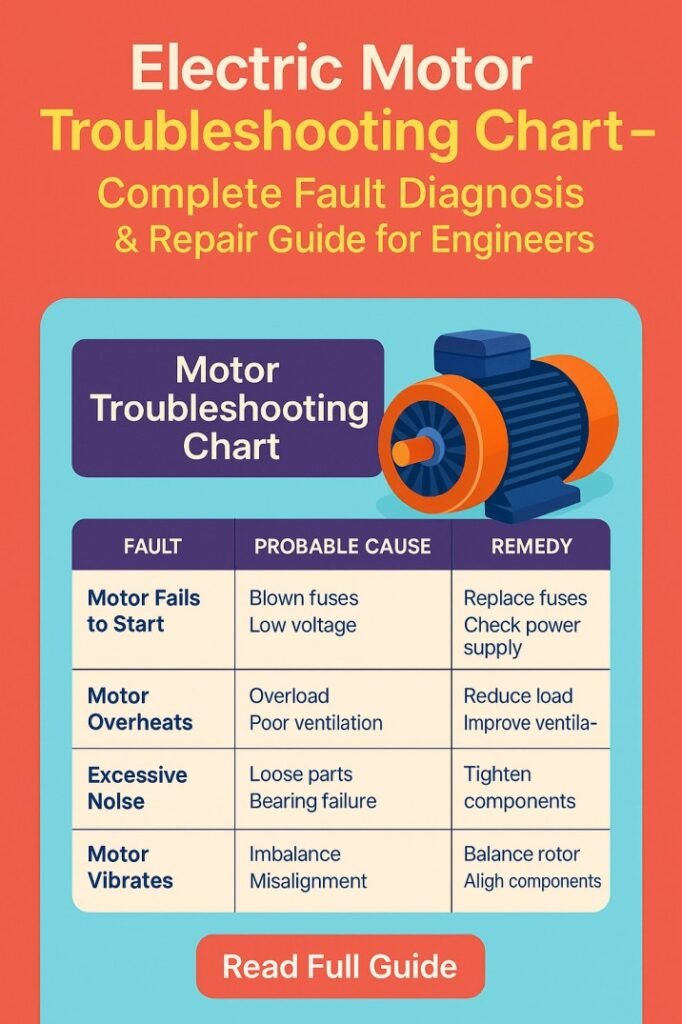
Table of Contents
An effective electric motor troubleshooting chart helps you move from symptoms to root cause in a logical way. Instead of guessing, you follow measurable parameters such as voltage, current, temperature, insulation resistance, and vibration levels. This guide explains how to use such a chart, what common motor problems look like, and how to apply corrective actions in real operating conditions.
Know more about Soft Starter Troubleshooting Guide: Quick Fix for Motor Start Up Faults
Why an Electric Motor Troubleshooting Chart Is Essential
Troubleshooting without a systematic method often leads to repeated failures. Replacing a bearing without checking shaft alignment or supply imbalance may only solve the problem temporarily. A well-prepared electric motor troubleshooting chart provides:
- Faster fault identification
- Reduced downtime
- Improved equipment reliability
- Safer maintenance practices
- Better documentation for future reference
It also supports predictive maintenance by linking symptoms such as overheating, noise, or low torque to specific electrical or mechanical causes.
Know more about Motor Starter Size Chart: 7 Essential Insights for Better Selection
Common Electric Motor Faults and Their Root Causes
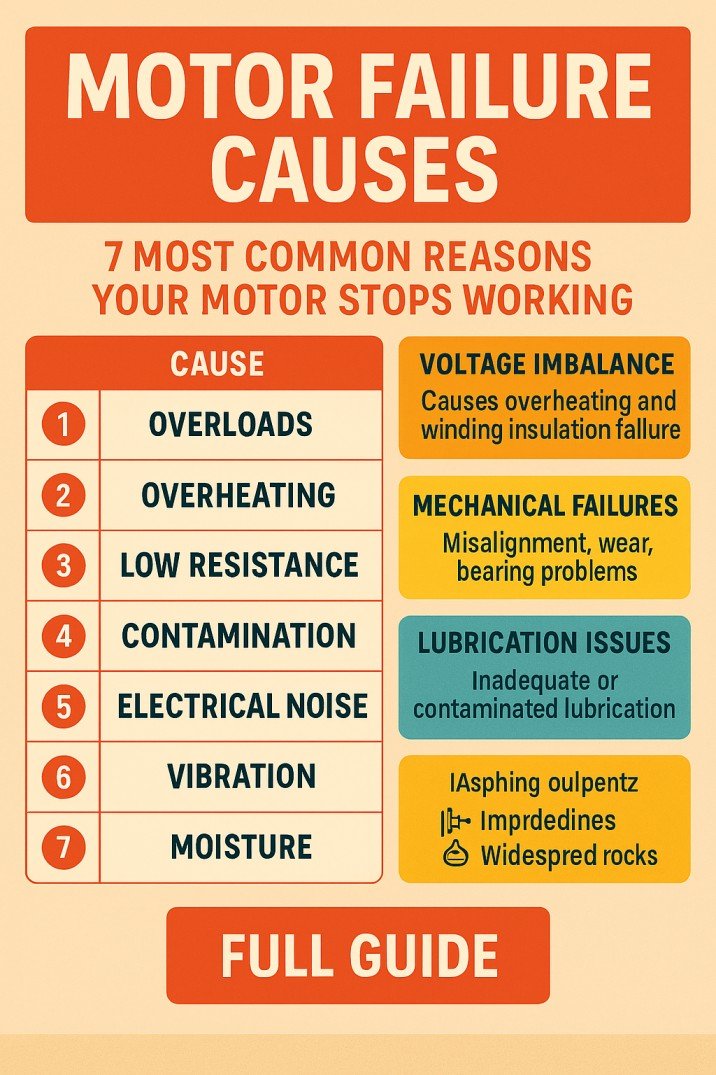
Most induction motor failures fall into two categories: electrical faults and mechanical faults. Environmental and operational issues also contribute significantly.
Electrical Faults
Electrical problems often originate from the power supply or internal winding damage.
- Single phasing
- Voltage imbalance
- Overvoltage or undervoltage
- Insulation breakdown
- Shorted stator windings
- Loose connections
These faults usually result in overheating, excessive current draw, and reduced efficiency.
Mechanical Faults
Mechanical issues are equally common and may not show immediate electrical symptoms.
- Bearing failure
- Shaft misalignment
- Rotor imbalance
- Cooling fan damage
- Coupling defects
Ignoring these problems can eventually damage the stator windings due to excessive vibration and heat.
Know more about VFD vs Soft Starter: Key Differences You Must Know for Motor Control
Electric Motor Troubleshooting Chart for Field Engineers
The following electric motor troubleshooting chart summarizes common symptoms, possible causes, and recommended corrective actions. This structured approach improves accuracy and saves time during breakdown analysis.
Motor Does Not Start
| Symptom | Possible Cause | Corrective Action |
|---|---|---|
| No sound, no rotation | No power supply | Check circuit breaker, fuses, and contactor |
| Humming sound only | Single phasing | Measure line voltage and check phase continuity |
| Trips immediately | Short circuit in windings | Perform insulation resistance test and winding resistance test |
| Shaft locked | Mechanical jam | Inspect bearings and driven load |
Always verify the supply voltage with a calibrated multimeter before opening the motor.
Learn more about servo motor interview questions
Motor Overheating
| Symptom | Possible Cause | Corrective Action |
|---|---|---|
| High surface temperature | Overloading | Measure load current and compare with nameplate rating |
| Uneven heating | Voltage imbalance | Check three-phase voltage balance (should be within 1–2%) |
| Hot bearings | Lack of lubrication | Regrease or replace bearings |
| Burnt smell | Insulation failure | Perform megger test and inspect windings |
Overheating is one of the leading causes of motor failure. The electric motor troubleshooting chart should always include temperature checks using an infrared thermometer.
Excessive Vibration
| Symptom | Possible Cause | Corrective Action |
|---|---|---|
| High vibration at startup | Misalignment | Check alignment with dial gauge or laser tool |
| Continuous vibration | Rotor imbalance | Perform dynamic balancing |
| Noise and vibration | Worn bearings | Replace bearings |
| Foundation movement | Loose mounting bolts | Tighten bolts and check base frame |
Vibration analysis tools can help detect early bearing damage and prevent catastrophic failure.
Find everything about ultrasonic sensor and servo motor
Low Speed or Reduced Torque
| Symptom | Possible Cause | Corrective Action |
|---|---|---|
| Slow acceleration | Low voltage | Measure terminal voltage under load |
| Motor stalls | Overloaded equipment | Reduce mechanical load |
| Speed drop | Broken rotor bars | Conduct rotor test or current signature analysis |
| Poor torque | Incorrect wiring | Verify star-delta connections |
Reduced torque often indicates either supply issues or internal rotor defects.
Step-by-Step Diagnostic Procedure
A troubleshooting process should always follow a logical sequence. The electric motor troubleshooting chart supports the following workflow:
- Visual inspection
- Electrical testing
- Mechanical inspection
- Load evaluation
- Environmental assessment
Start by checking obvious signs such as burnt terminals, loose cables, dust accumulation, or oil leakage. Then measure line voltage, current, and insulation resistance.
Discover everything about servo motor arduino code
For three-phase motors, voltage imbalance should not exceed 2 percent. Even small imbalances can cause a significant rise in temperature. Know everything about 3 Phase Motor Overload Relay Setting – Accurate Protection for Your Motor
Electrical Tests Every Engineer Should Perform
A proper electric motor troubleshooting chart must reference essential tests that confirm suspected faults.
Insulation Resistance Test
Use a megohmmeter to measure resistance between windings and ground. Low values indicate moisture ingress or insulation breakdown.
Winding Resistance Test
Measure phase-to-phase resistance and compare readings. Differences may indicate shorted turns or loose connections.
Current Measurement
Clamp meter readings help identify overload, single phasing, or unbalanced load conditions. Know more about Motor Starter Types: A Powerful Guide with 7 Key Options You’ll Appreciate
Power Quality Check
Harmonics, voltage dips, and frequency variations can affect motor performance. In critical installations, power analyzers are recommended.
Mechanical Inspection Guidelines
Electrical testing alone is not enough. Many motor failures originate from poor mechanical conditions.
Check the following:
- Bearing condition and lubrication
- Shaft alignment
- Coupling wear
- Cooling fan integrity
- Air ventilation path
Blocked ventilation reduces cooling efficiency and leads to insulation damage over time.
Preventive Maintenance Tips
Using an electric motor troubleshooting chart is not limited to breakdown situations. It also supports preventive maintenance programs.
Know more about How does the star delta starter reduce starting current? Important Concepts
Key preventive actions include:
- Periodic insulation testing
- Thermal scanning
- Vibration monitoring
- Proper lubrication schedule
- Cleaning of cooling fins and air passages
- Checking terminal tightness
Keeping detailed maintenance records allows trend analysis and early fault detection.
Environmental Factors Affecting Motor Performance
Operating conditions strongly influence motor lifespan. High ambient temperature, humidity, dust, and corrosive atmospheres accelerate degradation.
Install motors with proper IP rating in dusty or wet environments. In outdoor installations, ensure weather protection and adequate drainage.
Voltage fluctuations in industrial zones can also damage motors. Surge protection devices and voltage stabilizers improve reliability.
Use our online tool Motor Overload Setting Calculator for Single and Three Phase Motors
Safety Considerations During Troubleshooting
Always isolate the motor before inspection. Follow lockout and tagout procedures strictly. Discharge capacitors in single-phase motors before handling terminals.
Wear appropriate personal protective equipment including insulated gloves and safety glasses. Never perform insulation testing on energized circuits.
A safe engineer is an effective engineer.
Know more about Difference Between Star Delta and DOL Starter: A Comprehensive Guide
How to Create a Custom Electric Motor Troubleshooting Chart
Each plant has unique equipment and operating conditions. While the standard electric motor troubleshooting chart covers common faults, customization improves efficiency.
To develop your own chart:
- List critical motors and their ratings
- Document frequent failures
- Record operating parameters
- Add site-specific environmental factors
- Include standard test values
Store the chart in digital and printed format for quick access during emergencies. Know more about Thermal Overload Relay: Working Principle, Types and Important Settings Calculation
Conclusion
An electric motor troubleshooting chart is more than a reference sheet. It is a practical engineering tool that converts symptoms into structured diagnosis and actionable solutions. Whether you are dealing with overheating, vibration, starting problems, or reduced torque, a systematic approach prevents guesswork and minimizes downtime.
Know more about Motor Overload Protection Chart: Important Concepts
By combining electrical testing, mechanical inspection, and preventive maintenance strategies, engineers can extend motor life and improve operational reliability. Implementing a detailed electric motor troubleshooting chart in your facility ensures consistent fault diagnosis, safer maintenance practices, and long-term cost savings.
In modern industrial environments where uptime matters most, structured troubleshooting is not optional. It is a professional standard every engineer should follow.
Follow Us on Social:
Subscribe our Newsletter on Electrical Insights for latest updates from Electrical Engineering Hub
#electricmotortroubleshootingchart, #motortroubleshooting, #electricmotorrepair, #motorfaultdiagnosis, #industrialmaintenance, #threephasemotor, #motormaintenance, #electricalengineering, #motordiagnostics, #maintenanceguide