Busbar Dimensions Calculation: Complete Guide for Accurate Busbar Sizing & Current Capacity
Busbars are a critical part of electrical power distribution systems. They are widely used in switchgear, panel boards, substations, and industrial power systems to carry large currents safely and efficiently. Performing a correct busbar dimensions calculation ensures the conductor can handle the required current without excessive temperature rise, voltage drop, or mechanical failure.
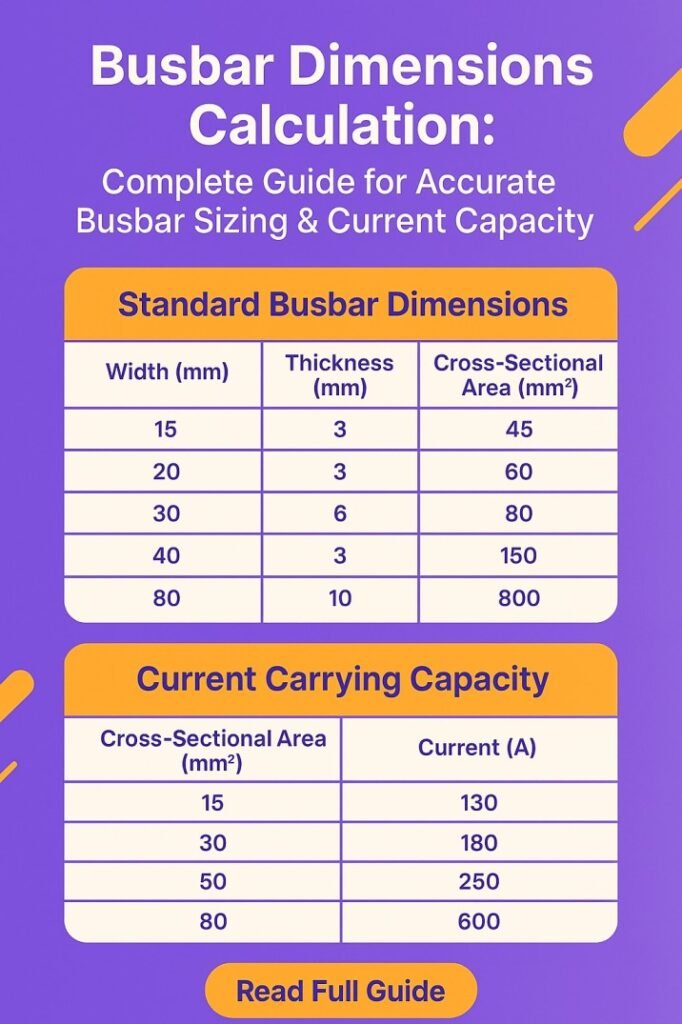
Table of Contents
Improper sizing can lead to overheating, reduced efficiency, insulation damage, and even catastrophic equipment failure. That is why engineers must carefully determine the correct busbar width, thickness, and material based on electrical and thermal requirements.
This guide explains the complete process of busbar sizing, including formulas, current capacity considerations, temperature limits, and practical engineering tables used in real-world electrical design.
Know more about Bus Bar Current Rating Calculation: Practical Method for Accurate Sizing and Load Capacity
What is a Busbar in Electrical Systems?
A busbar is a metallic conductor used to distribute electrical power within electrical equipment. It typically consists of copper or aluminum bars that connect incoming feeders and outgoing circuits.
Busbars are preferred over cables in many applications because they provide:
• Lower electrical resistance
• Better heat dissipation
• Higher current carrying capacity
• Easier installation in switchgear panels
• Improved reliability in power distribution systems
Common locations where busbars are used include:
| Application | Typical Usage |
|---|---|
| Switchgear Panels | Power distribution |
| Electrical Substations | High current connections |
| Motor Control Centers | Multiple feeder distribution |
| Industrial Plants | Heavy load distribution |
| Renewable Energy Systems | Inverters and combiner panels |
Because busbars carry large currents, accurate busbar dimensions calculation becomes essential during electrical design.
Find also about Busbar Sizing Rule of Thumb: Practical Engineer’s Guide for Accurate Panel Busbar Selection
Why Busbar Dimensions Calculation is Important
Determining the correct busbar size is not simply about choosing a large conductor. The design must balance electrical capacity, thermal performance, mechanical strength, and installation space.
A proper calculation ensures:
• Safe current carrying capacity
• Acceptable temperature rise
• Reduced voltage drop
• Long equipment life
• Compliance with electrical standards
If the busbar is undersized, it may overheat and damage insulation or nearby equipment. If it is oversized, it increases cost and panel size unnecessarily.
Therefore, engineers rely on structured busbar dimensions calculation methods to achieve an optimal design.
Key Factors Affecting Busbar Size
Several parameters influence the required busbar dimensions in electrical systems.
Current Carrying Requirement
The most important factor is the maximum current that the busbar must carry continuously.
Find all about Busbar Kg Calculation | Accurate Copper & Aluminum Busbar Weight Formula for Electrical Design
Typical current density values used in engineering practice are:
| Material | Current Density (A/mm²) |
|---|---|
| Copper | 1.2 – 1.6 |
| Aluminum | 0.8 – 1.2 |
These values depend on cooling conditions, enclosure type, and ambient temperature.
Busbar Material
Copper and aluminum are the most commonly used materials.
| Property | Copper Busbar | Aluminum Busbar |
|---|---|---|
| Conductivity | Very High | Moderate |
| Weight | Heavy | Lightweight |
| Cost | Expensive | Economical |
| Mechanical Strength | High | Moderate |
Copper busbars are widely used in switchgear due to their superior conductivity and durability.
Temperature Rise
Busbars heat up due to electrical resistance. Electrical standards typically limit temperature rise to around 30°C to 50°C above ambient temperature.
Proper busbar dimensions calculation ensures that the conductor stays within acceptable thermal limits.
Installation Environment
Cooling conditions significantly influence busbar size.
Examples include:
• Open air installation
• Ventilated electrical panels
• Enclosed switchgear systems
Poor ventilation requires larger busbar dimensions to prevent overheating.
Know more about Busbar Heating Calculation | Important Guide for Electrical Design & Thermal Analysis
Short Circuit Withstand Capability
Electrical Busbars must also withstand mechanical forces during short circuits. High fault currents generate strong electromagnetic forces that can bend or damage the conductor.
Therefore, mechanical strength is also considered during busbar dimensions calculation.
Basic Busbar Dimensions Calculation Formula
The basic formula used by electrical engineers for busbar sizing is based on current density.
Busbar Area (mm²) = Current / Current Density
Where:
• Current is the load current in amperes
• Current Density is selected based on material and cooling conditions
Once the area is calculated, engineers determine the busbar width and thickness.
Busbar Area = Width × Thickness
Example Calculation
Suppose a system carries 800 A using a copper busbar.
Assuming a current density of 1.5 A/mm²
Required Area = 800 / 1.5
Required Area = 533 mm²
Know more about Busbar Distance Calculation – Complete Guide, Formula, Standards & Design Tips
Possible busbar dimension combinations include:
| Width (mm) | Thickness (mm) | Area (mm²) |
|---|---|---|
| 50 | 10 | 500 |
| 60 | 10 | 600 |
| 80 | 8 | 640 |
Engineers typically choose the next larger standard size to ensure safety.
Standard Busbar Sizes Used in Industry
Electrical panel manufacturers commonly use standard dimensions to simplify manufacturing and maintenance.
| Width (mm) | Thickness (mm) | Area (mm²) | Approx Current (Copper) |
|---|---|---|---|
| 25 | 3 | 75 | 100 A |
| 30 | 5 | 150 | 200 A |
| 40 | 5 | 200 | 250 A |
| 50 | 6 | 300 | 400 A |
| 60 | 8 | 480 | 600 A |
| 80 | 10 | 800 | 1000 A |
These values vary depending on enclosure ventilation and ambient temperature.
Find all about Busbar Size Chart in mm
Proper busbar dimensions calculation ensures that selected sizes meet the required load current.
Temperature Rise Considerations
Electrical losses generate heat in busbars due to resistance.
Power Loss Formula:
Power Loss = I² × R
Where:
• I = Current
• R = Resistance of busbar
Higher current results in greater heat generation. If heat is not dissipated properly, busbars may reach unsafe temperatures.
Factors affecting temperature rise include:
• Material conductivity
• Busbar surface area
• Ventilation inside panel
• Spacing between busbars
To control temperature, designers may increase busbar width or use multiple parallel busbars. Find all about Busbar Bending Calculation
Single vs Multiple Busbar Arrangement
For very high currents, using a single large busbar may not be practical. Engineers often install multiple busbars in parallel.
Example configurations:
| Configuration | Total Current Capacity |
|---|---|
| Single 100×10 mm | ~1200 A |
| Two 50×10 mm | ~1200 A |
| Three 40×10 mm | ~1200 A |
Parallel busbars offer advantages such as:
• Better heat dissipation
• Easier installation
• Improved mechanical strength
• Reduced electromagnetic stress
Proper spacing between parallel bars is important for efficient cooling and accurate busbar dimensions calculation.
Find out more about Busbar Stability Test Procedure – Step-by-Step Method to Ensure Safe and Reliable Busbars
Busbar Spacing and Clearance
Electrical safety standards require minimum clearances between busbars and between phases.
Typical values used in switchgear design include:
| Voltage Level | Phase Spacing |
|---|---|
| Up to 415 V | 25 – 40 mm |
| 11 kV | 125 – 160 mm |
| 33 kV | 320 – 360 mm |
Adequate spacing prevents flashover and improves cooling.
These mechanical parameters are also considered during detailed busbar dimensions calculation.
Short Circuit Withstand Calculation
Busbars must tolerate thermal and mechanical stress during short circuit faults.
The short circuit thermal formula is:
S = I √t / k
Where:
• S = Cross sectional area (mm²)
• I = Short circuit current (A)
• t = Fault duration (seconds)
• k = Material constant
Typical constants:
| Material | k Value |
|---|---|
| Copper | 143 |
| Aluminum | 94 |
Engineers verify this condition after completing the basic busbar dimensions calculation to ensure the conductor survives fault conditions.
Find out more about Busbar Size Calculator – Accurate Sizing According to IEC and NEC Standards
Practical Design Tips for Engineers
Experienced electrical designers follow several practical rules when selecting busbar dimensions.
• Always select the next higher standard size after calculation
• Ensure proper ventilation in electrical panels
• Maintain recommended phase spacing
• Use tin plating to prevent oxidation
• Provide adequate busbar supports for mechanical strength
• Consider expansion due to thermal effects
These practices improve reliability and reduce maintenance issues.
Common Mistakes in Busbar Sizing
Many electrical installations face problems due to incorrect sizing.
Common mistakes include:
• Using very high current density
• Ignoring temperature rise limits
• Poor ventilation in panels
• Incorrect short circuit calculations
• Selecting busbars without standard sizing
Find out more about iec 61439 busbar clearance
Avoiding these mistakes ensures that the busbar dimensions calculation results in a safe and reliable electrical distribution system.
Final Thoughts
Busbars are essential components in modern electrical power systems, and their correct sizing directly affects safety, efficiency, and system reliability. A proper busbar dimensions calculation considers electrical current, temperature rise, material properties, short circuit withstand capability, and installation conditions.
By following structured engineering methods and using standard busbar sizes, electrical designers can create robust power distribution systems that operate efficiently for many years. Whether designing industrial switchgear, substations, or renewable energy systems, accurate busbar sizing remains a fundamental requirement in electrical engineering.
Know more about IEC Standard for Busbar Clearance
Follow Us on Social:
Subscribe our Newsletter on Electrical Insights for latest updates from Electrical Engineering Hub
BusbarDimensionsCalculation, #BusbarSizing, #ElectricalEngineering, #SwitchgearDesign, #PowerDistribution, #BusbarCurrentCapacity, #ElectricalPanelDesign, #CopperBusbar, #ElectricalCalculations, #EngineeringTools