
Testing Diode With Multimeter: Step-by-Step Professional Guide for Accurate Electrical Testing & Fault Detection
Testing diode with multimeter is a fundamental skill for electricians, technicians, and electronics enthusiasts who want to ensure circuit reliability and accurate fault detection. A diode controls current flow in one direction, and even a minor failure can disrupt an entire system. Learning the correct method of testing helps prevent unnecessary replacements and saves time during troubleshooting.
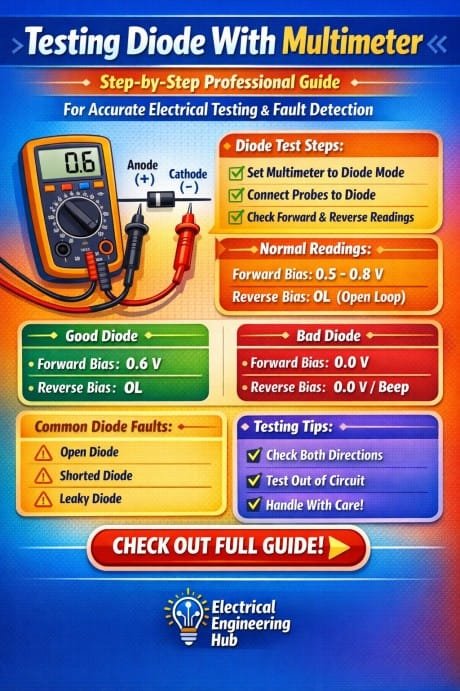
Table of Contents
This guide explains practical techniques, correct multimeter settings, and common mistakes to avoid while testing diode with multimeter in a professional way.
Understanding Diode Function Before Testing
Before starting testing diode with multimeter, it is important to understand how a diode works. A diode allows current to flow from the anode to the cathode while blocking reverse current. This behavior is known as forward bias and reverse bias.
Know more about IEC Standard for MV Cable Testing: Complete Acceptance, Routine & Type Test Guide
In forward bias, the diode conducts electricity and shows a voltage drop. In reverse bias, it blocks current and ideally shows no conduction. These two conditions form the basis of diode testing.
Types of Diodes You May Encounter
Different diode types may show slightly different readings during testing diode with multimeter. Knowing the type helps in interpreting results correctly.
| Diode Type | Typical Forward Voltage | Common Use |
|---|---|---|
| Silicon Diode | 0.6V to 0.7V | General rectification |
| Germanium Diode | 0.2V to 0.3V | Low voltage circuits |
| LED | 1.5V to 3V | Indicators and lighting |
| Schottky Diode | 0.2V to 0.4V | High-speed switching |
| Zener Diode | Varies | Voltage regulation |
Tools Required for Testing
Testing diode with multimeter does not require complex tools. A few basic items are enough to perform accurate checks.
- Digital multimeter with diode mode
- Analog multimeter if digital is not available
- Basic safety gloves for protection
- Circuit diagram if testing in-circuit
A digital multimeter is preferred because it provides precise voltage readings and easier interpretation.
Know more about Transformer Oil Testing: 9 Important Tests for Healthiness
Step-by-Step Process for Testing Diode With Multimeter
Testing diode with multimeter becomes simple when performed in a structured way. Follow these steps carefully for reliable results.
Step 1: Set the Multimeter
Turn the dial to diode testing mode. This mode usually has a diode symbol. If not available, you can use resistance mode, though it is less accurate.
Step 2: Identify Diode Terminals
Locate the anode and cathode. The cathode is usually marked with a stripe on the diode body.
Step 3: Forward Bias Testing
Place the red probe on the anode and the black probe on the cathode. A healthy diode will show a voltage drop within the expected range.
Step 4: Reverse Bias Testing
Reverse the probes by placing the black probe on the anode and the red probe on the cathode. The multimeter should show OL or no reading.
Step 5: Analyze the Results
Compare the readings with standard values. This helps determine whether the diode is functioning correctly or not.
Know more about Types of Circuit Breaker Testing
Expected Readings Table
Understanding readings is critical when testing diode with multimeter. The table below simplifies interpretation.
| Condition | Multimeter Reading | Diode Status |
|---|---|---|
| Forward Bias | 0.6V to 0.7V (silicon) | Good diode |
| Reverse Bias | OL or no reading | Good diode |
| Both directions | 0V or very low | Shorted diode |
| Both directions | OL | Open diode |
Testing Diode in Circuit vs Out of Circuit
Testing diode with multimeter can be done either inside the circuit or after removing it.
In-circuit testing is faster but may give false readings due to parallel components. Out-of-circuit testing provides more accurate results since the diode is isolated.
If you get inconsistent readings, it is better to remove one leg of the diode from the circuit and test again.
Common Mistakes to Avoid
Even simple procedures like testing diode with multimeter can lead to wrong conclusions if done incorrectly. Avoid these common errors.
- Testing without isolating power supply
- Misidentifying anode and cathode
- Ignoring diode type differences
- Using incorrect multimeter settings
- Not checking both forward and reverse bias
Paying attention to these details improves accuracy and prevents misdiagnosis.
Know more about Earth Fault Relay Testing Procedure
Advanced Tips for Accurate Testing
Professionals follow a few extra steps while testing diode with multimeter to ensure precision.
- Always calibrate the multimeter before use
- Test multiple diodes to compare readings
- Use datasheets for exact voltage drop values
- Check temperature influence on readings
- Use continuity mode as a quick pre-check
These practices help in diagnosing subtle faults that may not be visible in basic testing.
When to Replace a Diode
Testing diode with multimeter helps determine whether replacement is necessary. Replace the diode if:
- It shows conduction in both directions
- It does not conduct at all
- The forward voltage is significantly out of range
- The circuit performance is unstable despite correct readings
Replacing faulty diodes early prevents further damage to connected components.
Know more about Earth Fault Relay Testing Procedure
Practical Applications in Electrical Systems
Testing diode with multimeter is widely used in various applications.
- Power supply troubleshooting
- Solar panel junction box testing
- Battery charging circuits
- Inverter and UPS systems
- Automotive electrical diagnostics
In solar systems, for example, a faulty diode can reduce efficiency or cause reverse current flow, making testing essential for performance maintenance.
Safety Considerations During Testing
Safety should always be a priority while testing diode with multimeter.
- Ensure the circuit is powered off
- Discharge capacitors before testing
- Avoid touching exposed terminals
- Use insulated probes
- Work in a dry environment
Following these precautions reduces the risk of electrical hazards.
Know more about Best Transformer Testing Companies in Canada | Trusted Electrical Testing Experts & Utility Service Providers
Conclusion
Testing diode with multimeter is a simple yet powerful technique for ensuring the health of electronic circuits. By understanding diode behavior, using the correct method, and interpreting readings accurately, you can identify faults quickly and maintain system reliability.
With consistent practice and attention to detail, testing becomes faster and more precise. Whether you are working on industrial equipment, solar installations, or small electronic devices, mastering testing diode with multimeter is an essential skill that improves efficiency and reduces downtime. Know more about Top 20 Electrical Testing Tools Which You Must Have
Follow Us on Social:
Subscribe our Newsletter on Electrical Insights for latest updates from Electrical Engineering Hub
#TestingDiode,#DiodeTesting,#MultimeterUse,#ElectronicsRepair,#ElectricalTesting,#DIYElectronics,#DigitalMultimeter,#CircuitTesting,#ElectronicsBasics,#MeasureDiode