IEEE Standard For The Testing Of Microgrid Controllers | Complete Guide to Compliance, Validation & Smart Grid Performance Testing
The ieee standard for the testing of microgrid controllers plays a critical role in ensuring reliable, safe, and efficient operation of modern distributed energy systems. As microgrids become more common in renewable energy integration, industries and utilities depend on standardized testing methods to verify controller performance under real and simulated conditions.
The ieee standard for the testing of microgrid controllers defines how these systems should be evaluated for stability, interoperability, and response accuracy in both grid-connected and islanded modes.
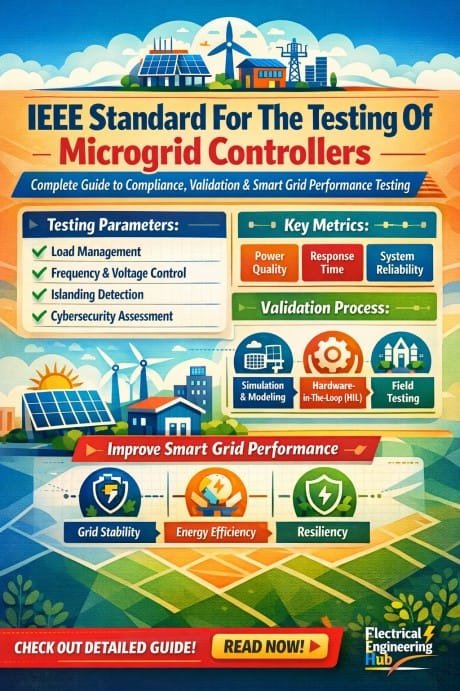
Table of Contents
In recent years, the adoption of solar PV, battery energy storage systems (BESS), and hybrid renewable setups has increased significantly. This has made controller validation more important than ever. Engineers and system integrators rely on structured testing frameworks to ensure smooth coordination between distributed energy resources (DERs), loads, and the main grid.
Find all about IEEE Standard for Insulation Resistance Test
Understanding Microgrid Controller Testing Standards
The ieee standard for the testing of microgrid controllers provides a structured approach for evaluating control systems used in microgrids. These controllers act as the brain of the system, managing power flow, voltage regulation, frequency stability, and load balancing.
In practical deployment, these standards ensure that controllers respond correctly to disturbances such as sudden load changes or grid outages. Without standardized testing, performance inconsistencies can lead to instability or even system failure. The ieee standard for the testing of microgrid controllers also helps manufacturers benchmark their solutions against globally accepted criteria.
Microgrid controllers are tested for multiple operational scenarios, including renewable variability, black start capability, and seamless switching between grid-connected and islanded modes. These tests ensure that systems remain resilient under unpredictable conditions.
Key Compliance Requirements in IEEE Framework
The ieee standard for the testing of microgrid controllers outlines several compliance requirements that manufacturers and integrators must follow. These include functional performance, communication reliability, and cybersecurity readiness.
Know more about IEEE Standard for Instrument Transformers
The framework ensures that controllers support real-time monitoring and advanced energy management functions. It also emphasizes compatibility with communication protocols such as IEC 61850, DNP3, and Modbus.
Below is a simplified overview of compliance areas:
| Compliance Area | Description |
|---|---|
| Functional Testing | Validates control logic, load sharing, and grid response |
| Interoperability Testing | Ensures compatibility with DERs and SCADA systems |
| Cybersecurity Assessment | Evaluates protection against unauthorized access |
| Performance Validation | Measures response time, stability, and efficiency |
| Communication Testing | Confirms protocol accuracy and data integrity |
The ieee standard for the testing of microgrid controllers ensures that each of these areas is tested under controlled and repeatable conditions. This reduces risks during real-world deployment and improves system reliability across diverse environments.
Testing Methodologies for Microgrid Controllers
The ieee standard for the testing of microgrid controllers defines several testing methodologies used to evaluate system behavior under different scenarios. These include functional testing, dynamic response testing, and interoperability verification.
Explore all about IEEE Standard for Cable Insulation Resistance Test
Functional testing focuses on verifying whether the controller performs its basic tasks correctly. Dynamic testing evaluates system response during sudden changes such as load shedding or renewable fluctuations. Interoperability testing ensures seamless communication between different energy assets.
The ieee standard for the testing of microgrid controllers is particularly important in hybrid renewable systems where solar, wind, and storage must operate in coordination.
| Test Type | Purpose |
|---|---|
| Functional Testing | Validates core controller logic |
| Dynamic Response Testing | Measures reaction to disturbances |
| Interoperability Testing | Ensures multi-vendor compatibility |
| Cybersecurity Testing | Checks system resilience against threats |
| Performance Benchmarking | Evaluates efficiency under load |
These methodologies ensure that controllers are capable of maintaining grid stability even under fluctuating renewable input conditions. Engineers use simulation tools and real-world test beds to replicate complex scenarios.
Hardware-in-the-Loop (HIL) Simulation Approach
The ieee standard for the testing of microgrid controllers strongly supports the use of Hardware-in-the-Loop (HIL) simulation for advanced validation. HIL testing allows engineers to connect actual controller hardware with simulated grid environments.
This approach helps in evaluating real-time behavior without risking actual grid infrastructure. It is widely used for testing extreme conditions such as faults, voltage dips, and frequency deviations.
In HIL setups, digital models simulate renewable sources, loads, and grid disturbances while the physical controller responds in real time. The ieee standard for the testing of microgrid controllers ensures that these simulations are accurate and repeatable for certification purposes.
Know more about IEEE Standard for Contact Resistance
HIL testing is especially useful for verifying black start operations and islanding transitions, which are critical for microgrid resilience. It also reduces development time and improves system confidence before field deployment.
Validation and Certification Process
The ieee standard for the testing of microgrid controllers defines a clear validation process that ensures controllers meet performance expectations before deployment. This process includes planning, simulation, execution, and final certification.
Validation begins with defining test cases based on expected operating conditions. Engineers then simulate grid behavior using software tools and hardware setups. After testing, results are analyzed to confirm compliance with performance thresholds.
The ieee standard for the testing of microgrid controllers ensures that validation is not limited to lab conditions but also includes field performance checks. This helps bridge the gap between theoretical design and real-world application.
Common Challenges in Controller Testing
The ieee standard for the testing of microgrid controllers highlights several challenges that engineers often face during testing and implementation. One major challenge is the integration of multi-vendor systems, where devices from different manufacturers must communicate seamlessly.
Find all about IEEE Standard for Short Circuit Calculation
Another challenge is handling intermittent renewable energy sources, which introduce variability into system behavior. Cybersecurity threats also add complexity to testing environments, requiring continuous updates to protection strategies.
In many cases, simulation accuracy can also be a limitation. If models do not accurately represent real-world conditions, test results may not reflect actual performance. The ieee standard for the testing of microgrid controllers addresses these issues by promoting standardized test environments and repeatable procedures.
Best Practices for Reliable Testing and Implementation
The ieee standard for the testing of microgrid controllers encourages several best practices to ensure consistent performance and reliability. These practices help engineers achieve better accuracy and system stability during deployment.
Key recommendations include:
- Using standardized simulation tools for consistency
- Conducting multi-stage testing from lab to field
- Ensuring cybersecurity validation at every stage
- Maintaining detailed test documentation
- Performing stress testing under extreme conditions
Know more about IEC Standard for Neutral to Earth Voltage – Limits, Measurement & Safety Guidelines
Following these practices helps reduce operational risks and improves long-term system performance. The ieee standard for the testing of microgrid controllers ensures that such practices are integrated into every phase of system development and deployment.
Standards Mapping and Technical Reference
To better understand how microgrid controller testing aligns with global standards, the following table provides a simplified mapping:
| IEEE/Industry Standard | Focus Area |
|---|---|
| IEEE 2030.7 | Microgrid controller functional requirements |
| IEEE 2030.8 | Microgrid controller testing and validation |
| IEC 61850 | Communication protocols in smart grids |
| IEEE 1547 | Interconnection of distributed energy resources |
| NERC CIP | Cybersecurity standards for power systems |
The ieee standard for the testing of microgrid controllers works in coordination with these frameworks to ensure full system compatibility and safety across power networks.
Find all about IEC Standard for Relay Testing: Best Guide
Conclusion
The ieee standard for the testing of microgrid controllers is essential for ensuring that modern energy systems operate safely, efficiently, and reliably. As microgrids continue to expand with renewable integration, standardized testing becomes a foundation for system stability and interoperability.
From simulation-based validation to real-world performance testing, these electrical standards provide a complete framework for engineers and utilities. The ieee standard for the testing of microgrid controllers ensures that every controller meets strict performance benchmarks before deployment, reducing risks and improving energy resilience in smart grid environments. Know all about ieee and iec standards
Follow Us on Social:
Subscribe our Newsletter on Electrical Insights for latest updates from Electrical Engineering Hub
IEEEMicrogrid, #MicrogridControllers, #PowerSystems, #SmartGridTechnology, #RenewableEnergy, #GridStability, #ElectricalEngineering, #PowerSystemProtection, #EnergyAutomation, #IEEEStandards