IEEE Standard for Short Circuit Calculation: Important Guide for Accurate Fault Analysis & Compliance
Accurate fault analysis is the backbone of any reliable electrical power system. Whether you are designing an industrial facility, managing a utility network, or installing a solar hybrid system, understanding the IEEE standard for short circuit calculation is essential. It ensures safety, proper equipment selection, and regulatory compliance while minimizing the risk of catastrophic failures.
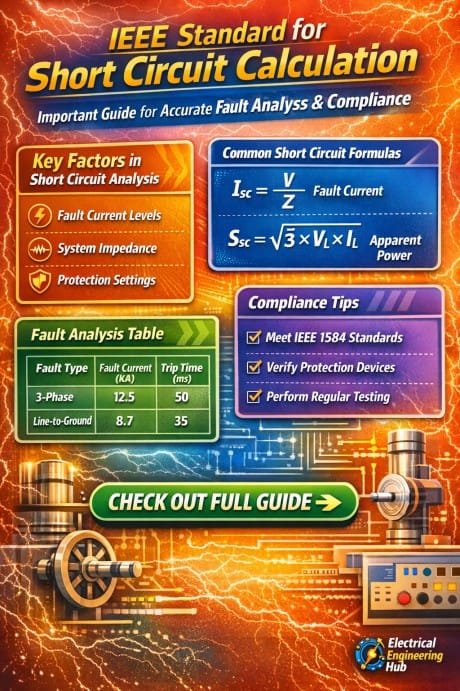
Table of Contents
This guide explains the core principles, methodology, and practical application of the IEEE standard for short circuit calculation in a clear and professional manner. It is designed for engineers, technicians, and decision-makers who want precise and compliant results without unnecessary complexity.
What is Short Circuit Calculation?
Short circuit calculation is the process of determining the magnitude of current that flows during a fault condition in an electrical system. These faults may include:
- Three-phase faults
- Line-to-line faults
- Line-to-ground faults
- Double line-to-ground faults
The results help engineers select appropriate protective devices, verify equipment ratings, and ensure system stability.
Without proper fault current analysis, systems may experience equipment damage, fire hazards, or complete failure.
Find all about BS 7671 Wiring Regulations: Expert Guide to Compliance, Safety, and Practical Applications
Overview of IEEE Standard for Short Circuit Calculation
The IEEE standard for short circuit calculation primarily refers to IEEE Std 551 (Violet Book) and IEEE Std 399 (Brown Book), along with updates integrated into IEEE 3000 series standards. These documents define methods for calculating fault currents in industrial and commercial power systems.
The standard provides:
- Calculation procedures for different fault types
- Guidelines for modeling system components
- Correction factors for real-world conditions
- Recommendations for compliance and safety
It is widely accepted across industries due to its accuracy and adaptability.
Why IEEE Standards Are Important
Using the IEEE standard for short circuit calculation ensures consistency and reliability in engineering practices. It also aligns your system design with international benchmarks.
Key benefits include:
- Improved safety margins
- Accurate equipment sizing
- Better coordination of protection systems
- Compliance with regulatory authorities
- Reduced risk of system downtime
Ignoring standard-based calculations often leads to under-rated equipment or excessive investment in oversized components.
Know more about IEC Standard for MV Cable Testing: Complete Acceptance, Routine & Type Test Guide
Key Parameters in Short Circuit Analysis
To perform calculations correctly, several parameters must be considered. These variables directly influence the fault current magnitude.
| Parameter | Description | Impact on Fault Current |
|---|---|---|
| System Voltage | Operating voltage level | Higher voltage increases fault current |
| Source Impedance | Utility or generator impedance | Lower impedance increases fault current |
| Transformer Impedance | % impedance of transformers | Higher impedance reduces fault current |
| Cable Impedance | Resistance and reactance of cables | Longer cables reduce fault current |
| Motor Contribution | Current from running motors | Adds to total fault current |
| X/R Ratio | Reactance to resistance ratio | Affects peak asymmetrical current |
Understanding these parameters is essential when applying the IEEE standard for short circuit calculation in real projects.
Types of Faults Covered in IEEE Calculations
The IEEE methodology considers multiple fault conditions to ensure comprehensive analysis.
Three-Phase Fault
- Most severe type of fault
- Used for equipment rating
- Produces maximum symmetrical current
Know more about IEC Standard for Insulation Resistance Test – Procedures, Limits & Best Practices Explained
Line-to-Ground Fault
- Most common fault in real systems
- Depends on grounding method
- Requires sequence network analysis
Line-to-Line Fault
- Less severe than three-phase faults
- Occurs due to insulation failure
Double Line-to-Ground Fault
- Combination of line and ground fault
- Requires complex calculations
Each fault type must be analyzed to fully comply with the IEEE standard for short circuit calculation. Know more about IEC Standard for Earthing System
Calculation Methodology
The IEEE approach follows a structured process. It ensures that all influencing factors are considered systematically.
Step 1: System Modeling
Create a single-line diagram including:
- Utility source
- Transformers
- Generators
- Cables and busbars
- Loads and motors
Step 2: Convert to Per Unit System
Per unit (PU) system simplifies calculations by normalizing values. It allows easier comparison across different voltage levels.
Step 3: Determine Impedances
Calculate or obtain:
- Source impedance
- Transformer impedance
- Line impedance
- Equipment impedance
Step 4: Apply Fault Equations
Use standard formulas based on fault type. For example:
- Three-phase fault current
- Sequence component method for unsymmetrical faults
Know more about Phase to Phase Clearance as per IEC 61439: Best Guide
Step 5: Apply Correction Factors
IEEE recommends adjustments for:
- Voltage variation
- Temperature effects
- Motor contribution decay
Know more about What Provides Short Circuit Protection for the Motor
Step 6: Calculate Symmetrical and Asymmetrical Currents
- Symmetrical current: steady-state RMS value
- Asymmetrical current: includes DC offset
These values are critical for breaker selection and protection design.
Typical Short Circuit Calculation Table
Below is a simplified example used in engineering practice.
| Bus Location | Voltage (kV) | Fault Type | Symmetrical Current (kA) | X/R Ratio | Peak Current (kA) |
|---|---|---|---|---|---|
| Main Bus | 11 | 3-Phase | 25 | 10 | 63 |
| Motor Bus | 0.4 | L-G | 18 | 7 | 42 |
| Distribution Panel | 0.4 | L-L | 12 | 6 | 28 |
Such tables help engineers quickly evaluate system strength and protection requirements.
Know more about Fault Current and Short Circuit Current: A Quick Guide
Equipment Rating and Selection
One of the main objectives of the IEEE standard for short circuit calculation is to ensure that all equipment can safely withstand fault conditions.
Important considerations include:
- Circuit breaker interrupting capacity
- Busbar withstand rating
- Transformer thermal limits
- Cable short circuit rating
If calculated fault current exceeds equipment rating, immediate redesign is required.
Use our online tool electricity load calculator in kw for home
Role of Software in Short Circuit Analysis
Modern engineering relies heavily on simulation tools. Software like ETAP, SKM, and PowerWorld simplifies the application of the IEEE standard for short circuit calculation.
Advantages of using software:
- Faster calculations
- Reduced human error
- Easy scenario analysis
- Automatic report generation
However, engineers must still understand the underlying principles to validate results. Know more about What is the Maximum Value for Short Circuit Protection for Multi-Motor Branch Circuits
Compliance and Safety Requirements
Compliance with IEEE standards is often linked with other international standards such as:
- IEC 60909
- NFPA 70 (NEC)
- ANSI standards
Following the IEEE standard for short circuit calculation ensures:
- Safe system operation
- Legal compliance
- Insurance approval
- Reduced liability risks
Safety audits frequently require documented fault analysis reports.
Explore details on iec standard for underground cable laying
Common Mistakes to Avoid
Even experienced engineers can make errors during fault calculations. Avoiding these mistakes improves accuracy.
- Ignoring motor contribution
- Using incorrect base values in PU system
- Neglecting cable impedance
- Assuming constant voltage under fault
- Overlooking X/R ratio impact
Careful verification at each step is essential.
Practical Application in Industry
The IEEE standard for short circuit calculation is widely used across different sectors. Know more about Short Circuit Calculation Methods: IEC vs ANSI
Industrial Plants
- Protect heavy machinery
- Ensure continuity of operations
Power Distribution Networks
- Maintain grid stability
- Coordinate protection systems
Learn more about earthing cable size as per iec
Renewable Energy Systems
- Analyze inverter fault contribution
- Design hybrid systems safely
Commercial Buildings
- Protect occupants and equipment
- Ensure compliance with safety codes
Each application requires precise and tailored calculations. Use our online tool Short Circuit Current Calculator: Best Tool
Future Trends in Fault Analysis
With the integration of smart grids and renewable energy, fault analysis is evolving rapidly.
Emerging trends include:
- Real-time fault monitoring
- AI-assisted system modeling
- Advanced simulation tools
- Integration with IoT devices
Start using our online tool today — it’s free Transformer Short Circuit Calculator – Accurate Fault Current & Transformer Protection Tool
Despite these advancements, the IEEE standard for short circuit calculation remains a foundational reference for all modern systems.
Conclusion
The IEEE standard for short circuit calculation is an essential tool for accurate fault analysis and system design. It provides a structured, reliable, and widely accepted methodology for evaluating fault currents in electrical systems.
By understanding its principles and applying them correctly, engineers can ensure safety, optimize equipment selection, and achieve full compliance with international standards. Whether working on industrial installations or modern renewable systems, mastering this standard is a critical step toward building efficient and resilient power networks.
Use our online tool Short Circuit Current Calculator for Motors: Best Tool
Follow Us on Social:
Subscribe our Newsletter on Electrical Insights for latest updates from Electrical Engineering Hub
IEEEShortCircuitCalculation, #ShortCircuitAnalysis, #PowerSystemProtection, #ElectricalEngineering, #FaultCalculation, #IEEEStandards, #PowerEngineering, #ElectricalDesign, #ProtectionSystems, #GridSafety