
NEMA Standard for Cable Tray: Complete Compliance Guide, Types, Load Ratings & Installation Practices
The nema standard for cable tray is a critical benchmark for designing, selecting, and installing cable tray systems in industrial and commercial environments. It ensures safety, structural integrity, and long-term performance under various operating conditions. Whether you are planning a new electrical installation or upgrading an existing system, understanding these standards helps you make informed decisions and stay compliant with industry requirements.
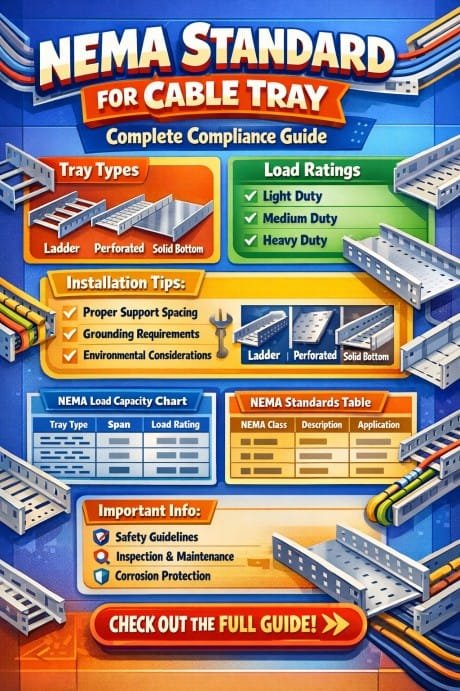
Table of Contents
What is the NEMA Standard for Cable Tray?
The nema standard for cable tray is defined under NEMA VE 1 and NEMA VE 2 guidelines. These standards are developed by the National Electrical Manufacturers Association to regulate the manufacturing and installation practices of cable tray systems.
NEMA VE 1 focuses on the metal cable tray systems, including their construction, materials, and performance requirements. NEMA VE 2 provides installation guidelines to ensure proper support, spacing, and safety during deployment.
Know more about IEC Standard for Neutral to Earth Voltage – Limits, Measurement & Safety Guidelines
These standards are widely recognized in electrical engineering, particularly in power plants, oil and gas facilities, and commercial buildings.
Key Objectives of NEMA Cable Tray Standards
Understanding the purpose behind the nema standard for cable tray helps in practical implementation. The main objectives include:
- Ensuring structural strength and load-bearing capacity
- Providing uniform manufacturing specifications
- Enhancing electrical safety and grounding
- Supporting efficient cable management systems
- Maintaining consistency across projects
By following these objectives, engineers can reduce system failures and improve operational reliability.
Types of Cable Trays as per NEMA
The nema standard for cable tray classifies cable trays into several types based on design and application. Each type serves a specific purpose depending on the environment and cable load.
| Cable Tray Type | Description | Common Applications |
|---|---|---|
| Ladder Tray | Consists of two side rails with rungs | Heavy power cables, industrial plants |
| Perforated Tray | Ventilated bottom with holes | Medium-duty cable installations |
| Solid Bottom Tray | Flat base without openings | Sensitive cables requiring protection |
| Wire Mesh Tray | Lightweight and flexible | Data centers, IT installations |
| Channel Tray | Narrow width tray | Limited cable runs |
Selecting the correct type ensures compliance with the nema standard for cable tray while optimizing performance and cost.
Find all about Capacitor Bank Sizing for Power Factor Correction – Step by Step
Load Ratings and Classification
Load rating is a crucial aspect of the nema standard for cable tray. It determines how much weight a tray can safely support over a given span.
Load Classes Defined by NEMA
| Load Class | Load Capacity (lbs/ft) | Typical Use Case |
|---|---|---|
| 8A | 50 lbs/ft | Light instrumentation cables |
| 12B | 75 lbs/ft | Medium electrical loads |
| 20C | 100 lbs/ft | Industrial applications |
| 25D | 200 lbs/ft | Heavy-duty power cables |
These classifications are based on standard support spans, usually ranging from 8 to 20 feet. The nema standard for cable tray ensures that trays are tested under real-world conditions before certification.
Material Specifications and Finishes
Material selection plays a major role in compliance with the nema standard for cable tray. The most commonly used materials include:
- Galvanized steel for general indoor use
- Aluminum for lightweight and corrosion resistance
- Stainless steel for harsh environments
- FRP (Fiber Reinforced Plastic) for chemical industries
Each material is tested for durability, corrosion resistance, and mechanical strength under the nema standard for cable tray.
Find all about IEC Standard for Relay Testing: Best Guide
Installation Practices as per NEMA VE 2
Proper installation is as important as selecting the right tray. The nema standard for cable tray provides detailed guidelines for installation practices.
Key Installation Guidelines
- Maintain proper support spacing based on load ratings
- Ensure proper grounding and bonding of trays
- Avoid overloading beyond rated capacity
- Provide expansion joints for thermal movement
- Maintain safe cable fill limits
Following these practices ensures system longevity and compliance with safety standards.
Cable Fill Capacity and Spacing
Cable fill capacity is another critical requirement under the nema standard for cable tray. Overfilling can lead to overheating and system failure.
| Tray Type | Maximum Fill Capacity |
|---|---|
| Ladder Tray | Up to 50% fill |
| Solid Bottom | 40% fill |
| Wire Mesh | 50% fill |
Maintaining proper spacing between cables also improves heat dissipation and reduces electromagnetic interference.
Find all about BS 7671 Wiring Regulations: Expert Guide to Compliance, Safety, and Practical Applications
Grounding and Bonding Requirements
Grounding is essential for electrical safety. The nema standard for cable tray outlines requirements for effective grounding and bonding of metallic trays.
- Use bonding jumpers at expansion joints
- Ensure continuity across tray sections
- Connect trays to the main grounding system
- Use listed grounding hardware
These practices reduce the risk of electrical faults and improve system reliability. Know all about ieee and iec standards
Advantages of Following NEMA Standards
Adhering to the nema standard for cable tray offers several advantages:
- Improved safety and compliance
- Enhanced durability of cable systems
- Reduced maintenance costs
- Better load management
- Standardized design approach
These benefits make NEMA standards a preferred choice in modern electrical infrastructure.
Common Mistakes to Avoid
Even with proper guidelines, certain mistakes can lead to non-compliance with the nema standard for cable tray.
- Ignoring load calculations
- Using incorrect support spacing
- Overfilling cable trays
- Improper grounding practices
- Selecting unsuitable materials
Avoiding these issues ensures smooth project execution and long-term performance.
Know more about IEC Standard for MV Cable Testing: Complete Acceptance, Routine & Type Test Guide
NEMA vs Other Standards
While the nema standard for cable tray is widely used, other standards like IEC and BS are also applicable in different regions.
| Standard | Region | Key Focus |
|---|---|---|
| NEMA | USA & global projects | Load ratings, construction |
| IEC | Europe & Asia | Electrical performance |
| BS | UK | Installation practices |
Understanding these differences helps in selecting the appropriate standard for your project.
Final Thoughts
The nema standard for cable tray serves as a comprehensive framework for designing and installing efficient cable management systems. From selecting the right type to ensuring proper load capacity and installation practices, every aspect is covered to maintain safety and performance.
Know more about IEC Standard for Insulation Resistance Test – Procedures, Limits & Best Practices Explained
By following these guidelines, engineers and contractors can build reliable systems that meet international quality standards. Whether you are working on a small commercial project or a large industrial facility, adherence to the nema standard for cable tray ensures long-term success and operational efficiency.
Follow Us on Social:
Subscribe our Newsletter on Electrical Insights for latest updates from Electrical Engineering Hub
#NEMAStandardForCableTray, #CableTrayStandards, #ElectricalEngineering, #CableManagement, #IndustrialElectrical, #NEMAGuidelines, #ElectricalDesign, #PowerDistribution, #EngineeringStandards, #ElectricalInstallation