IEC Standard for RCCB: Complete Guide to Compliance, Testing & Selection
Residual Current Circuit Breakers (RCCBs) are essential safety devices used in modern electrical systems to protect against electric shock and leakage currents. Understanding the iec standard for rccb is critical for engineers, electricians, and facility managers who want to ensure safety, compliance, and system reliability. This guide explains the standards, testing methods, and proper selection of RCCBs in a practical and professional manner.
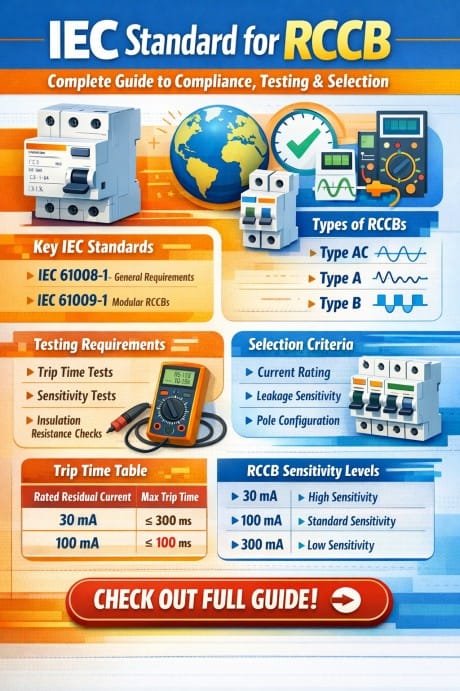
Table of Contents
What is an RCCB?
An RCCB is a protective device designed to disconnect a circuit when it detects an imbalance between phase and neutral currents. This imbalance usually indicates leakage current flowing through an unintended path, such as a human body.
Unlike MCBs, RCCBs do not provide overload or short circuit protection. Their main role is protection against earth leakage and electric shock.
Overview of IEC Standard for RCCB
The iec standard for rccb defines the design, performance, and testing requirements for RCCBs to ensure safe operation. The primary standard governing RCCBs is:
- IEC 61008 – Residual current operated circuit-breakers without integral overcurrent protection
This standard ensures that RCCBs meet strict safety and performance benchmarks across different applications.
Know more about Difference Between GFCI and ELCB
Key Parts of IEC 61008
| Standard Part | Description |
|---|---|
| IEC 61008-1 | General rules and requirements |
| IEC 61008-2-1 | Applicability for RCCBs independent of line voltage |
| IEC 61008-2-2 | Functionality depending on line voltage |
The iec standard for rccb ensures uniformity in manufacturing and performance worldwide, making it easier to select reliable devices.
Types of RCCBs as per IEC Standards
RCCBs are classified based on the type of residual current they detect. The iec standard for rccb defines these types clearly.
RCCB Types
| Type | Application | Sensitivity |
|---|---|---|
| Type AC | Pure AC leakage currents | Basic residential use |
| Type A | Pulsating DC and AC | Appliances with electronics |
| Type F | Mixed frequency leakage | Variable speed drives |
| Type B | Smooth DC and AC | EV chargers, solar systems |
Choosing the correct type is essential for compliance with the iec standard for rccb and for ensuring effective protection.
Know more about Ground Fault Protection vs Earth Leakage Protection
Rated Parameters Defined by IEC
The iec standard for rccb specifies important electrical ratings that must be considered during selection.
Important Ratings
| Parameter | Description |
|---|---|
| Rated Current (In) | Maximum continuous current |
| Rated Residual Current (IΔn) | Tripping sensitivity |
| Rated Voltage | Operating voltage |
| Breaking Capacity | Fault current handling capability |
Typical RCCB sensitivities include:
- 30 mA for personal protection
- 100 mA or 300 mA for fire protection
These values are standardized under the iec standard for rccb to ensure consistent safety levels.
Testing Requirements for RCCBs
Testing is a critical part of compliance. The iec standard for rccb outlines strict procedures to verify performance and reliability.
Key Tests
| Test Type | Purpose |
|---|---|
| Residual Current Test | Ensures correct tripping at leakage current |
| Time Delay Test | Verifies tripping time |
| Mechanical Endurance Test | Confirms durability |
| Temperature Rise Test | Checks thermal performance |
| Dielectric Strength Test | Ensures insulation reliability |
Each RCCB must pass these tests before certification. Following the iec standard for rccb guarantees that the device performs reliably under real-world conditions.
Know more about Circuit Breaker Sizing Guide for Electric Water Heaters
Tripping Characteristics as per IEC
The tripping time of RCCBs is crucial for safety. The iec standard for rccb defines maximum allowable disconnection times.
Tripping Time Limits
| Residual Current | Maximum Trip Time |
|---|---|
| 1 × IΔn | ≤ 300 ms |
| 2 × IΔn | ≤ 150 ms |
| 5 × IΔn | ≤ 40 ms |
Fast tripping reduces the risk of electric shock and equipment damage. Compliance with the iec standard for rccb ensures these limits are maintained.
Installation Guidelines
Proper installation is just as important as selecting the right device. The iec standard for rccb provides general guidance for safe installation.
Best Practices
- Install RCCB in distribution boards close to load circuits
- Ensure proper earthing system is in place
- Avoid mixing neutral connections across circuits
- Use RCCB with MCB for complete protection
- Test RCCB periodically using test button
Following these guidelines ensures that the RCCB operates according to the iec standard for rccb.
Know more about Types of Circuit Breaker Testing
How to Select the Right RCCB
Selecting the correct RCCB depends on application, load type, and safety requirements. The iec standard for rccb serves as a reference for making the right choice.
Selection Criteria
| Factor | Recommendation |
|---|---|
| Application | Residential, commercial, industrial |
| Sensitivity | 30 mA for human safety |
| Type | A or B for modern electronics |
| Rated Current | Based on load calculation |
| Environment | Consider temperature and humidity |
For example, in homes, a 30 mA Type A RCCB is usually preferred, while industrial setups may require Type B devices. Following the iec standard for rccb ensures proper selection and compliance.
Common Mistakes to Avoid
Even experienced professionals can make mistakes when dealing with RCCBs. Understanding the iec standard for rccb helps avoid these issues.
- Using RCCB as overload protection
- Selecting incorrect sensitivity
- Improper neutral wiring
- Ignoring periodic testing
- Using Type AC in modern electronic loads
Know more about Residual Current Devices Examples
Avoiding these mistakes improves both safety and system performance.
Importance of Compliance
Compliance with the iec standard for rccb is not just a regulatory requirement. It directly impacts safety, reliability, and system efficiency.
Benefits of Compliance
- Enhanced protection against electric shock
- Reduced fire risk due to leakage currents
- Improved equipment lifespan
- International acceptance and reliability
Adhering to the iec standard for rccb ensures that installations meet global safety benchmarks.
Conclusion
Understanding the iec standard for rccb is essential for anyone involved in electrical design, installation, or maintenance. From selecting the right type to ensuring proper testing and compliance, every step plays a role in maintaining safety.
Know more about What is Residual Current and How it Arises? Important Concepts
RCCBs are simple devices, but their effectiveness depends heavily on correct application and adherence to standards. By following the iec standard for rccb, professionals can ensure reliable protection against electrical hazards while meeting international compliance requirements.
Follow Us on Social:
Subscribe our Newsletter on Electrical Insights for latest updates from Electrical Engineering Hub
IECStandardForRCCB, #RCCBStandards, #ElectricalSafety, #ResidualCurrentBreaker, #IECCompliance, #CircuitProtection, #ElectricalEngineering, #PowerDistribution, #SafetyStandards, #LowVoltageProtection