IEC Standard for Wind Turbine: Complete Guide to IEC 61400 Compliance, Design & Certification
The IEC standard for wind turbine plays a critical role in ensuring the safety, reliability, and performance of modern wind energy systems. As global demand for renewable energy continues to grow, adherence to internationally recognized standards has become essential for manufacturers, developers, and operators. Among these, the IEC 61400 series stands out as the benchmark framework governing wind turbine design, testing, and certification.
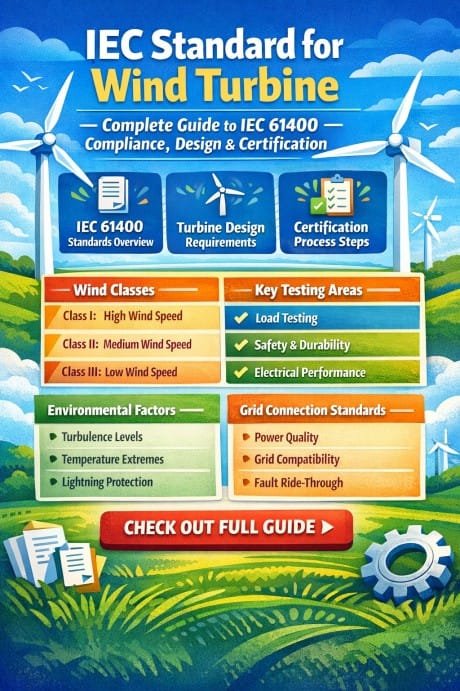
Table of Contents
This guide explains everything you need to know about the IEC standard for wind turbine, including its structure, key requirements, compliance process, and its impact on turbine performance and project success.
What is IEC 61400?
The IEC standard for wind turbine is formally known as IEC 61400, a comprehensive set of international standards developed by the International Electrotechnical Commission (IEC). It provides guidelines for the design, manufacture, installation, and maintenance of wind turbines.
Know more about IEC Standard for Neutral to Earth Voltage – Limits, Measurement & Safety Guidelines
IEC 61400 ensures that wind turbines operate safely under various environmental conditions while delivering optimal efficiency. It is widely adopted across global wind energy markets and is often mandatory for project financing and grid integration.
Key Parts of IEC 61400 Standard
The IEC 61400 series is divided into multiple parts, each focusing on specific aspects of wind turbine systems. The table below highlights the most important components:
| Standard Part | Description | Application |
|---|---|---|
| IEC 61400-1 | Design requirements | General turbine design |
| IEC 61400-2 | Small wind turbines | Turbines up to 200 m² swept area |
| IEC 61400-3 | Offshore wind turbines | Marine and offshore conditions |
| IEC 61400-12-1 | Power performance testing | Energy output measurement |
| IEC 61400-22 | Certification procedures | Compliance and certification |
| IEC 61400-21 | Power quality | Grid compatibility |
Each of these standards contributes to the overall framework of the IEC standard for wind turbine, ensuring consistency and reliability across different projects.
Find all about Capacitor Bank Sizing for Power Factor Correction – Step by Step
Design Requirements Under IEC 61400-1
IEC 61400-1 is the core document in the IEC standard for wind turbine framework. It defines essential design requirements to ensure structural integrity and operational safety.
Key design considerations include:
- Wind load calculations and turbulence modeling
- Fatigue analysis for long-term durability
- Structural safety factors
- Electrical system reliability
- Control and protection mechanisms
Wind turbines must be designed to withstand extreme weather conditions such as storms, gusts, and temperature variations. The standard also defines turbine classes based on wind speed and turbulence intensity.
Wind Turbine Classes
The IEC standard for wind turbine categorizes turbines into classes depending on site conditions. This classification helps engineers select suitable turbines for specific environments.
| Turbine Class | Average Wind Speed | Turbulence Level |
|---|---|---|
| Class I | High (10 m/s) | High |
| Class II | Medium (8.5 m/s) | Medium |
| Class III | Low (7.5 m/s) | Low |
| Class IV | Very Low | Special cases |
Choosing the correct class ensures optimal performance and prevents premature failure.
Find all about IEC Standard for Relay Testing: Best Guide
Certification Process for IEC Compliance
Certification is a key requirement under the IEC standard for wind turbine. It ensures that turbines meet international safety and performance benchmarks.
The certification process typically includes:
- Design evaluation
- Type testing
- Manufacturing inspection
- Installation assessment
- Final certification
Independent certification bodies such as DNV, TÜV, and UL conduct these assessments. Certification improves investor confidence and is often required for insurance and financing.
Power Performance Testing
Power performance testing is another critical aspect of the IEC standard for wind turbine. It is defined under IEC 61400-12-1 and measures the actual energy output of a turbine.
This process involves:
- Measuring wind speed using calibrated anemometers
- Recording electrical power output
- Creating a power curve
- Comparing results with design expectations
Find all about BS 7671 Wiring Regulations: Expert Guide to Compliance, Safety, and Practical Applications
Accurate power performance data helps developers estimate energy production and project returns.
Grid Integration and Power Quality
Modern wind turbines must operate efficiently within electrical grids. The IEC standard for wind turbine addresses this through IEC 61400-21, which focuses on power quality.
Important parameters include:
- Voltage fluctuations
- Harmonics
- Flicker
- Reactive power control
Compliance ensures stable grid operation and minimizes disturbances caused by wind power generation.
Offshore Wind Turbine Requirements
Offshore wind projects present unique challenges, including corrosion, wave loads, and accessibility issues. IEC 61400-3 specifically addresses these factors within the IEC standard for wind turbine.
Key requirements include:
- مقاومة corrosion-resistant materials
- Enhanced structural design for wave loading
- Specialized installation procedures
- Maintenance planning under harsh conditions
Offshore turbines require stricter compliance due to higher risks and costs.
Know more about Innovative Wind Turbine Design Ideas
Importance of IEC 61400 Compliance
Compliance with the IEC standard for wind turbine offers several benefits:
- Improved safety and reliability
- Increased investor confidence
- Easier regulatory approvals
- Better operational performance
- Reduced maintenance costs
Without proper compliance, turbines may face operational failures, financial losses, or regulatory penalties.
Challenges in Implementing IEC Standards
While the IEC standard for wind turbine provides a solid framework, implementation can be challenging.
Common issues include:
- High certification costs
- Complex testing procedures
- Site-specific design adjustments
- Evolving technology requirements
Manufacturers must continuously adapt to updated standards and innovations in turbine technology.
Know more about Detailed Analysis of Wind Turbine Power Curve Regions
Future Trends in IEC Standards
The IEC standard for wind turbine continues to evolve with advancements in renewable energy. Future updates are expected to focus on:
- Larger turbine capacities
- Digital monitoring and smart control systems
- Floating offshore wind technology
- Improved grid integration techniques
These developments will further enhance the efficiency and reliability of wind energy systems worldwide.
Conclusion
The IEC standard for wind turbine is the backbone of modern wind energy development. It ensures that turbines are designed, tested, and operated according to internationally recognized benchmarks. From design requirements to certification and grid integration, IEC 61400 covers every aspect of wind turbine performance.
Find more about Wind Turbine Design With Example
For engineers, developers, and investors, understanding and implementing the IEC standard for wind turbine is essential for achieving long-term success in the renewable energy sector. As wind energy continues to expand, adherence to these electrical standards will remain a key driver of safety, efficiency, and sustainability.
Follow Us on Social:
Subscribe our Newsletter on Electrical Insights for latest updates from Electrical Engineering Hub
#IECStandardForWindTurbine, #WindTurbineStandards, #IEC61400, #WindEnergyCompliance, #RenewableEnergyStandards, #WindPowerEngineering, #TurbineSafety, #GreenEnergyTech, #ElectricalStandards, #WindEnergyDesign