
IEC Standard for Thermocouple: Important Guide to International Temperature Measurement & Calibration Standards
Temperature measurement plays a critical role in modern industry. From power plants and manufacturing facilities to laboratories and research environments, accurate temperature monitoring ensures safety, efficiency, and product quality. Among the most widely used temperature sensors are thermocouples because they are durable, reliable, and capable of measuring a wide range of temperatures. To maintain consistency and accuracy worldwide, international bodies have established the IEC standard for thermocouple that defines the design, tolerance, calibration, and identification of thermocouple sensors.
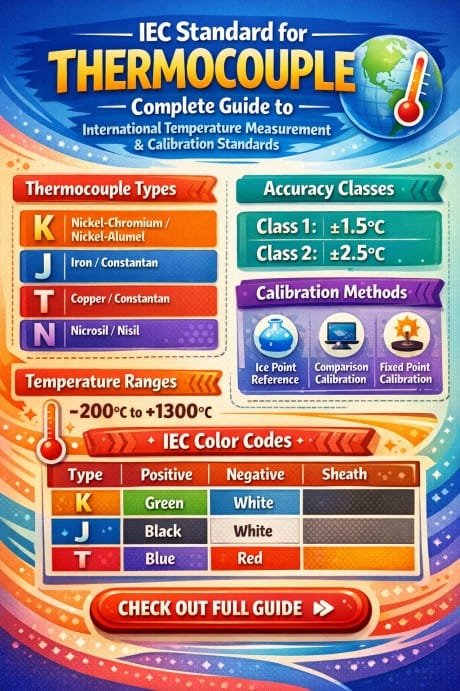
Table of Contents
Understanding the IEC standard for thermocouple helps engineers, technicians, and quality professionals ensure that their temperature measurement systems meet global requirements. These standards also simplify equipment compatibility, calibration processes, and industrial compliance.
What is a Thermocouple
A thermocouple is a temperature sensor made from two different metal wires joined together at one end. When the junction experiences a temperature difference compared to the reference end, a voltage is produced. This phenomenon is known as the Seebeck effect.
The voltage generated by the thermocouple is proportional to the temperature difference between the hot junction and the cold junction. Because of their simple construction and ability to withstand harsh conditions, thermocouples are widely used in industrial temperature measurement.
Know more about Thermistor vs RTD vs Thermocouple
Key characteristics of thermocouples include:
- Wide temperature measurement range
- Fast response time
- High durability in harsh environments
- Compatibility with industrial control systems
To ensure reliable readings across different manufacturers and applications, the IEC standard for thermocouple defines how thermocouples should be manufactured and calibrated.
Overview of IEC Standards for Thermocouples
The International Electrotechnical Commission (IEC) develops global standards for electrical and electronic technologies. The most important IEC standard for thermocouple is IEC 60584, which defines the reference tables, tolerances, and classification of thermocouples.
IEC 60584 ensures that thermocouples manufactured anywhere in the world produce consistent temperature readings.
Main Parts of IEC 60584
| IEC Standard Section | Description |
|---|---|
| IEC 60584-1 | Reference tables for thermocouple electromotive force (EMF) |
| IEC 60584-2 | Tolerances for thermocouple types |
| IEC 60584-3 | Extension and compensating cables |
| IEC 60584-5 | Thermocouple junction temperature reference tables |
These standards are widely used in power plants, refineries, chemical industries, and industrial automation systems.
Know more about Difference Between RTD and Thermocouple
Common Thermocouple Types Defined by IEC
The IEC standard for thermocouple specifies several thermocouple types based on different metal combinations. Each type has a unique temperature range and sensitivity.
| Thermocouple Type | Positive Leg | Negative Leg | Temperature Range |
|---|---|---|---|
| Type K | Nickel-Chromium | Nickel-Aluminum | -200°C to 1260°C |
| Type J | Iron | Copper-Nickel | -210°C to 760°C |
| Type T | Copper | Copper-Nickel | -200°C to 400°C |
| Type E | Nickel-Chromium | Copper-Nickel | -200°C to 900°C |
| Type N | Nicrosil | Nisil | -200°C to 1300°C |
| Type S | Platinum-Rhodium | Platinum | 0°C to 1600°C |
Among these, Type K thermocouple is the most widely used because of its large temperature range and good resistance to oxidation.
The IEC standard for thermocouple ensures that each thermocouple type follows standardized voltage-to-temperature conversion tables.
Know more about Types of Field Effect Transistor
Thermocouple Tolerance Classes According to IEC
Temperature measurement accuracy depends heavily on thermocouple tolerance. The IEC standard for thermocouple defines tolerance classes to ensure predictable performance.
Standard Tolerance Classes
| Class | Accuracy |
|---|---|
| Class 1 | High precision measurements |
| Class 2 | Standard industrial applications |
| Class 3 | General purpose use |
Example for Type K thermocouple tolerance:
| Class | Temperature Range | Maximum Error |
|---|---|---|
| Class 1 | -40°C to 1000°C | ±1.5°C or 0.004t |
| Class 2 | -40°C to 1200°C | ±2.5°C or 0.0075t |
These tolerances help engineers select the right sensor depending on the required measurement accuracy.
Find all about Types of Transistor
Thermocouple Color Coding According to IEC
To simplify identification, the IEC standard for thermocouple specifies a universal color coding system for thermocouple cables.
| Thermocouple Type | Positive Wire Color | Negative Wire Color |
|---|---|---|
| Type K | Green | White |
| Type J | Black | White |
| Type T | Brown | White |
| Type E | Violet | White |
| Type N | Pink | White |
This color coding allows technicians to quickly identify thermocouple types during installation and maintenance.
Calibration Requirements for Thermocouples
Calibration ensures that thermocouples provide accurate temperature readings. The IEC standard for thermocouple outlines calibration practices using reference standards and temperature sources.
Common thermocouple calibration methods include:
- Comparison calibration using reference thermometers
- Fixed point calibration using melting point cells
- Dry block temperature calibration
Calibration laboratories typically follow IEC 60584 guidelines along with ISO/IEC 17025 quality standards.
Know more about Floating Gate MOSFET: A Comprehensive Guide
Important factors affecting thermocouple calibration include:
- Sensor aging
- Oxidation of metal wires
- Mechanical stress
- Exposure to extreme temperatures
Regular calibration helps maintain measurement accuracy in industrial processes.
Advantages of Following IEC Thermocouple Standards
Using the IEC standard for thermocouple provides many benefits for industries and laboratories.
Key advantages include:
- Global compatibility between manufacturers
- Reliable temperature measurement results
- Simplified calibration procedures
- Standardized thermocouple identification
- Improved industrial safety and quality control
When industries follow these standards, they can easily integrate sensors, controllers, and monitoring systems without compatibility issues.
Industrial Applications of IEC Standard Thermocouples
Thermocouples designed according to the IEC standard for thermocouple are used in many industries where accurate temperature monitoring is essential.
Common applications include:
- Power generation plants
- Cement manufacturing
- Oil and gas refineries
- Steel and metal processing
- Chemical processing industries
- Food and pharmaceutical production
Know more about Leakage Current in MOSFET
In high temperature environments such as furnaces and boilers, thermocouples provide reliable measurements where other sensors may fail.
Key Installation Practices for Thermocouples
Even when a thermocouple meets the IEC standard for thermocouple, incorrect installation can cause inaccurate readings. Proper installation practices are essential for reliable measurements.
Important installation guidelines include:
- Ensure proper thermocouple immersion depth
- Avoid electrical noise near signal cables
- Use correct extension and compensating cables
- Protect sensors from mechanical vibration
- Maintain proper grounding of instrumentation systems
Following these practices improves measurement stability and extends thermocouple life.
Know more about Best Electrical Design Software for Industrial Projects
Conclusion
Thermocouples remain one of the most reliable and widely used temperature sensors in industrial environments. However, consistent performance and accurate readings require adherence to internationally recognized standards. The IEC standard for thermocouple, particularly IEC 60584, defines the reference tables, tolerance classes, cable color coding, and calibration requirements that ensure global consistency in temperature measurement.
By following the IEC standard for thermocouple, industries can achieve accurate temperature monitoring, improved safety, and better process control. Engineers and technicians working with temperature instrumentation should understand these standards to ensure their systems meet international quality and performance requirements. Proper sensor selection, calibration, and installation further enhance the reliability of thermocouple-based measurement systems in modern industrial applications.
Follow Us on Social:
Subscribe our Newsletter on Electrical Insights for latest updates from Electrical Engineering Hub
#IECStandardForThermocouple, #ThermocoupleStandards, #TemperatureMeasurement, #IndustrialInstrumentation, #IECTestingStandards, #ThermocoupleCalibration, #ElectricalEngineering, #ProcessControl, #TemperatureSensors, #InstrumentationEngineering
