Single-Phase Motor Problems and Solutions – Complete Troubleshooting & Repair Guide for Electrical Engineers
Single-phase motors are widely used in residential, commercial, and light industrial applications. From water pumps and air compressors to HVAC systems and small workshop machines, these motors play a critical role in daily operations. However, like any electrical equipment, they are prone to faults over time. Understanding single-phase motor problems and solutions is essential for electrical engineers, maintenance teams, and technicians who want to ensure reliability, safety, and long service life.
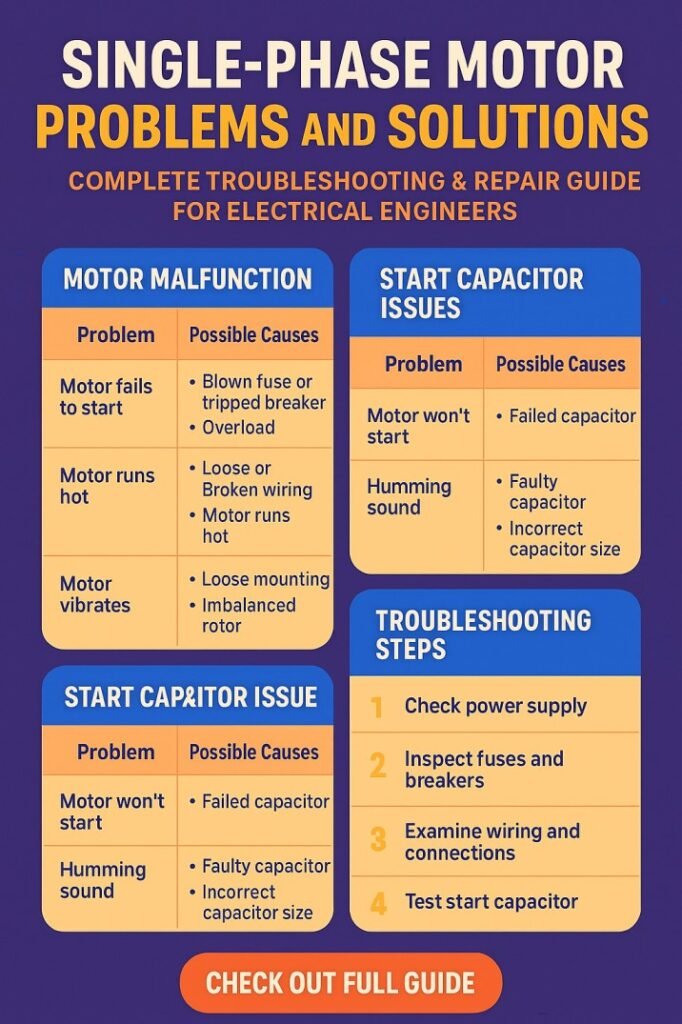
Table of Contents
This detailed troubleshooting and repair guide explains common failure modes, root causes, diagnostic methods, and practical corrective actions. It also covers motor starting issues, capacitor failures, winding damage, overheating, and voltage-related faults.
Know more about Electric Motor Troubleshooting Chart – Complete Fault Diagnosis & Repair Guide for Engineers
Understanding the Basics of Single-Phase Motors
Before diving into single-phase motor problems and solutions, it is important to recall how these motors operate. Unlike three-phase motors, a single-phase induction motor does not produce a rotating magnetic field on its own. It requires auxiliary components such as:
- Start winding
- Run winding
- Start capacitor
- Run capacitor
- Centrifugal switch or relay
Common types include:
- Split-phase motor
- Capacitor start motor
- Capacitor start capacitor run motor
- Shaded pole motor
Each type has specific characteristics, but their failure patterns are often similar.
Motor Fails to Start
One of the most common single-phase motor problems and solutions scenarios involves a motor that hums but does not start.
Know more about Soft Starter Troubleshooting Guide: Quick Fix for Motor Start Up Faults
Possible Causes
- Faulty start capacitor
- Open start winding
- Defective centrifugal switch
- Low supply voltage
- Excessive mechanical load
Troubleshooting Checklist
| Symptom | Likely Cause | Testing Method | Recommended Solution |
|---|---|---|---|
| Humming sound only | Failed start capacitor | Test capacitance with multimeter | Replace capacitor |
| No sound at all | No power supply | Check voltage at terminals | Restore supply |
| Trips breaker instantly | Shorted winding | Insulation resistance test | Rewind or replace motor |
| Starts manually when rotated | Start circuit failure | Inspect centrifugal switch | Repair or replace switch |
A weak or failed capacitor is responsible for many starting failures. Always discharge the capacitor safely before testing.
Motor Overheating
Overheating is another major concern when dealing with single-phase motor problems and solutions. Excessive temperature reduces insulation life and may lead to winding failure.
Common Reasons
- Overloading
- Poor ventilation
- High ambient temperature
- Voltage imbalance
- Frequent start-stop cycles
Know more about VLF Testing vs Hipot: Best Guide on Key Differences and Applications
Temperature and Cause Analysis
| Observed Condition | Probable Cause | Corrective Action |
|---|---|---|
| Motor hot with normal load | Low voltage | Correct supply voltage |
| Motor extremely hot | Overload | Reduce mechanical load |
| Burning smell | Insulation breakdown | Perform winding resistance test |
| Hot bearings | Lack of lubrication | Re-grease or replace bearings |
Proper load calculation and voltage verification are critical steps in resolving overheating issues.
Capacitor Failure and Replacement
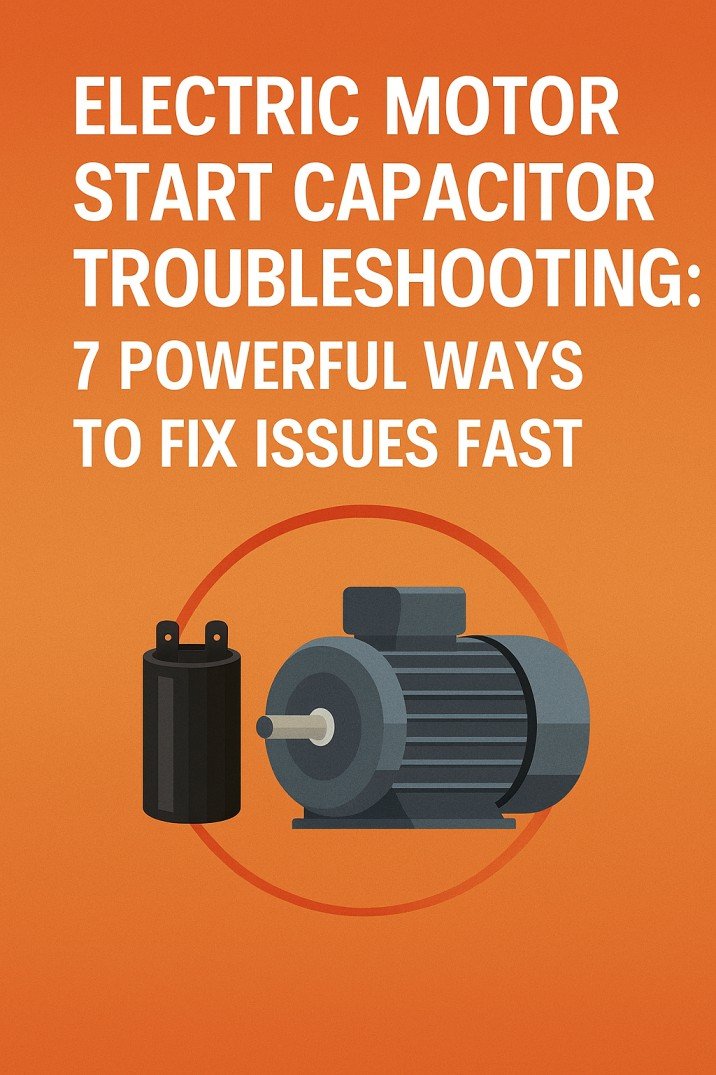
Capacitor-related faults are central to many single-phase motor problems and solutions. Capacitors provide the phase shift required to create starting torque.
Signs of Capacitor Failure
- Bulging casing
- Oil leakage
- Reduced torque
- Motor humming
- Frequent tripping
Testing Procedure
- Disconnect power supply
- Discharge the capacitor safely
- Use a digital multimeter with capacitance function
- Compare measured value with rated value
A deviation of more than ±10% typically indicates replacement is necessary.
Use our online tool Electrical Insurance Premium Calculator – Estimate Your Electrical Coverage Cost Online
Motor Runs but Has Low Torque
In some cases, the motor runs but fails to deliver rated torque. This condition affects pumps, compressors, and conveyor systems.
Likely Causes
- Weak run capacitor
- Voltage drop
- Partially shorted winding
- Mechanical binding
Diagnostic Approach
| Issue | Measurement | Expected Result | Action |
|---|---|---|---|
| Voltage drop | Measure terminal voltage under load | Within ±5% of rated | Correct supply |
| Winding resistance | Compare start and run windings | Balanced values | Rewind if abnormal |
| Current draw | Clamp meter test | Within nameplate rating | Inspect load |
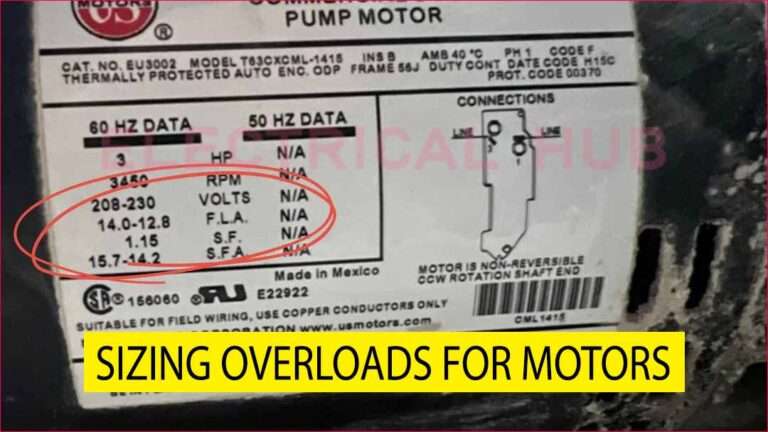
Electrical engineers should always compare measured current with nameplate full-load current to confirm abnormal loading conditions.
Frequent Tripping of Circuit Breaker
Frequent breaker tripping is a serious issue in single-phase motor problems and solutions. It may indicate short circuit, ground fault, or excessive current draw.
Know more about Contact Resistance Test Acceptable Value for Breaker
Causes
- Shorted windings
- Locked rotor condition
- Incorrect breaker size
- Ground insulation failure
Recommended Checks
- Perform insulation resistance test using megger
- Check winding continuity
- Inspect mechanical rotation
- Verify breaker rating against motor FLC
Incorrect breaker sizing can lead to nuisance tripping. Always follow NEC or IEC standards for motor protection selection.
Unusual Noise and Vibration
Mechanical faults are often mistaken for electrical failures. Noise and vibration must be properly evaluated.
Know more about What Are the Applications of Overcurrent Relays in Power Systems?
Common Sources
- Worn bearings
- Shaft misalignment
- Bent rotor
- Loose mounting bolts
Mechanical Fault Table
| Noise Type | Probable Cause | Solution |
|---|---|---|
| Grinding sound | Bearing failure | Replace bearings |
| Rattling noise | Loose mounting | Tighten bolts |
| High vibration | Shaft misalignment | Realign motor |
| Scraping sound | Rotor rubbing stator | Check air gap |
Routine preventive maintenance can significantly reduce these mechanical issues.
Winding Failure and Insulation Breakdown
Winding damage is one of the most expensive single-phase motor problems and solutions scenarios. It often results from prolonged overheating or voltage stress.
Causes of Winding Damage
- Sustained overload
- High inrush current
- Poor ventilation
- Moisture ingress
- Voltage spikes
Insulation Resistance Guidelines
| Motor Voltage | Minimum IR Value |
|---|---|
| Up to 440 V | 1 Mega Ohm |
| 440–690 V | 5 Mega Ohm |
If insulation resistance is below acceptable limits, drying or rewinding may be required.
Know more about Thermal Overload Relay: Working Principle, Types and Important Settings Calculation
Preventive Maintenance Strategies
Preventive maintenance plays a key role in reducing single-phase motor problems and solutions cases in industrial and domestic settings.
Recommended Maintenance Schedule
| Activity | Frequency |
|---|---|
| Visual inspection | Monthly |
| Bearing lubrication | Every 6 months |
| Insulation resistance test | Annually |
| Capacitor testing | Annually |
| Terminal tightening | Quarterly |
Maintaining clean ventilation paths and monitoring operating current improves motor life.
Voltage and Power Quality Issues
Poor power quality contributes significantly to single-phase motor problems and solutions. Voltage drop, harmonics, and loose connections can impact performance.
Voltage Tolerance
- Acceptable range: ±5% of rated voltage
- Severe performance issues beyond ±10%
Low voltage increases current draw and overheating. High voltage increases magnetic flux and core losses.
Electrical engineers should verify:
- Terminal voltage under load
- Supply cable size
- Connection tightness
- Distribution panel condition
Know more about Motor Overload Protection Chart: Important Concepts
Quick Troubleshooting Flow Guide
For practical fieldwork, use this simplified sequence:
- Check supply voltage
- Inspect capacitor
- Measure winding resistance
- Check insulation resistance
- Verify mechanical rotation
- Compare current with nameplate
This structured method simplifies identifying single-phase motor problems and solutions efficiently.
Safety Precautions During Troubleshooting
Safety must never be compromised while addressing single-phase motor problems and solutions.
- Isolate and lock out power source
- Discharge capacitors before handling
- Use insulated tools
- Wear protective gloves
- Follow electrical safety standards
Proper lockout-tagout procedures prevent accidental energization.
Know more about Difference Between Star Delta and DOL Starter: A Comprehensive Guide
Final Thoughts
Mastering single-phase motor problems and solutions requires a combination of theoretical knowledge and hands-on experience. Most failures originate from capacitor issues, overheating, voltage irregularities, or mechanical wear. A systematic troubleshooting approach helps engineers diagnose faults quickly and reduce downtime.
By performing regular preventive maintenance, verifying supply conditions, and testing key components such as windings and capacitors, you can significantly extend motor lifespan. Whether you are dealing with a domestic water pump or a light industrial compressor, understanding these practical repair techniques ensures safe and reliable motor operation.
Electrical engineers who apply structured diagnostic methods, follow safety standards, and maintain accurate maintenance records will consistently resolve single-phase motor problems and solutions with confidence and precision.
Know more about How does the star delta starter reduce starting current? Important Concepts
Follow Us on Social:
Subscribe our Newsletter on Electrical Insights for latest updates from Electrical Engineering Hub
#SinglePhaseMotorProblems, #SinglePhaseMotorSolutions, #ElectricMotorRepair, #MotorTroubleshootingGuide, #ElectricalMaintenance, #MotorFaultDiagnosis, #IndustrialElectrical, #MotorStartingIssues, #CapacitorFailure, #ElectricalEngineeringHub