High Voltage DC Power vs AC Power Transmission: Advantages, Efficiency & Modern Applications
High voltage DC power vs AC power transmission has been a topic of considerable discussion among electrical engineers, utility planners, and energy enthusiasts. As the demand for efficient long-distance power delivery grows, understanding the differences, benefits, and applications of HVDC (High Voltage Direct Current) and HVAC (High Voltage Alternating Current) becomes essential.
This article explores the technical, economic, and operational aspects of both systems, providing a clear comparison to help professionals and students grasp their modern relevance.
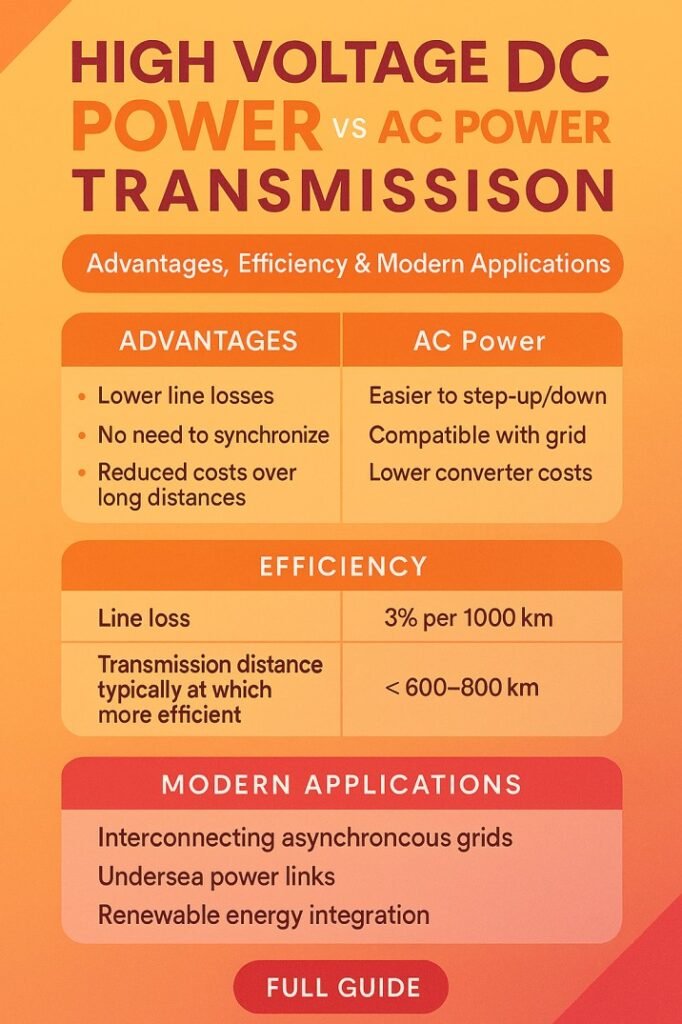
Table of Contents
Understanding High Voltage DC Power Transmission
High voltage DC power transmission refers to the process of sending electrical energy in direct current form over long distances using high voltage. Unlike AC power, where voltage alternates in a sinusoidal pattern, DC power maintains a constant polarity, which reduces losses in certain scenarios. HVDC systems are increasingly adopted in modern grids for connecting distant power sources like hydroelectric plants, offshore wind farms, and intercontinental interconnections.
Know more about HVDC Transmission Explained: Key Components, Working & Real-World Applications
The main advantages of HVDC include reduced line losses, improved stability, and the ability to connect asynchronous grids. For very long transmission distances, HVDC can be more economical than AC due to lower conductor requirements and the absence of reactive power losses.
Overview of High Voltage AC Power Transmission
High voltage AC power transmission is the traditional method for transporting electricity from generation sites to consumers. AC power alternates its direction at a fixed frequency (50 or 60 Hz), which allows for the use of transformers to step up or step down voltage easily. This feature makes AC highly suitable for widespread power distribution networks.
HVAC systems are cost-effective for medium to short distances and allow multiple substations to draw power along the route. However, as transmission distance increases, AC lines suffer from reactive power losses, capacitance effects, and stability challenges, making long-distance HVDC lines preferable in specific scenarios.
Know more about 7 Important HVDC Operating Modes
Key Differences Between HVDC and HVAC
The choice between high voltage DC power vs AC power transmission depends on technical and economic considerations. The following table highlights major differences:
| Feature | HVDC (High Voltage DC) | HVAC (High Voltage AC) |
|---|---|---|
| Voltage Type | Direct Current (DC) | Alternating Current (AC) |
| Transmission Distance | Ideal for long distances (>600 km overhead, >50 km underground/subsea) | Better for shorter distances |
| Line Losses | Lower due to no reactive power | Higher due to reactive power and skin effect |
| Substations | Converter stations needed at both ends | Transformers can be used to adjust voltage |
| Stability | More stable over long distances and under grid disturbances | Less stable for very long distances |
| Cost | Higher initial converter cost but lower line cost for long distances | Lower initial line and transformer cost, higher long-term losses for long distances |
| Power Flow Control | Independent, can control magnitude and direction | Less flexible; flow depends on network impedance |
Know more about HVDC Converter Efficiency: 3 Important Formulas
Efficiency Considerations
Efficiency plays a critical role in evaluating high voltage DC power vs AC power transmission. HVDC systems excel in long-distance transmission because they eliminate reactive power losses and reduce resistive line losses. Underground or subsea cables benefit significantly from DC operation, as AC cables generate high charging currents, which reduce effective transmission capacity.
In contrast, HVAC systems are more efficient for short distances due to lower conversion costs. For distances under 500 km, the efficiency difference may not justify the higher investment in HVDC converters. However, with the growing need to integrate renewable energy from remote locations, HVDC lines have become increasingly attractive.
The following efficiency comparison illustrates typical losses:
| Transmission Distance | HVDC Losses | HVAC Losses |
|---|---|---|
| 100 km | 3-4% | 3-4% |
| 500 km | 6-7% | 12-14% |
| 1000 km | 10-11% | 20-25% |
This table clearly shows that as distance increases, HVDC becomes significantly more efficient than HVAC.
Know more about HVDC Converter: Best Guide to HVDC Transmission System
Modern Applications of HVDC and HVAC
The evolution of power grids and renewable energy has brought new applications for both HVDC and HVAC systems. HVDC is widely used in intercontinental power links, underwater cables, and integration of offshore wind energy. Some examples include the China Southern HVDC line and the North Sea offshore wind connections.
HVAC remains dominant in national and regional grids due to its simplicity, compatibility with existing infrastructure, and lower upfront costs. HVAC is preferred for urban power distribution, medium-distance transmission, and local substations.
Hybrid systems combining both HVDC and HVAC technologies are also emerging. These systems leverage the advantages of both types, using AC for distribution and DC for long-distance bulk transfer. Smart grids increasingly rely on these hybrid designs for efficiency and reliability.
Know more about HVDC Transformer Working Principle Explained – How Converter Transformers Handle Extreme DC Power
Technical Challenges and Solutions
Both HVDC and HVAC have technical challenges. HVDC requires sophisticated converter stations with power electronics that can handle high voltages and currents. These stations are costly and require precise control. However, innovations in voltage-source converters (VSC) have reduced costs and improved performance.
HVAC faces challenges like reactive power management, line charging effects, and voltage stability over long distances. Capacitor banks, FACTS devices, and improved transmission conductors are commonly used to mitigate these issues.
Cost Analysis and Economic Factors
When comparing high voltage DC power vs AC power transmission, cost considerations are crucial. While HVDC lines have higher upfront costs due to converter stations, they are economically advantageous over long distances because fewer conductors are required, and losses are lower. HVAC systems have lower initial costs but higher operational losses and increased maintenance for very long-distance lines.
The break-even point for HVDC typically ranges from 500 to 600 km for overhead lines and 50 km for submarine cables. Beyond this distance, HVDC is more cost-effective.
| Parameter | HVDC | HVAC |
|---|---|---|
| Initial Cost | High (converters) | Moderate |
| Line Cost | Lower | Higher (more conductors needed) |
| Maintenance | Moderate | Moderate to high |
| Long-Term Losses | Low | High |
| Ideal Distance | >500 km (overhead), >50 km (subsea) | <500 km |
Know more about Applications of HVDC Transmission: Where High-Voltage DC Outperforms AC in Modern Power Grids
Environmental and Grid Stability Impacts
HVDC transmission is environmentally favorable for long distances because it requires narrower rights-of-way and less conductor material. Additionally, HVDC allows connection between grids of different frequencies, enhancing stability and resilience. For instance, HVDC links can help stabilize renewable energy fluctuations by transferring surplus energy across regions efficiently.
HVAC transmission, while well-established, can face voltage instability issues during high demand or fault conditions. Compensating devices like series reactors and shunt capacitors are necessary to maintain grid reliability.
Future Trends in Power Transmission
As renewable energy adoption accelerates, high voltage DC power vs AC power transmission discussions are increasingly focused on efficiency, integration, and grid modernization. HVDC technology is expected to dominate in intercontinental and offshore power transmission. The combination of HVDC and HVAC in hybrid smart grids will optimize energy delivery, reduce losses, and provide enhanced stability for future power systems.
Know more about HVDC Transformer Working Principle Explained – How Converter Transformers Handle Extreme DC Power
Advancements in power electronics, control systems, and superconducting materials may further improve HVDC efficiency. On the other hand, HVAC will continue to serve urban and regional grids due to its proven reliability and cost-effectiveness.
Conclusion
High voltage DC power vs AC power transmission offers distinct advantages depending on distance, application, and economic considerations. HVDC is ideal for long-distance, high-capacity, and underwater transmission, providing lower losses, better stability, and flexibility in grid integration.
HVAC remains the backbone of conventional power distribution networks, excelling in short to medium distances with lower initial costs and simple infrastructure requirements. Understanding these differences allows engineers, planners, and policymakers to make informed decisions for modern and future energy systems.
Follow Us on Social:
Subscribe our Newsletter on Electrical Insights for latest updates from Electrical Engineering Hub
#HighVoltageDC, #HVDCvsAC, #PowerTransmission, #ElectricalEngineering, #EnergyEfficiency, #GridTechnology, #RenewableEnergy, #SmartGrid, #ElectricPower, #TransmissionLines