
Busbar Protection Calculation – Complete Guide for Engineers, Formulas, Settings & Practical Methods
Busbars are the backbone of any power system. They collect and distribute electrical energy from multiple feeders, transformers, and generators within substations and industrial switchgear. Because several circuits converge at this point, a fault on the bus can be severe and widespread. That is why mastering busbar protection calculation is essential for engineers responsible for system reliability and safety.
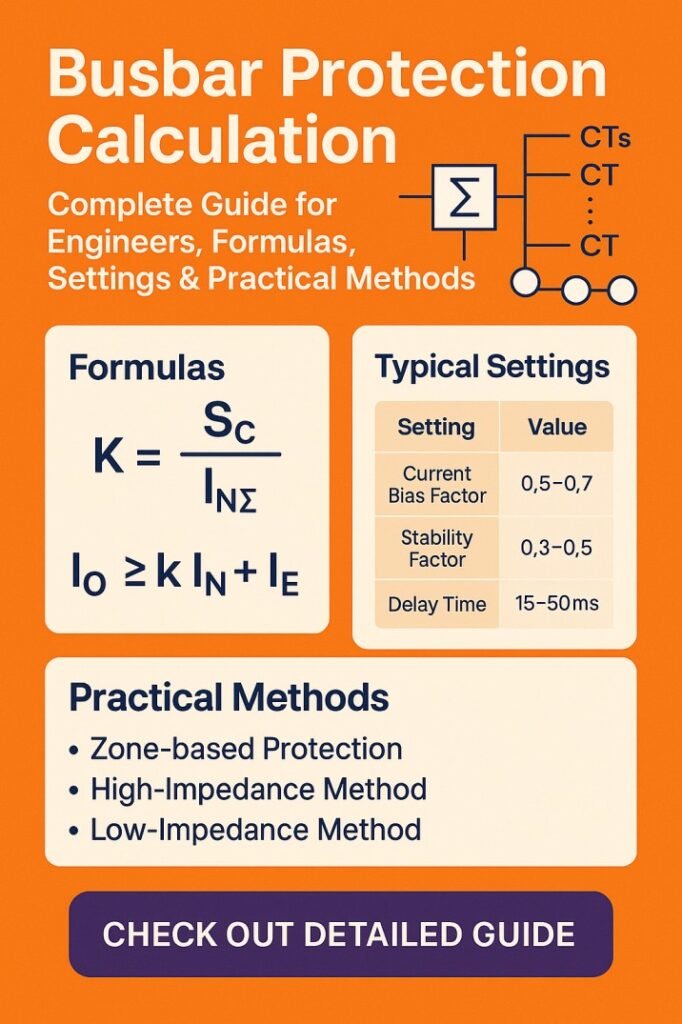
Table of Contents
This guide explains the practical approach to busbar protection calculation, including engineering concepts, formulas, relay settings, and field-oriented methods used in modern substations. The focus is on understanding how to determine pickup values, stability criteria, and verification checks so protection schemes operate quickly without false tripping.
Find out more about contact resistance test acceptable value for busbar
Understanding the Purpose of Busbar Protection
A busbar is designed to operate continuously under heavy electrical stress. When insulation fails or mechanical damage occurs, fault current can rise instantly. The goal of busbar protection calculation is to ensure that protective relays detect internal faults and isolate them while remaining stable for external disturbances.
Unlike feeder protection, bus protection must consider multiple current sources and directional flow. Engineers typically rely on differential schemes, impedance-based backup, and high-impedance arrangements. The design process must account for current transformer accuracy, saturation effects, and system short circuit levels.
Some practical objectives include:
- Instant detection of internal phase-to-phase or phase-to-ground faults
- Security against maloperation during through faults
- Coordination with upstream and downstream relays
- Maintaining system stability
These objectives shape every busbar protection calculation carried out during project design or retrofit work.
Know more about IEC Standard for Busbar Clearance
Common Protection Methods Used in Busbars
Several protection principles are implemented depending on voltage level and configuration. Each method influences the approach taken for busbar protection calculation.
| Protection Method | Typical Application | Key Advantage | Limitation |
|---|---|---|---|
| Differential Protection | HV and EHV substations | Fast and selective | Requires precise CT matching |
| High Impedance Scheme | Legacy or smaller systems | Stable and simple | Less flexible for expansions |
| Low Impedance Numerical | Modern digital relays | Adaptive and configurable | Higher engineering effort |
| Zone Interlocking | Backup protection | Enhances coordination | Slower operation |
| Overcurrent Backup | Secondary layer | Economical | Limited selectivity |
Differential protection remains the primary technique, so most busbar protection calculation work centers on differential current evaluation.
Read in detail about iec 61439 busbar calculation
Basic Differential Principle
Differential protection compares current entering and leaving the bus. Under normal conditions, vector sum equals zero. During an internal fault, imbalance appears and relay operates.
The fundamental relation used in busbar protection calculation is:
Id = |I1 + I2 + I3 + … + In|
Where Id represents differential current and individual currents represent feeder contributions.
Restraint current is also calculated to prevent operation during external faults:
Ir = (|I1| + |I2| + … + |In|) / 2
Relay characteristic typically uses:
Operate if Id > (Slope × Ir) + Pickup
Engineers performing busbar protection calculation must select slope and pickup carefully to ensure sensitivity and stability.
Get complete information about iec standard for busbar sizing
Steps for Practical Busbar Protection Calculation
In real projects, engineers follow a structured sequence. This helps translate system data into relay settings.
System Data Collection
Gather information including:
- Short circuit current levels
- Bus configuration and number of feeders
- CT ratios and accuracy class
- Maximum load current
- Relay characteristics
Accurate data collection is the foundation of reliable busbar protection calculation.
Find out more about iec 61439 busbar clearance
CT Ratio Selection
Current transformer matching is critical. Mismatch introduces spill current even without faults.
| Parameter | Example Value |
|---|---|
| Feeder Current | 800 A |
| Selected CT Ratio | 800/1 |
| Transformer Feeder | 1200 A |
| Selected CT Ratio | 1200/1 |
Scaling factors must be applied in busbar protection calculation so secondary currents are normalized.
Spill Current Estimation
Engineers calculate expected spill current caused by CT errors:
Spill Current ≈ Maximum Through Current × CT Error %
This value helps determine minimum pickup setting.
Find out more about Busbar Size Calculator – Accurate Sizing According to IEC and NEC Standards
Relay Pickup Setting
Pickup should exceed spill current yet remain sensitive to internal faults.
Pickup Setting = Safety Factor × Calculated Spill Current
Typical safety factors range from 1.2 to 1.5 depending on engineering judgment and system criticality.
Slope Determination
Slope defines restraint region for stability during heavy through faults.
| Condition | Typical Slope Range |
|---|---|
| Normal Load Region | 20–30% |
| High Fault Current | 40–70% |
Selecting proper slope is an important part of busbar protection calculation, especially for numerical relays.
Find out more about High Impedance Busbar Protection Explained with Example Calculations
Example Engineering Calculation
Consider a bus with three feeders each contributing 1 A secondary during external fault and CT error of 5%.
Spill Current = 3 × 1 × 0.05
Spill Current = 0.15 A
Pickup Setting with safety factor 1.3:
Pickup = 0.15 × 1.3
Pickup = 0.195 A
Rounded value may be set at 0.2 A.
Such straightforward steps illustrate how busbar protection calculation converts theoretical data into practical relay parameters.
Stability Checks in Engineering Practice
After determining preliminary values, engineers verify scheme stability. This step ensures external faults do not trigger false trips.
Through Fault Stability
Simulate maximum short circuit current flowing through the bus and confirm:
Differential Current < Relay Pickup
Find out more about Busbar Stability Test Procedure – Step-by-Step Method to Ensure Safe and Reliable Busbars
Saturation Analysis
CT saturation can distort measurements. Busbar protection calculation must consider knee point voltage and burden resistance.
Check Zone Selection Logic
Modern relays use dynamic zone allocation. Verification confirms correct zone tripping during switching operations.
These checks are essential before commissioning.
Modern Numerical Relay Considerations
Digital relays have expanded the scope of busbar protection calculation. Engineers must evaluate additional parameters:
- Percentage restraint characteristics
- Blocking logic during CT failure
- Breaker failure integration
- Event recording configuration
Unlike older static systems, modern devices allow adaptive settings, so busbar protection calculation often includes simulation studies using software tools.
Testing and Commissioning Approach
Once calculations are finalized, validation testing confirms scheme performance.
| Test Type | Purpose |
|---|---|
| Secondary Injection | Verifies relay logic |
| Primary Injection | Confirms CT polarity and wiring |
| Stability Test | Simulates external faults |
| Trip Verification | Checks breaker operation |
Field testing results may lead to refinement in busbar protection calculation before final acceptance.
Find all about Busbar Bending Calculation
Practical Engineering Tips
Experience often refines theory. Engineers working regularly with busbar protection calculation adopt several practical habits:
- Always verify CT polarity physically
- Confirm wiring diagrams against panel termination
- Keep documentation of scaling factors
- Coordinate with system protection philosophy
- Record final settings for maintenance reference
Attention to these details prevents costly outages and misoperations.
Coordination with System Protection
Bus protection must align with feeder, transformer, and generator protection. During busbar protection calculation, coordination studies ensure selective operation. Engineers compare clearing times and backup margins to avoid overlapping trips.
System integration also considers arc flash hazards, equipment ratings, and operational procedures. A comprehensive approach ensures that the bus protection scheme supports overall network resilience.
Find all about Busbar Size Chart in mm
Conclusion
Busbars serve as the central node of electrical distribution, and any fault within them carries serious consequences. Developing expertise in busbar protection calculation enables engineers to design schemes that respond instantly while maintaining stability during external disturbances. From differential current evaluation to slope selection and stability testing, each step requires careful analysis and engineering judgment.
As substations evolve toward digital protection platforms, the fundamentals remain unchanged. Accurate data collection, thoughtful parameter selection, and rigorous testing define successful busbar protection calculation. Engineers who master these methods contribute directly to system reliability, operational safety, and efficient power delivery across modern electrical networks.
Follow Us on Social:
Subscribe our Newsletter on Electrical Insights for latest updates from Electrical Engineering Hub
#busbarprotection, #busbarprotectioncalculation, #powerprotectionsystems, #electricalengineering, #relaycoordination, #substationprotection, #powersystemanalysis, #differentialprotection, #faultanalysis, #protectionengineering