NFPA 780 Lightning Protection Requirements — Complete Compliance Guide for Engineers & Installers
Lightning remains one of the most unpredictable threats to structures and electrical systems. For engineers and installers, understanding NFPA 780 lightning protection requirements is not just about compliance; it is about safeguarding life, equipment, and infrastructure. This standard provides a structured approach to designing and installing lightning protection systems that can withstand high-energy surges while maintaining operational safety.
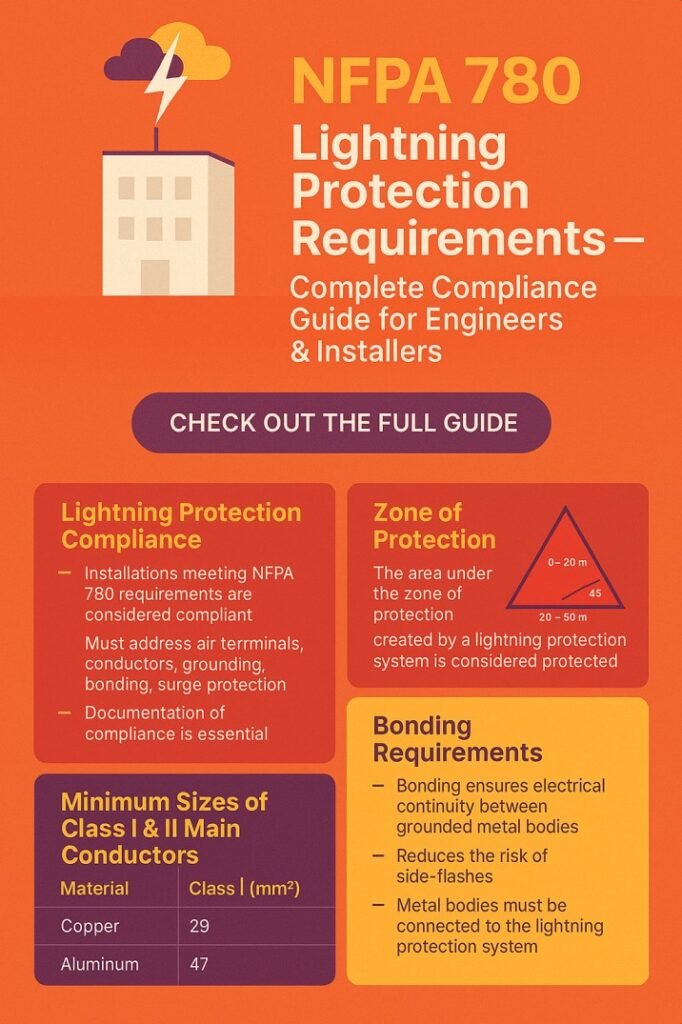
Table of Contents
In practice, NFPA 780 lightning protection guidance acts as the benchmark for risk mitigation, installation methods, and inspection procedures. Whether you are planning protection for industrial plants, commercial buildings, or renewable energy facilities, applying these requirements ensures reliable performance and reduced liability.
Understanding the Purpose of NFPA 780
The National Fire Protection Association developed this standard to establish minimum design and installation practices for lightning protection systems. Engineers depend on NFPA 780 lightning protection principles to determine how air terminals, down conductors, and grounding networks should function together.
The standard addresses several important goals. It aims to intercept lightning strikes safely, conduct current through controlled paths, and dissipate energy into the earth without damaging structural or electrical assets. Compliance also improves insurance acceptance and supports project approvals.
Installers benefit from following NFPA 780 lightning protection guidelines because they provide tested methodologies rather than theoretical assumptions. This ensures consistency across projects and reduces design guesswork.
Know more about What Is Early Streamer Emission A Practical Guide for Engineers, Standards, and Lightning Protection Design
Key Components of a Compliant Lightning Protection System
Designing according to NFPA 780 lightning protection rules requires understanding system components and how they interact. Each part must meet material and installation requirements defined by the code.
Table below summarizes essential components and their functions.
| Component | Function | Installation Considerations |
|---|---|---|
| Air Terminals | Capture lightning strike | Placement based on roof geometry and height |
| Down Conductors | Carry current to ground | Routed with minimal bends and protected from damage |
| Grounding Electrodes | Dissipate energy into soil | Proper spacing and resistance requirements |
| Bonding Connections | Equalize potential differences | Required for metallic systems and structural elements |
| Surge Protection Devices | Protect electrical equipment | Coordinated with service entrance design |
By implementing these elements correctly, NFPA 780 lightning protection ensures that the lightning current remains controlled throughout its path.
Know more about What Is Air Terminal in Lightning Protection? Function, Types & Installation Explained
Risk Assessment and Structure Evaluation
Before installation begins, engineers must evaluate the structure and surrounding environment. The risk assessment process within NFPA 780 lightning protection considers building height, occupancy, geographic location, and exposure to lightning density.
The evaluation determines whether protection is recommended or essential. For example, critical facilities such as hospitals, data centers, and energy plants often demand robust solutions aligned with NFPA 780 lightning protection provisions.
During assessment, installers review rooftop equipment, nearby trees, and adjacent structures. Identifying potential strike points allows accurate placement of air terminals and reduces design errors.
Placement and Spacing Requirements
One of the most detailed aspects of NFPA 780 lightning protection involves positioning system components correctly. Air terminals must cover all vulnerable surfaces, including edges and protruding elements.
Engineers calculate spacing according to roof dimensions and protection zones. Down conductors must be distributed evenly around the perimeter to balance current flow. Sharp bends are avoided to reduce impedance and heating risks.
Know more about Earth Cable Size for Lightning Protection
Proper spacing also applies to grounding electrodes. According to NFPA 780 lightning protection practice, separation distances and conductor routing directly affect system effectiveness and longevity.
Grounding and Bonding Guidelines
Grounding remains central to the success of NFPA 780 lightning protection installations. The objective is to disperse lightning current rapidly while preventing dangerous voltage gradients.
Installers select electrode types based on soil conditions and site constraints. Bonding ensures metallic systems, piping, and structural steel remain at equal potential during a strike event.
Table below outlines grounding considerations relevant to compliance.
| Parameter | Typical Requirement | Impact on Performance |
|---|---|---|
| Soil Resistivity | Measured before design | Determines electrode configuration |
| Electrode Depth | Based on site conditions | Improves current dissipation |
| Conductor Size | Meets code minimums | Prevents overheating |
| Bonding Points | Connected to metallic systems | Reduces flashover risk |
Careful grounding execution ensures NFPA 780 lightning protection systems perform reliably even during high-energy strikes.
Materials and Installation Practices
Material selection plays a critical role in NFPA 780 lightning protection durability. Conductors must meet conductivity and corrosion resistance criteria. Copper and aluminum are commonly used depending on environmental exposure.
Installers must also follow routing and support requirements. Fasteners, connectors, and fittings must be compatible to prevent galvanic corrosion. The standard emphasizes workmanship quality, recognizing that poor installation undermines system integrity.
Routine documentation helps verify that NFPA 780 lightning protection installation methods meet specification requirements and pass inspection stages.
Know more about Leakage Current in Lightning Arrester: Best Guide
Inspection, Testing, and Maintenance
Compliance does not end after installation. NFPA 780 lightning protection recommends periodic inspection to ensure continued reliability. Environmental conditions, construction changes, or mechanical damage may affect system performance.
Maintenance procedures typically include checking conductor continuity, verifying bonding integrity, and examining grounding connections. Visual inspections detect corrosion or physical displacement.
Table below shows common inspection intervals.
| Inspection Type | Frequency | Purpose |
|---|---|---|
| Visual Check | Annually | Identify physical damage |
| Detailed Inspection | Every few years | Confirm system integrity |
| Post-Modification Review | After structural changes | Maintain compliance |
| Post-Strike Assessment | After lightning event | Verify operational condition |
Following these steps preserves NFPA 780 lightning protection effectiveness throughout the structure’s life cycle.
Know more about IEC Standard for Lightning Protection: A Complete Technical Guide
Integration with Electrical Protection Systems
Modern facilities often integrate lightning protection with surge protection and grounding networks. Coordination ensures that incoming surges do not propagate through power or communication systems.
Engineers align NFPA 780 lightning protection practices with electrical standards governing service entrance protection. This integration minimizes equipment downtime and improves resilience.
By combining structural and electrical safeguards, designers achieve layered protection rather than relying on a single barrier.
Documentation and Compliance Records
Proper documentation supports compliance verification and project transparency. Drawings, material certifications, and inspection reports form part of the compliance record.
Maintaining documentation demonstrates adherence to NFPA 780 lightning protection requirements and simplifies future audits. Engineers and installers should retain records detailing layout changes or upgrades.
Know more about IEC Standard for Lightning Arrester – IEC 60099 Guide for Surge and Overvoltage Protection
Thorough documentation also aids maintenance planning and ensures continuity when project teams change.
Practical Tips for Engineers and Installers
Professionals working with NFPA 780 lightning protection standards often rely on field experience alongside technical requirements. Several practical considerations improve installation outcomes.
Focus on early coordination with structural and electrical teams. Verify routing paths before construction advances. Use calibrated measurement tools when testing grounding resistance. Maintain clear labeling for inspection access points.
Applying these habits ensures consistent results and reinforces compliance with NFPA 780 lightning protection guidelines.
Conclusion
Reliable lightning protection is built on structured design, careful installation, and ongoing maintenance. For engineers and installers, mastering NFPA 780 lightning protection requirements provides confidence that systems will perform when needed most.
This standard delivers practical guidance covering risk evaluation, component placement, grounding, materials, and inspection procedures. When applied correctly, it protects assets, reduces operational disruptions, and strengthens project credibility.
Know more about Top 10 Lightning Protection Design Softwares: Best Guide
Adhering to NFPA 780 lightning protection principles is not simply about meeting a code requirement. It represents a commitment to engineering responsibility and long-term safety. By understanding and implementing these provisions thoroughly, professionals ensure structures remain resilient against one of nature’s most powerful forces.
Follow Us on Social:
Subscribe our Newsletter on Electrical Insights for latest updates from Electrical Engineering Hub
#NFPA780, #LightningProtection, #ElectricalSafety, #GroundingSystems, #SurgeProtection, #PowerEngineering, #ElectricalStandards, #EarthingDesign, #BuildingProtection, #EngineeringCodes