IEC Standard for Zinc Ion Battery: Safety Limits, Testing Rules & Global Compliance Explained
The rapid growth of energy storage technologies has pushed zinc ion batteries into the global spotlight. These batteries are gaining attention because they offer improved safety, cost efficiency, and environmental benefits compared to traditional lithium-based systems.
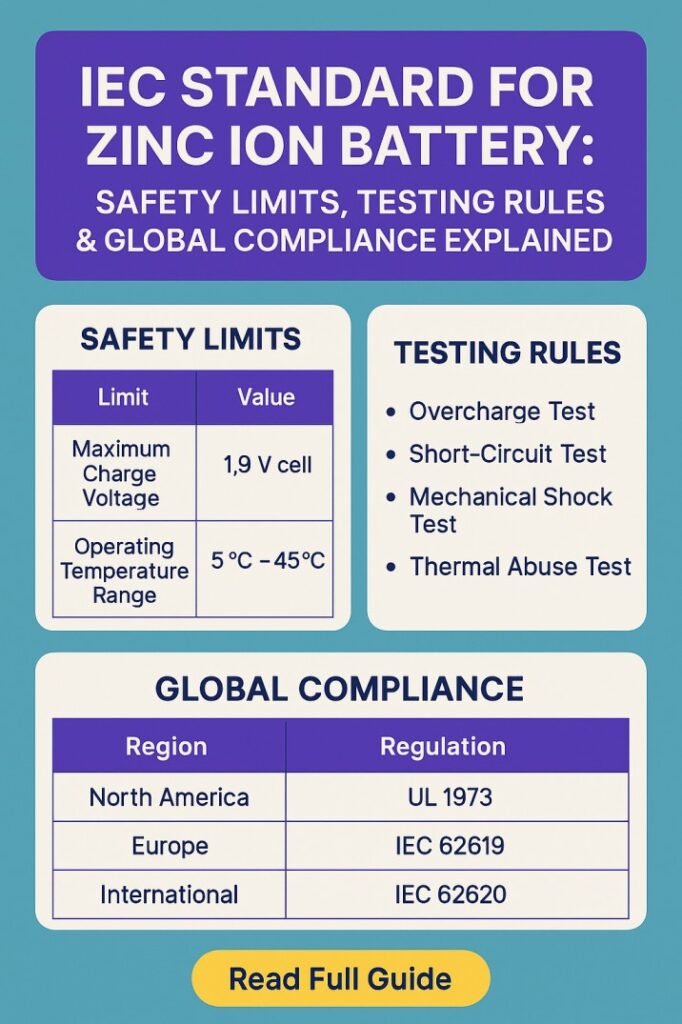
Table of Contents
As adoption increases, manufacturers and system integrators must understand the IEC standard for zinc ion battery to ensure product safety, performance reliability, and international acceptance. This article explains the safety limits, testing rules, and compliance framework defined by IEC standards in a practical and easy-to-understand way.
Understanding Zinc Ion Battery Technology
Zinc ion batteries use zinc as the primary charge carrier instead of lithium. This chemistry allows for aqueous electrolytes, which significantly reduces fire and explosion risks. Because of these advantages, zinc ion batteries are increasingly used in stationary energy storage, backup power systems, telecom infrastructure, and renewable energy integration.
However, even safer chemistries require standardized evaluation. The IEC standard for zinc ion battery provides a structured approach to testing electrical safety, mechanical robustness, and environmental resistance. These standards ensure that batteries behave predictably under normal operation and fault conditions.
Know more about IEC Standard for Earthing System
Why IEC Standards Matter for Zinc Ion Batteries
IEC standards are globally recognized benchmarks developed by technical experts from multiple countries. Compliance with the IEC standard for zinc ion battery helps manufacturers demonstrate that their products meet internationally accepted safety and performance criteria.
From a regulatory perspective, IEC compliance simplifies market entry across regions such as Europe, Asia, and parts of the Middle East. From a technical perspective, it reduces the risk of field failures, recalls, and liability issues.
Key benefits of IEC compliance include:
| Benefit | Practical Impact |
|---|---|
| Global acceptance | Easier certification and export |
| Improved safety | Reduced risk of thermal or electrical hazards |
| Product credibility | Higher trust among utilities and investors |
| System compatibility | Better integration with certified equipment |
Know more about IEC Standard for Busbar Clearance
Scope of the IEC Standard for Zinc Ion Battery
The IEC standard for zinc ion battery does not exist as a single standalone document. Instead, zinc ion batteries are evaluated under a combination of IEC battery safety and performance standards that apply to secondary cells and battery systems.
These standards typically cover:
| Area | What Is Evaluated |
|---|---|
| Electrical safety | Overcharge, short circuit, insulation |
| Mechanical integrity | Vibration, shock, drop resistance |
| Environmental endurance | Temperature cycling, humidity |
| Performance consistency | Capacity retention, cycle life |
| System-level safety | Battery management and protection |
By following these criteria, zinc ion battery manufacturers can align their designs with global expectations.
Safety Limits Defined Under IEC Framework
Safety is the core focus of the IEC standard for zinc ion battery. Even though zinc-based chemistries are inherently safer, limits are still defined to prevent misuse or abnormal operation.
Key safety limits typically include voltage, current, temperature, and pressure thresholds. These limits ensure that the battery remains stable during charging, discharging, and storage.
| Safety Parameter | Typical IEC Focus |
|---|---|
| Maximum charge voltage | Prevents electrolyte degradation |
| Charge and discharge current | Avoids excessive heating |
| Operating temperature range | Ensures chemical stability |
| Insulation resistance | Reduces electric shock risk |
| Enclosure integrity | Prevents electrolyte leakage |
These limits are validated through standardized laboratory tests before certification is granted.
Use our online tool Creepage Distance Calculator – Calculate Safe Insulation & Clearance for PCB and High Voltage Design
Electrical Testing Rules and Requirements
Electrical testing forms the backbone of the IEC standard for zinc ion battery. These tests simulate real-world electrical stress scenarios to verify that the battery can handle both normal and abnormal conditions.
Common electrical tests include overcharge testing, external short circuit testing, and forced discharge evaluation. During these tests, the battery must not catch fire, rupture, or leak hazardous materials.
| Test Type | Purpose |
|---|---|
| Overcharge test | Confirms voltage control effectiveness |
| Short circuit test | Evaluates fault tolerance |
| Insulation test | Verifies protection against electric shock |
| Capacity verification | Confirms rated energy output |
Passing these tests demonstrates that the battery design includes adequate protective mechanisms.
Mechanical and Environmental Testing
Mechanical and environmental testing ensures that zinc ion batteries remain safe and functional under physical stress and harsh conditions. The IEC standard for zinc ion battery requires testing that reflects transportation, installation, and operational environments.
Explore details on ev battery degradation calculator
Mechanical tests include vibration and shock testing, which simulate handling during shipping or seismic activity. Environmental tests expose the battery to temperature extremes and high humidity.
| Test Category | Real-World Scenario Simulated |
|---|---|
| Vibration | Transport and operational movement |
| Shock | Accidental drops or impacts |
| Thermal cycling | Day-night temperature changes |
| Damp heat | Humid installation locations |
These evaluations help confirm long-term reliability and safety. Use our online tool for free Battery Cable Size Calculator – Instantly Find the Right Wire Gauge for Any Battery Setup
Performance and Durability Evaluation
Beyond safety, the IEC standard for zinc ion battery also addresses performance consistency. Batteries must deliver stable capacity and efficiency over their intended service life.
Performance testing focuses on cycle life, energy efficiency, and self-discharge characteristics. These tests provide data that system designers rely on for accurate sizing and lifecycle cost analysis.
| Performance Metric | Why It Matters |
|---|---|
| Cycle life | Predicts replacement intervals |
| Capacity retention | Ensures usable energy over time |
| Efficiency | Impacts system operating cost |
| Shelf life | Important for backup applications |
Meeting these benchmarks enhances confidence in zinc ion battery deployments.
Know more about EV Battery Types Explained for Professionals: Standards, Safety, Costs, and Performance Comparison
Global Compliance and Certification Process
Achieving compliance with the IEC standard for zinc ion battery involves third-party testing and certification. Accredited laboratories conduct all required tests according to IEC procedures and issue test reports.
Once compliance is confirmed, manufacturers can use these reports to support regional certifications or regulatory approvals. This process reduces duplication of testing across different markets.
| Compliance Step | Description |
|---|---|
| Design review | Verification of safety concepts |
| Laboratory testing | Execution of IEC test protocols |
| Documentation review | Evaluation of manuals and labels |
| Certification issuance | Formal proof of compliance |
This structured approach streamlines global market access.
Relationship with Other International Standards
While IEC standards are widely accepted, zinc ion batteries may also need to align with other frameworks such as ISO quality systems or regional electrical codes. The IEC standard for zinc ion battery often acts as the technical foundation upon which additional certifications are built.
For example, IEC test data may support CE marking in Europe or conformity assessments in Asia-Pacific regions. This interoperability makes IEC standards particularly valuable for manufacturers with global ambitions.
Explore everything about Electric Vehicle Battery Replacement Cost: Real Prices, Lifespan & Smart Savings in 2026
Practical Implications for Manufacturers and Users
For manufacturers, following the IEC standard for zinc ion battery from the design stage reduces redesign costs and accelerates certification timelines. For end users, IEC compliance provides assurance that the battery system meets strict safety and reliability benchmarks.
System integrators and project developers also benefit because standardized batteries simplify risk assessment and insurance approval.
Future Outlook for IEC and Zinc Ion Batteries
As zinc ion technology matures, IEC committees are expected to refine existing standards and introduce more application-specific requirements. Grid-scale storage, data centers, and critical infrastructure will likely drive new testing criteria focused on long-duration performance and system integration.
Staying aligned with the IEC standard for zinc ion battery will remain essential for manufacturers seeking long-term relevance in the global energy storage market.
Know more about Why Are Lithium Batteries Dangerous: 7 Hidden Risks You Must Know
Conclusion
The IEC standard for zinc ion battery plays a critical role in shaping the safe and reliable adoption of this emerging energy storage technology. By defining clear safety limits, rigorous testing rules, and a globally recognized compliance framework, IEC standards protect users while enabling innovation. For manufacturers, integrators, and regulators alike, understanding and applying these standards is not just a regulatory step but a strategic advantage in a rapidly evolving energy landscape.
Follow Us on Social:
Subscribe our Newsletter on Electrical Insights for latest updates from Electrical Engineering Hub
#IECStandard, #ZincIonBattery, #IECBatteryStandards, #ZincBatteryTechnology, #BatterySafetyStandards, #EnergyStorageIEC, #BatteryCompliance, #ElectrochemicalStandards, #NextGenBatteries, #BatteryTesting