Bus Differential Relay Working Principle Explained – How Modern Busbar Protection Detects Faults Instantly
The bus differential relay working principle is one of the most critical concepts in modern power system protection. Busbars are the heart of any substation, carrying power from multiple feeders, transformers, and generators. A single fault on the busbar can disturb the entire network, cause large-scale outages, and damage costly equipment. Because of this risk, busbar protection must be extremely fast, selective, and dependable.
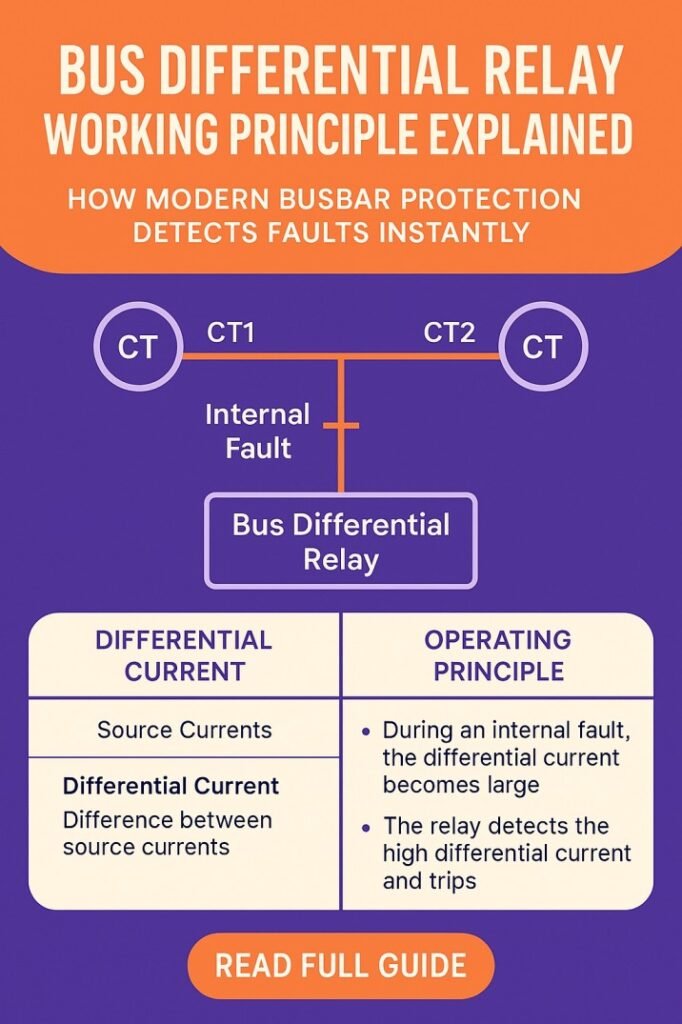
Table of Contents
Understanding the bus differential relay working principle helps engineers appreciate how internal faults are detected almost instantaneously while external faults are safely ignored. This article explains the concept in simple, practical language, covering traditional and numerical schemes, operating logic, advantages, and real-world applications.
Why Busbar Protection Is So Important
Busbars interconnect several circuits at the same voltage level. Unlike line or transformer faults, a busbar fault is fed by multiple sources at the same time. This results in:
- Very high fault current levels
- Rapid thermal and mechanical stress
- Risk of cascading trips across the substation
To manage these risks, protection must operate within milliseconds. The bus differential relay working principle is specifically designed for this task.
Know more about IEC Standard for Busbar Clearance
Basic Concept of Bus Differential Protection
The bus differential relay working principle is based on Kirchhoff’s Current Law. This law states that the algebraic sum of currents entering and leaving a node is zero under normal conditions.
In a healthy busbar:
- Incoming currents equal outgoing currents
- The vector sum of all measured currents is nearly zero
When a fault occurs inside the busbar zone:
- Current balance is disturbed
- The difference current exceeds a preset threshold
- The relay issues a trip command instantly
This simple idea becomes powerful when implemented with precise current transformers and high-speed relays.
Current Transformer Arrangement in Busbar Protection
Current transformers are installed on each feeder, transformer, or generator connected to the busbar. Their secondary currents are wired to the bus differential relay.
The correct CT placement is essential for the bus differential relay working principle to function accurately.
- All CTs must have correct polarity
- Ratio matching is critical
- Saturation characteristics must be considered
If CTs are incorrectly connected, false differential current may appear, leading to unwanted tripping.
Find out more about contact resistance test acceptable value for busbar
Internal and External Fault Discrimination
One of the strengths of the bus differential relay working principle is its ability to distinguish between internal and external faults.
For an external fault:
- Fault occurs outside the protected busbar zone
- All CTs see fault current flowing in the same direction
- The differential current remains close to zero
- Relay remains stable
For an internal fault:
- Fault lies within the busbar protection zone
- Currents flow toward the fault from multiple feeders
- Differential current becomes high
- Relay trips all connected breakers
This selectivity ensures reliability and system stability.
Read in detail about iec 61439 busbar calculation
Operating Principle Explained Step by Step
The bus differential relay working principle can be understood through a simple sequence.
- Each CT measures line current
- Secondary currents are summed vectorially
- Relay continuously calculates differential current
- If differential current exceeds pickup value
- Time delay logic is checked
- Trip command is issued to all bus-connected breakers
Modern numerical relays complete this process in a few milliseconds.
Get complete information about iec standard for busbar sizing
Types of Bus Differential Protection Schemes
Different schemes exist based on system size and complexity. The bus differential relay working principle remains the same, but implementation varies.
Low-Impedance Differential Scheme
This is the most common approach in modern substations.
- CT secondary currents connected in parallel
- Differential current directly measured
- High-speed operation
- Easier testing and commissioning
High-Impedance Differential Scheme
This scheme was widely used in older installations.
- CTs connected in series
- High stabilizing resistor used
- Sensitive to CT mismatch
- Requires careful design
Both schemes rely on the same fundamental bus differential relay working principle, but numerical relays have largely replaced high-impedance systems.
Role of Numerical Relays in Modern Busbar Protection
Numerical relays have transformed how the bus differential relay working principle is applied.
- Digital signal processing improves accuracy
- Adaptive restraint prevents false trips
- Event records support fault analysis
- Communication enables busbar zone selection
These relays can also integrate breaker failure protection and check zone logic.
Stability During CT Saturation
CT saturation is a major challenge during external faults. Modern relays handle this using advanced restraint algorithms.
- Percentage differential characteristic
- Bias current calculation
- Harmonic filtering
- Dynamic stabilization
Find out more about iec 61439 busbar clearance
These features strengthen the bus differential relay working principle by ensuring security without sacrificing speed.
Typical Tripping Logic for Busbar Protection
The tripping logic follows a well-defined sequence.
- Detect differential current above threshold
- Confirm fault inside busbar zone
- Verify no blocking conditions
- Issue trip to all associated breakers
This coordinated action isolates the faulty busbar section quickly and safely.
Comparison Between Busbar and Line Differential Protection
The table below highlights key differences while reinforcing the bus differential relay working principle.
| Parameter | Bus Differential Protection | Line Differential Protection |
|---|---|---|
| Protected zone | Substation busbar | Transmission or distribution line |
| Fault current sources | Multiple feeders | Usually two ends |
| Operating speed | Extremely fast | Fast but communication dependent |
| CT requirement | One per feeder | One at each line end |
| Communication | Not required | Often required |
Advantages of Bus Differential Protection
The bus differential relay working principle offers several technical benefits.
- Fast fault clearing time
- High sensitivity to internal faults
- Complete selectivity
- Reduced equipment damage
- Improved system reliability
These advantages make it indispensable in medium and high-voltage substations.
Find out more about Busbar Size Calculator – Accurate Sizing According to IEC and NEC Standards
Limitations and Design Considerations
Despite its strengths, careful design is required.
- CT selection and accuracy class
- Proper polarity and wiring checks
- Reliable auxiliary supply
- Correct zone configuration
Ignoring these aspects can weaken the bus differential relay working principle and compromise protection reliability.
Practical Example from a Substation
Consider a 132 kV substation with five outgoing feeders and two transformers.
- All seven circuits have CTs
- Secondary currents feed the bus differential relay
- Normal load shows near-zero differential current
- A phase-to-ground fault occurs on the busbar
- Differential current rises instantly
- Relay trips all seven breakers
This example clearly demonstrates the bus differential relay working principle in real operation.
Find out more about High Impedance Busbar Protection Explained with Example Calculations
Testing and Maintenance Practices
Regular testing ensures dependable performance.
- Secondary injection tests
- CT polarity verification
- Functional trip checks
- Relay setting review
Proper maintenance keeps the bus differential relay working principle effective throughout the system’s life.
Conclusion
The bus differential relay working principle remains the most reliable and fastest method for busbar protection. By continuously comparing incoming and outgoing currents, it detects internal faults within milliseconds while staying stable during external disturbances. Modern numerical relays have further enhanced this principle through advanced algorithms, improved stability, and better diagnostics.
For power engineers and protection specialists, mastering the bus differential relay working principle is essential for designing safe, secure, and resilient substations. When implemented correctly, it ensures uninterrupted power flow and protects one of the most critical nodes in the electrical network.
Find out more about Busbar Stability Test Procedure – Step-by-Step Method to Ensure Safe and Reliable Busbars
Follow Us on Social:
Subscribe our Newsletter on Electrical Insights for latest updates from Electrical Engineering Hub
#BusDifferentialRelay,#DifferentialProtection,#BusbarProtection,#PowerSystemProtection,#SubstationProtection,#RelayWorkingPrinciple,#ElectricalRelays,#ProtectionEngineering,#GridProtection,#HVSubstation