Transformer Secondary Protection Sizing – Complete Engineering Guide for Accurate Relay & Breaker Selection
Transformer secondary protection sizing is one of the most critical steps in power system design. An incorrectly sized breaker or relay can lead to nuisance tripping, equipment damage, or even catastrophic failure. On the other hand, properly engineered protection improves system reliability, ensures safety, and extends transformer life.
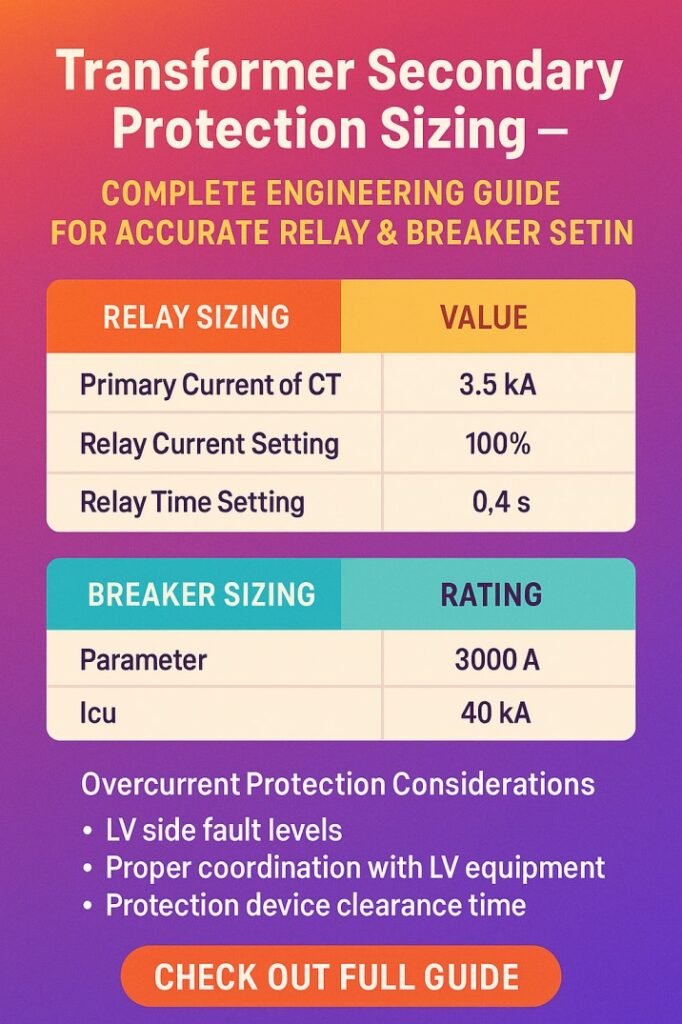
Table of Contents
In practical engineering projects, transformer secondary protection sizing requires a balanced understanding of full load current, short circuit levels, relay coordination, and applicable standards. This guide explains the complete method for accurate relay and breaker selection in a clear and practical way.
Read in detail about types of transformer protection relays
Understanding the Purpose of Secondary Protection
The secondary side of a transformer feeds downstream loads such as motor control centers, distribution panels, or switchboards. Protection on this side serves several important functions:
- Protect the transformer from overload conditions
- Clear secondary side faults quickly
- Coordinate with downstream breakers
- Limit thermal and mechanical stress
- Ensure personnel safety
Transformer secondary protection sizing must always consider both transformer characteristics and downstream system behavior.
Find out more about transformer differential protection
Step 1: Calculate Transformer Full Load Current
The starting point for transformer secondary protection sizing is calculating the full load current (FLC).
For a three phase transformer:
FLC = kVA × 1000 / (√3 × Voltage)
For a single phase transformer:
FLC = kVA × 1000 / Voltage
The calculated current becomes the base value for selecting breakers and configuring relays.
Example:
A 1000 kVA, 400 V, three phase transformer:
FLC = 1000 × 1000 / (1.732 × 400)
FLC ≈ 1443 A
This current value is the reference for all further protection decisions.
Find more about Best Medium Voltage Transformers for Solar Plants
Step 2: Determine Short Circuit Current on Secondary Side
Short circuit current plays a decisive role in transformer secondary protection sizing. It depends on transformer impedance.
Fault Current = FLC / (Impedance % / 100)
If transformer impedance is 6%:
Fault Current = 1443 / 0.06
Fault Current ≈ 24,050 A
This value determines the required breaking capacity of the circuit breaker and the relay instantaneous settings.
Typical Transformer Impedance Values
| Transformer Rating | Typical Impedance % |
|---|---|
| Up to 500 kVA | 4% – 6% |
| 500–2500 kVA | 5% – 7% |
| Above 2500 kVA | 6% – 10% |
The higher the impedance, the lower the fault current. Transformer secondary protection sizing must always be based on actual nameplate impedance.
Use our online tool for free Transformer Neutral Current Calculator – Accurate Neutral Current Estimation
Step 3: Selecting the Secondary Circuit Breaker
The secondary breaker must satisfy three essential conditions:
- Continuous current rating above FLC
- Adequate interrupting capacity
- Proper coordination with downstream devices
Continuous Current Rating
Industry practice typically selects a breaker rated at 125% of full load current to avoid nuisance trips during overload or inrush conditions.
For the earlier example:
Required breaker rating ≈ 1443 × 1.25 ≈ 1800 A
Standard breaker rating selected: 1600 A or 2000 A depending on load profile.
Transformer secondary protection sizing must consider expected loading patterns. If the transformer operates consistently near 100% load, selecting the next higher standard breaker size is advisable.
Know more about Transformer Sizing for Residential Building
Breaking Capacity Selection
Breaker interrupting capacity must exceed the calculated short circuit current.
In our example:
- Calculated fault current ≈ 24 kA
- Breaker minimum breaking capacity selected: 36 kA or 50 kA
Always provide a safety margin.
Typical Breaker Selection Guide
| Transformer kVA | Voltage | FLC (Approx) | Recommended Breaker |
|---|---|---|---|
| 250 kVA | 400 V | 360 A | 400 A, 36 kA |
| 500 kVA | 400 V | 721 A | 800 A, 50 kA |
| 1000 kVA | 400 V | 1443 A | 1600–2000 A, 50 kA |
| 2000 kVA | 400 V | 2887 A | 3200 A, 65 kA |
These values support accurate transformer secondary protection sizing in industrial systems.
Know more about Transformer Cooling Methods: ONAN, ONAF, OFAF & More
Step 4: Relay Selection and Protection Functions
Modern systems use protective relays integrated into air circuit breakers or separate digital relays. Transformer secondary protection sizing includes setting the following protection functions:
- Long time protection (overload)
- Short time protection
- Instantaneous protection
- Ground fault protection
Long Time Setting (Overload Protection)
Long time pickup is generally set between 1.0 to 1.1 times transformer full load current.
Time delay depends on transformer thermal withstand characteristics.
Example:
- FLC = 1443 A
- Long time pickup setting ≈ 1500 A
This protects against sustained overload without unnecessary tripping during temporary peaks.
Explore all about Transformer Bond Sizing
Short Time Protection
Short time pickup is usually set between 4 to 8 times FLC depending on coordination requirements.
Example:
- Short time pickup ≈ 6 × 1443 ≈ 8658 A
- Time delay is adjusted to coordinate with downstream MCCBs.
- Transformer secondary protection sizing must ensure downstream breakers clear faults first. Find more Transformer calculators here
Instantaneous Protection
Instantaneous setting should be above maximum downstream fault current but below transformer mechanical damage threshold.
Typical setting range: 8 to 12 times FLC.
Ground Fault Protection
Ground fault protection improves safety and limits damage.
Common pickup setting: 20% to 40% of FLC.
Example:
Ground fault pickup ≈ 300 to 600 A
This depends on system earthing configuration such as solid grounding or resistance grounding.
Step 5: Coordination with Downstream Devices
Selective coordination ensures only the nearest protective device trips during a fault.
Transformer secondary protection sizing must consider:
- Time current curves
- Cable ampacity
- Downstream breaker ratings
- Motor starting currents
Know all about Transformer Sizing for EV Charger
Coordination studies are performed using protection software. Manual verification using time current characteristic curves is also essential in smaller systems.
Key Coordination Principles
| Protection Element | Must Coordinate With |
|---|---|
| Long Time | Cable ampacity |
| Short Time | Downstream MCCB |
| Instantaneous | Busbar withstand |
| Ground Fault | Feeder protection |
Proper grading prevents cascading outages.
Know more about Transformers Earthspark Size Chart
Step 6: Consider Transformer Inrush Current
- Transformer energization produces magnetizing inrush current that may reach 8 to 12 times full load current.
- Transformer secondary protection sizing must ensure the instantaneous setting does not trip during energization.
- Using time delay or inrush restraint logic helps avoid nuisance tripping.
Step 7: Compliance with Standards
Protection must comply with relevant standards such as:
- IEC 60947 for circuit breakers
- IEC 60255 for protective relays
- IEEE C37 standards
- Local electrical codes
Adhering to these standards ensures transformer secondary protection sizing meets safety and reliability requirements.
Find all about Transformer Disconnect Sizing
Practical Engineering Checklist
Before finalizing settings, verify the following:
- Transformer kVA and impedance confirmed
- Maximum short circuit level calculated
- Breaker interrupting rating verified
- Long time pickup aligned with FLC
- Short time coordinated with feeders
- Instantaneous setting avoids inrush
- Ground fault protection matches earthing system
This structured approach reduces design errors.
Common Mistakes to Avoid
- Overlooking transformer impedance
- Selecting breaker with insufficient interrupting capacity
- Ignoring downstream coordination
- Setting instantaneous pickup too low
- Not considering future load expansion
Transformer secondary protection sizing must account for future growth. Leaving 10 to 20 percent margin supports system scalability.
Know more about Best Transformer Testing Companies in Canada | Trusted Electrical Testing Experts & Utility Service Providers
Example Complete Protection Setting Summary
For a 1000 kVA, 400 V transformer:
| Parameter | Value |
|---|---|
| Full Load Current | 1443 A |
| Breaker Rating | 1600–2000 A |
| Breaking Capacity | 50 kA |
| Long Time Pickup | 1500 A |
| Short Time Pickup | 8500–9000 A |
| Instantaneous Pickup | 12,000–15,000 A |
| Ground Fault Pickup | 400 A |
This structured example demonstrates proper transformer secondary protection sizing in a practical industrial scenario.
Read in detail about transformer manufacturers in egypt
Final Thoughts
Accurate transformer secondary protection sizing is not simply about selecting a breaker above full load current. It requires evaluating short circuit levels, relay characteristics, coordination requirements, inrush behavior, and compliance standards.
When executed correctly, the protection scheme ensures safe operation, minimizes downtime, and extends equipment life. Every transformer installation deserves careful engineering attention on its secondary protection system. Explore details on largest transformer manufacturer in usa
Follow Us on Social:
Subscribe our Newsletter on Electrical Insights for latest updates from Electrical Engineering Hub
#TransformerSecondaryProtectionSizing, #TransformerProtection, #ElectricalEngineeringDesign, #PowerSystemProtection, #RelayCoordination, #CircuitBreakerSizing, #PowerDistributionSystems, #ElectricalStandards, #IndustrialElectrical, #SubstationDesign