
Transformer Primary Protection Sizing – Complete Guide for Accurate Breaker & Fuse Selection
Transformer primary protection sizing is one of the most critical steps in safe and reliable electrical system design. An incorrectly sized breaker or fuse can cause nuisance tripping, overheating, insulation failure, or even catastrophic equipment damage. Whether you are working on a low voltage distribution transformer or a medium voltage power transformer, accurate protection sizing ensures both safety and operational continuity.
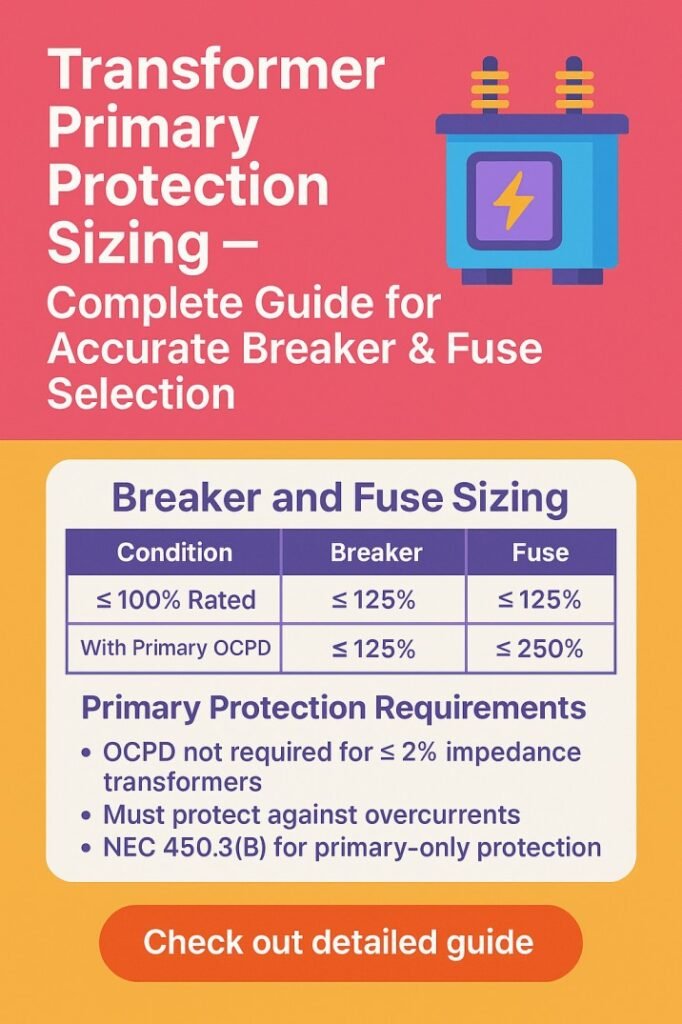
Table of Contents
This complete guide explains transformer primary protection sizing in a practical and professional manner. It covers calculations, NEC considerations, inrush current, breaker selection, fuse sizing, and real-world design tips used by electrical engineers in industrial and commercial installations.
Understanding Transformer Primary Protection
Transformer primary protection is installed on the supply side of the transformer. Its purpose is to protect:
- The transformer windings
- Upstream cables and switchgear
- Downstream connected loads
- The overall electrical system from fault currents
Find all about Transformer Disconnect Sizing
Transformer primary protection sizing must consider full load current, inrush current, short circuit levels, and applicable electrical code requirements. The goal is to allow normal operation while disconnecting dangerous fault conditions quickly.
Unlike simple load protection, transformers introduce magnetizing inrush current, which can be 8 to 12 times the rated full load current during energization. This makes proper protection sizing more technical than standard feeder breaker selection.
Step 1: Calculate Transformer Full Load Current
The first step in transformer primary protection sizing is calculating the primary full load current (FLC). The formula depends on whether the transformer is single-phase or three-phase.
For single-phase transformers:
Primary Current (A) = kVA × 1000 ÷ Primary Voltage
For three-phase transformers:
Primary Current (A) = kVA × 1000 ÷ (√3 × Primary Voltage)
Let us look at a practical example.
- Transformer Rating: 100 kVA
- Primary Voltage: 400 V
- Three-phase system
Know more about Transformers Earthspark Size Chart
Primary Current = 100 × 1000 ÷ (1.732 × 400)
Primary Current = 144.3 A
This calculated current is the base value used in transformer primary protection sizing.
Step 2: Apply Code Multipliers for Overcurrent Protection
Electrical codes such as NEC Article 450 provide guidelines for transformer overcurrent protection. For primary-only protection, typical maximum values are:
- 125% of primary full load current for breakers
- Up to 250% for time-delay fuses
These values allow for magnetizing inrush while still protecting against sustained overloads.
The following table summarizes common protection multipliers.
Table 1: Typical Primary Protection Sizing Multipliers
| Protection Type | Maximum Rating (Percentage of FLC) |
|---|---|
| Inverse time breaker | 125% |
| Time-delay fuse | 250% |
| Instantaneous trip | Case specific |
For our 100 kVA transformer with 144.3 A FLC:
- Breaker sizing = 144.3 × 125%
- Breaker sizing = 180 A
Know all about Transformer Sizing for EV Charger
The next standard breaker rating would typically be 175 A or 200 A depending on manufacturer availability.
Transformer primary protection sizing should always use the next standard rating above the calculated value if exact rating is unavailable.
Step 3: Consider Transformer Inrush Current
Inrush current is a major factor in transformer primary protection sizing. When a transformer is energized, the magnetizing current can reach 8 to 12 times the rated current for a short duration.
If protection is undersized, nuisance tripping will occur during energization. This is especially common in dry-type transformers installed in commercial buildings. Find more Transformer calculators here
To avoid this:
- Use inverse time breakers with adjustable magnetic trip
- Select time-delay fuses for better inrush tolerance
- Verify manufacturer inrush characteristics
Time-current coordination curves are extremely useful during transformer primary protection sizing. They help ensure the protection device withstands inrush but trips quickly during faults.
Step 4: Breaker Selection Guidelines
Circuit breakers are commonly used for primary protection in low voltage systems. When performing transformer primary protection sizing for breakers, consider:
- Continuous current rating
- Interrupting capacity (kAIC)
- Adjustable long-time and short-time settings
- Coordination with upstream devices
The breaker must have sufficient interrupting rating to handle available fault current at the installation point.
Table 2: Breaker Selection Checklist
| Parameter | Requirement |
|---|---|
| Continuous current rating | ≥ Calculated protection value |
| Interrupting rating | ≥ Available fault current |
| Trip curve type | Inverse time preferred |
| Coordination | Verified with upstream protection |
Failing to verify interrupting capacity is a common design mistake. Transformer primary protection sizing is incomplete without short circuit analysis.
Explore all about Transformer Bond Sizing
Step 5: Fuse Selection Guidelines
Fuses are widely used in medium voltage transformer applications and industrial panels. Time-delay fuses are preferred due to high inrush tolerance.
Advantages of fuses include:
- Fast fault clearing
- High current limiting capability
- Lower cost compared to breakers
For transformer primary protection sizing using fuses:
Fuse Rating = Up to 250% of primary FLC (as per applicable code)
For our example transformer:
- Fuse rating = 144.3 × 250%
- Fuse rating = 360 A
The next standard fuse rating might be 350 A or 400 A depending on manufacturer standards.
Always check manufacturer data to confirm compatibility with transformer impedance and fault levels.
Know more about Transformer Cooling Methods: ONAN, ONAF, OFAF & More
Step 6: Consider Transformer Impedance
Transformer impedance percentage affects fault current magnitude. A transformer with lower impedance produces higher short circuit current.
Fault Current = Full Load Current ÷ (Impedance % ÷ 100)
If a transformer has 5% impedance:
- Fault Current = 144.3 ÷ 0.05
- Fault Current = 2886 A
This calculation helps verify whether selected breakers or fuses can safely interrupt the fault current.
Transformer primary protection sizing must account for impedance to prevent under-rated protection devices.
Step 7: Coordination with Secondary Protection
Good transformer primary protection sizing ensures coordination with secondary overcurrent devices. The primary device should not trip before secondary branch protection during downstream faults.
Coordination studies use time-current curves to verify selective operation.
Benefits of proper coordination include:
- Reduced downtime
- Improved reliability
- Localized fault isolation
- Enhanced system stability
Poor coordination leads to unnecessary outages and operational disruption.
Know more about Transformer Sizing for Residential Building
Practical Transformer Primary Protection Sizing Example
Let us combine everything into a full example.
- Transformer Rating: 250 kVA
- Primary Voltage: 11 kV
- Impedance: 6%
- Three-phase system
Step 1: Calculate primary current
- Primary Current = 250 × 1000 ÷ (1.732 × 11000)
- Primary Current = 13.1 A
Step 2: Breaker sizing at 125%
13.1 × 125% = 16.4 A
Select next standard breaker: 20 A
Step 3: Fuse sizing at 250%
13.1 × 250% = 32.8 A
Select next standard fuse: 35 A
Find all about Top 10 Pole Mounted Transformer Manufacturers in Dubai
Step 4: Fault current check
Fault Current = 13.1 ÷ 0.06
Fault Current = 218 A
Verify selected device interrupting rating exceeds 218 A.
This structured approach ensures accurate transformer primary protection sizing every time.
Common Mistakes to Avoid
Even experienced engineers sometimes overlook critical aspects of transformer primary protection sizing. Avoid these common errors:
- Ignoring inrush current
- Using exact FLC without multiplier
- Overlooking fault current levels
- Not verifying interrupting rating
- Failing to coordinate with upstream breakers
- Using non-time-delay fuses for transformers
Each of these mistakes can cause equipment damage or safety hazards.
Key Design Considerations for Industrial Systems
In industrial plants, transformer primary protection sizing becomes more complex due to:
- Multiple transformers in parallel
- Generator backup systems
- Harmonic distortion
- Motor starting loads
In such systems, detailed protection coordination studies and short circuit analysis software are recommended.
Always consult manufacturer data sheets and follow national electrical standards when finalizing protection ratings.
Read in detail about types of transformer protection relays
Final Thoughts
Transformer primary protection sizing is not just a calculation exercise. It is a safety-critical design process that protects assets, ensures compliance, and maintains power system reliability. By calculating full load current correctly, applying appropriate multipliers, accounting for inrush current, verifying interrupting capacity, and coordinating protection devices, you can design a system that operates safely for decades.
Whether you are selecting a breaker for a 100 kVA dry-type transformer or choosing medium voltage fuses for an 11 kV power transformer, accurate transformer primary protection sizing ensures stable performance and long-term operational security.
Find out more about transformer differential protection
Follow Us on Social:
Subscribe our Newsletter on Electrical Insights for latest updates from Electrical Engineering Hub
#TransformerPrimaryProtectionSizing, #TransformerProtection, #BreakerSizing, #ElectricalDesign, #PowerSystemProtection, #OvercurrentProtection, #ElectricalEngineering, #ProtectionCoordination, #HVACCalculations, #ElectricalSafety