Solar Export Limitation UK: How to Maximize Your Solar Savings & Avoid Penalties
The growing popularity of solar energy in the UK has made it essential for homeowners and businesses to understand solar export limitation UK rules. These regulations are designed to control the amount of electricity that small-scale solar installations feed back into the grid. Understanding these limitations can help you maximize your solar savings, reduce energy bills, and avoid potential penalties from grid operators or suppliers.
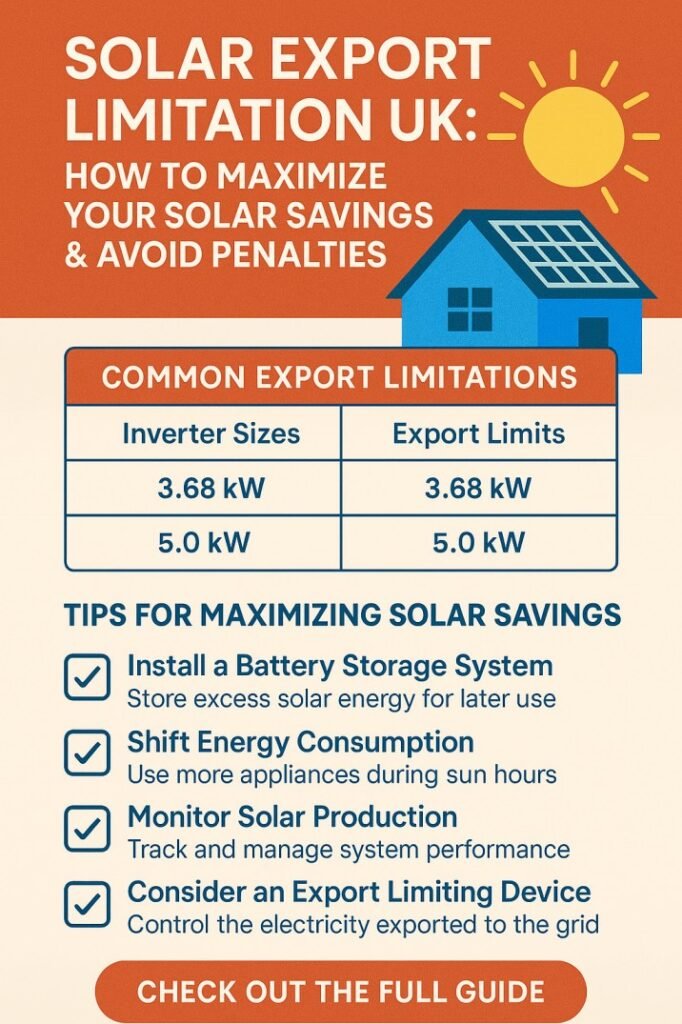
Table of Contents
What is Solar Export Limitation?
Solar export limitation UK refers to the restrictions placed on the amount of electricity a solar photovoltaic (PV) system can export to the national grid. This is particularly relevant for residential solar systems or small commercial installations. Grid operators introduce these limitations to maintain grid stability, prevent overloading, and manage renewable energy distribution effectively.
This tool can help you get the job done more efficiently Solar Wire Size Calculator (DC): Best Solar Cable Sizing Tool
Unlike traditional electricity consumption, where you simply use energy from the grid, solar export involves sending surplus energy generated by your solar panels back to the grid. When your system produces more electricity than your home consumes, the excess is exported. However, without limitations, uncontrolled export can create technical and financial challenges for the energy network.
Why Solar Export Limitation Matters
Understanding solar export limitation UK is crucial because exceeding the permitted export level can lead to penalties, reduced feed-in tariff payments, or even disconnection in extreme cases. Moreover, managing your export efficiently allows you to optimize self-consumption, which is often more financially beneficial than exporting surplus energy at low tariff rates.
In short, solar export limitations help:
- Protect the national grid from voltage instability
- Ensure fair distribution of renewable energy
- Encourage homeowners to maximize self-consumption
- Avoid penalties for exceeding allowed export limits
Current UK Export Limitation Rules
In the UK, most small-scale solar installations, especially those under 16A per phase or approximately 4 kW per household, face specific export limitations. These limitations are often set by your Distribution Network Operator (DNO) and may vary depending on your location and grid capacity.
| Parameter | Typical Limit | Notes |
|---|---|---|
| Single-phase system export | 3.68 kW | Standard for most residential properties |
| Three-phase system export | 11 kW | Common in larger homes or small commercial buildings |
| Smart export meters | Variable | Allows dynamic adjustment based on grid demand |
| Feed-in tariff eligibility | Up to 4 kW | Exceeding may reduce payments |
These limitations ensure your solar PV system does not negatively affect grid performance while still allowing you to benefit from clean energy production.
This tool is perfect for achieving better results in solar system design. Try here Wire Size Calculator for Solar Panels – Avoid Power Loss in Off-Grid and Hybrid Systems
How to Maximize Solar Savings under Export Limitation
Maximizing solar savings under solar export limitation UK requires strategic planning of your energy consumption and system setup. Here are some effective methods:
1. Increase Self-Consumption
The most straightforward way to maximize savings is to use the electricity you generate. Timing your energy-intensive appliances, such as washing machines, dishwashers, or EV chargers, to run during peak solar production hours reduces reliance on grid electricity and lowers your energy bills.
2. Install Smart Energy Storage
Battery storage systems can store excess solar energy instead of exporting it. By storing surplus power, you can use it during evenings or cloudy days, significantly increasing self-consumption and reducing grid dependency. Modern battery systems are compatible with smart export limitation devices, allowing you to stay within regulated export limits while maximizing energy efficiency.
3. Use Export Limitation Devices
Export limitation devices, also known as solar export controllers, can manage the flow of energy sent back to the grid. These devices adjust the output of your solar inverter to comply with solar export limitation UK regulations, preventing penalties and maintaining grid compliance.
4. Optimize Your Solar System Size
Oversizing your solar PV system without considering export limits may result in wasted energy. Calculating your typical energy consumption and matching your system size ensures maximum self-use while staying within export constraints.
Dive deeper into off grid solar system design
| Strategy | Benefit | Implementation Tip |
|---|---|---|
| Load shifting | Reduces exported energy | Run appliances during peak generation hours |
| Battery storage | Increases self-consumption | Choose a battery with compatible smart export feature |
| Export limiter | Avoids penalties | Install with inverter for automatic control |
| System sizing | Prevents wasted energy | Assess average daily consumption before installation |
Avoiding Penalties
Penalties for exceeding solar export limitation UK can vary depending on your supplier and network operator. Common measures include:
- Reduced feed-in tariff payments
- Charges for excessive export
- Requirement to install export-limiting equipment
Proactive management of your solar system is key to avoiding these issues. Using smart meters, monitoring energy consumption, and aligning system output with your property’s demand ensures compliance while maintaining financial benefits.
Use our online tool for free Solar Performance Ratio Calculator – Measure Solar System Efficiency Accurately
Monitoring and Tracking
Monitoring your solar PV system is essential for maximizing savings and staying compliant with export limits. Smart inverters and monitoring apps provide real-time data on production, consumption, and export levels. Tracking this data allows you to adjust your energy usage, schedule appliance operation, and fine-tune storage systems for optimal performance.
| Monitoring Tool | Purpose | Key Feature |
|---|---|---|
| Smart inverter app | Tracks generation and export | Alerts when approaching limit |
| Home energy management system | Optimizes energy usage | Automates appliance scheduling |
| Battery monitoring | Tracks stored energy | Indicates when to discharge for self-use |
Use our online tool for free Solar Panel Tilt Angle Calculator – Find the Perfect Angle for Maximum Solar Power
Future of Solar Export Limitation in the UK
As solar adoption grows, the UK government and energy regulators are expected to update solar export limitation UK policies to reflect grid capacity and renewable energy goals. Innovations in smart meters, dynamic export tariffs, and grid-responsive storage will offer homeowners more flexibility while maintaining grid stability. Staying informed about these developments ensures you can adapt your system to new rules and continue maximizing solar savings.
Key Takeaways
Understanding solar export limitation UK is essential for every solar PV owner in the country. By implementing smart energy management strategies, using storage solutions, and carefully monitoring your system, you can:
- Avoid penalties and grid issues
- Increase self-consumption of solar energy
- Maximize financial returns from your solar investment
- Contribute effectively to the UK’s renewable energy goals
Use our online tool for free Solar Panel Size Calculator by Load – Find the Right System for Your Power Needs
| Action Step | Benefit | Practical Tip |
|---|---|---|
| Install export limiter | Compliance with regulations | Connect with smart inverter |
| Use battery storage | Reduce reliance on grid | Choose system with export control |
| Adjust appliance usage | Increase self-consumption | Schedule washing, heating, and EV charging |
| Monitor energy | Track performance | Use apps and smart meters regularly |
By staying proactive and informed, UK homeowners and businesses can fully leverage the benefits of solar energy while respecting the solar export limitation UK guidelines. These strategies ensure a balance between energy independence, financial savings, and responsible grid use.
Follow Us on Social:
Subscribe our Newsletter on Electrical Insights for latest updates from Electrical Engineering Hub
#SolarExportLimitationUK, #SolarEnergyUK, #RenewableEnergy, #SolarGridLimits, #UKSolarPolicy, #SolarExportRules, #SolarPowerUK, #CleanEnergyUK, #SolarIncentives, #UKEnergyStandards