Residual vs Zero Sequence Ground Fault Protection: Important Differences Every Engineer Must Know
Ground fault protection is a critical aspect of modern electrical power systems. Among the most commonly discussed methods are residual ground fault protection and zero sequence ground fault protection. While both methods aim to detect earth faults and protect equipment, they operate on different principles and are suitable for different applications.
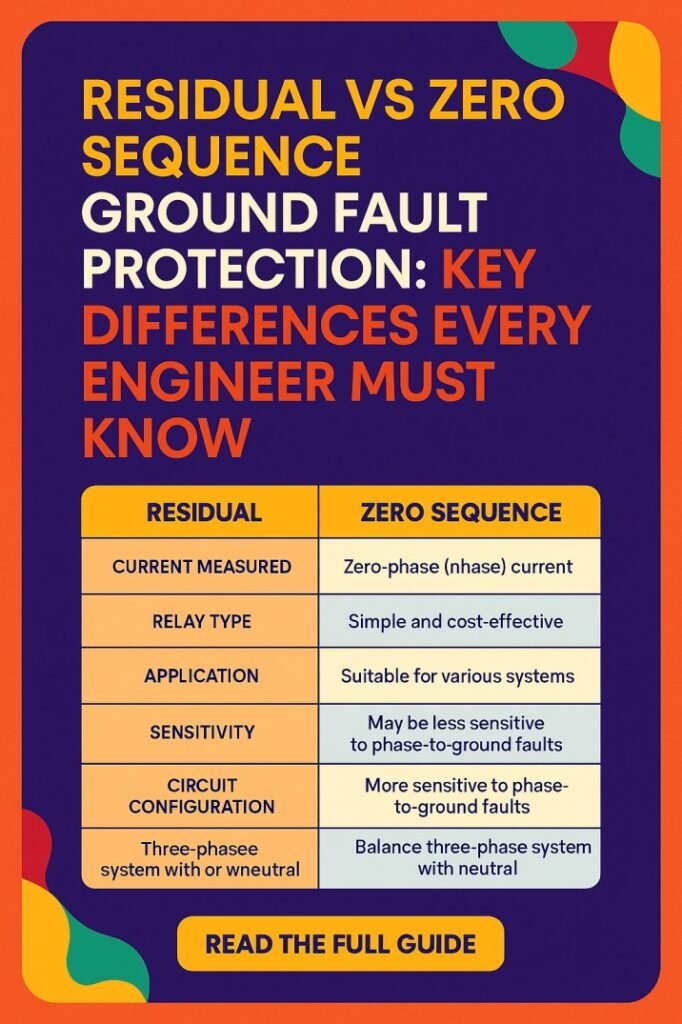
Table of Contents
Understanding the distinctions between these two types of protection is essential for engineers, electricians, and system designers. In this article, we will dive deep into the residual vs zero sequence ground fault protection debate, highlight their working mechanisms, and outline their applications, advantages, and limitations.
Know more about IEC Standard for Ground Fault Protection Explained: Compliance, Requirements & Best Practices
Residual vs Zero Sequence Ground Fault Protection
What is Residual Ground Fault Protection?
Residual ground fault protection, sometimes referred to as residual current protection, is a method used to detect ground faults in electrical systems by measuring the imbalance between line currents. In a three-phase system, the sum of the three line currents in a healthy system should be zero. If there is a leakage to the ground, this sum, called the residual current, becomes non-zero.
Key points about residual ground fault protection include:
- It is highly sensitive to low-magnitude ground faults, making it ideal for protecting personnel from electric shocks.
- It can detect line-to-ground faults even in systems without a neutral connection.
- The system uses residual current transformers (RCTs) to sense the imbalance in currents.
Residual protection is widely used in industrial setups, commercial buildings, and renewable energy systems, especially where leakage currents are a concern.
What is Zero Sequence Ground Fault Protection?
Zero sequence ground fault protection operates on a slightly different principle. It measures the zero sequence current, which is the sum of all three phase currents and the neutral current. In a balanced system, the zero sequence current is ideally zero. Any earth fault generates a current that is identifiable as zero sequence current, which can then trigger protective devices.
Key features of zero sequence protection are:
- It is more suitable for medium and high-voltage systems.
- Zero sequence protection can detect high-magnitude ground faults, including those through the neutral.
- It often uses zero sequence current transformers (ZSCTs) installed around phase conductors.
This type of protection is commonly found in power generation plants, substations, and distribution networks, where precise fault detection is critical for system stability.
Know more about How Does Earth Fault Relay Protect Electrical Circuits? Complete Guide to Ground Fault Protection
Key Differences Residual vs Zero Sequence Ground Fault Protection
To make the comparison clearer, the following table summarizes the main differences:
| Feature | Residual Ground Fault Protection | Zero Sequence Ground Fault Protection |
|---|---|---|
| Principle | Measures imbalance of line currents (residual current) | Measures zero sequence current (sum of phase and neutral currents) |
| Sensitivity | Very sensitive to low-level faults | Suitable for higher magnitude faults |
| Typical Applications | Residential, commercial, industrial | Medium & high-voltage networks, substations |
| Detection Method | Residual current transformers (RCTs) | Zero sequence current transformers (ZSCTs) |
| Neutral Requirement | Not necessary | Often requires neutral connection |
| Response Time | Fast, ideal for personal protection | Moderate, suitable for system protection |
| Fault Type Detection | Line-to-ground, leakage currents | Line-to-ground, neutral faults in balanced or unbalanced systems |
| Advantage | Protects humans and equipment from minor leakage | Effective for large-scale system protection and selective tripping |
| Limitation | Not ideal for high-voltage networks | Less sensitive to low-magnitude leakage |
Know more about Benshaw Soft Starter Problems
Working Mechanism: Residual vs Zero Sequence
Residual ground fault protection works by continuously monitoring the current balance in all phases. If the sum of the three-phase currents deviates from zero, the relay detects a ground fault. The sensitivity of residual protection makes it highly effective for preventing electric shocks, which is why it is mandated in many building codes.
Zero sequence ground fault protection, on the other hand, focuses on high-magnitude earth faults. By monitoring the zero sequence current, it identifies faults even when neutral currents are present. This method is particularly useful for selective tripping, preventing unnecessary shutdown of the entire system during faults.
Applications of Residual and Zero Sequence Ground Fault Protection
Understanding the proper application of each protection type is essential for engineers:
Residual Ground Fault Protection Applications:
- Residential and commercial buildings to protect occupants from electric shocks
- Low-voltage industrial systems with sensitive equipment
- Renewable energy installations such as solar PV and wind farms
Know more about NEC Grounding Table 250.122 Explained: Correct Equipment Grounding Conductor Size
Zero Sequence Ground Fault Protection Applications:
- Medium and high-voltage transmission lines
- Substations and power distribution networks
- Large industrial plants with complex grounding schemes
Advantages and Limitations
While both methods provide ground fault protection, their effectiveness depends on the context.
Residual Ground Fault Protection Advantages:
- Highly sensitive to low-level faults
- Provides immediate warning against leakage currents
- Simple installation in low-voltage systems
Residual Ground Fault Protection Limitations:
- Not effective for high-voltage or large-scale industrial systems
- Can trigger nuisance trips if not calibrated correctly
Know more about Earth Fault Relay Testing Procedure
Zero Sequence Ground Fault Protection Advantages:
- Reliable for high-magnitude fault detection
- Suitable for selective tripping in complex networks
- Supports grounding and neutral connections effectively
Zero Sequence Ground Fault Protection Limitations:
- Less sensitive to minor leakages
- Requires more infrastructure, including ZSCTs and proper relays
Choosing the Right Protection Method
Selecting between residual and zero sequence ground fault protection depends on several factors: system voltage, load sensitivity, grounding configuration, and fault detection requirements.
- For low-voltage residential and commercial systems, residual protection is preferred.
- For medium and high-voltage industrial and utility systems, zero sequence protection is more effective.
- Hybrid protection schemes sometimes combine both methods to achieve comprehensive fault coverage.
Know more about Earth Fault Relay Sensitivity Setting: 5 Proven Tips for Better Protection
Installation Considerations
Proper installation ensures reliable operation of either protection type. Key considerations include:
- Correct placement of current transformers around all phases
- Ensuring proper relay settings according to fault current levels
- Coordinating with system grounding methods
- Periodic testing and calibration to avoid false trips
Maintenance and Testing
Regular testing is essential for both residual and zero sequence protection systems. Recommended practices include:
- Insulation resistance tests to detect degradation
- Simulated fault tests to ensure relays respond correctly
- Visual inspection of transformers and wiring
- Periodic calibration of protective relays for accurate detection
Common Misconceptions
Many engineers confuse residual and zero sequence protection due to their similar objectives. Key points to clarify include:
- Residual protection is not just a “smaller version” of zero sequence; it is designed for sensitivity to leakage currents.
- Zero sequence protection does not replace residual protection in low-voltage systems.
- Both systems can coexist, providing a layered protection strategy for complex installations.
Explore details on IEC Standard for Differential Protection
Conclusion
Understanding the residual vs zero sequence ground fault protection distinction is essential for any electrical engineer working with power systems. While residual protection excels in detecting low-magnitude leakage currents and safeguarding personnel, zero sequence protection is more suited for high-voltage systems and large-scale industrial networks.
Choosing the right method—or even combining both—can improve system reliability, enhance safety, and reduce downtime. By applying the principles discussed here, engineers can design robust ground fault protection schemes tailored to specific operational requirements, ensuring both equipment and human safety.
Learn more about types of generator protection relays
Follow Us on Social:
Subscribe our Newsletter on Electrical Insights for latest updates from Electrical Engineering Hub
#ResidualGroundFault, #ZeroSequenceProtection, #ElectricalSafety, #PowerSystemProtection, #GroundFaultDetection, #IndustrialElectrical, #ElectricalEngineering, #FaultProtection, #SmartGridSafety, #ElectricalMaintenance