
Ofgem Electricity Regulations Explained: Key UK Compliance Rules Every Energy Professional Must Know
Understanding Ofgem electricity regulations is essential for anyone working in the UK energy sector. Whether you are an engineer, compliance officer, consultant, or part of a supply business, these rules shape how electricity is generated, distributed, supplied, and priced. They influence technical decisions, commercial models, and long-term investment planning across the industry.
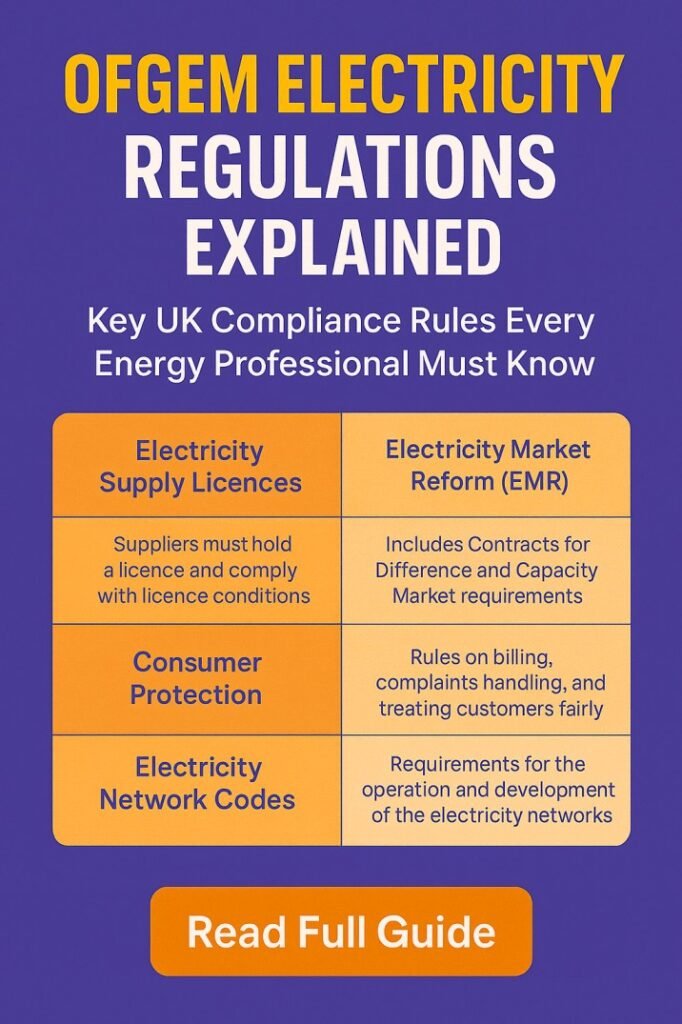
Table of Contents
Ofgem electricity regulations exist to protect consumers, ensure fair competition, and support the transition to a low-carbon energy system. They also define the legal and operational framework that licensed companies must follow. For energy professionals, knowing how these rules apply in real projects is just as important as understanding the engineering behind the grid.
The Role of Ofgem in the UK Electricity Market
The Office of Gas and Electricity Markets, commonly known as Ofgem, is the independent regulator for Great Britain’s energy markets. Its authority comes from legislation such as the Electricity Act 1989 and subsequent amendments. Through this legal foundation, Ofgem electricity regulations set out the obligations for generators, suppliers, and network operators.
Know more about G99 Grid Connection Standard: Guide to Compliance, Safety & Efficient Integration
Ofgem’s core duties include protecting the interests of existing and future consumers, promoting competition, and ensuring security of supply. In recent years, sustainability and decarbonisation have become central themes. This means Ofgem electricity regulations increasingly align with net zero targets, renewable integration, and smarter grid operation.
From a professional perspective, Ofgem does not just write policy. It enforces licence conditions, monitors performance, and can issue fines or require corrective action when companies fail to comply.
Electricity Licensing Framework
A major part of Ofgem electricity regulations revolves around licensing. Most companies involved in generation, supply, distribution, or transmission must hold a licence or operate under a specific exemption.
Below is a simplified overview of key licence types.
| Licence Type | Who Needs It | Main Compliance Focus |
|---|---|---|
| Generation Licence | Large power generators | Grid connection, balancing, market participation |
| Supply Licence | Retail electricity suppliers | Consumer protection, billing accuracy, switching rules |
| Distribution Licence | Distribution Network Operators (DNOs) | Network reliability, investment, connections |
| Transmission Licence | National Grid Electricity Transmission and others | System operation, transmission planning |
| Interconnector Licence | Cross-border operators | Capacity allocation, market coupling |
Each licence contains standard and special conditions. These form a large portion of Ofgem electricity regulations and cover technical performance, financial resilience, and reporting duties. Energy professionals often interact with these conditions when designing projects or managing operations.
Explore Top 30 UK G99 Grid Connection Interview Questions: Master Your Power System Job Prep
Consumer Protection and Supplier Obligations
Consumer protection is a central pillar of Ofgem electricity regulations. Suppliers must follow strict rules on billing, communication, and treatment of vulnerable customers. These requirements affect not only commercial teams but also metering engineers, data managers, and system designers.
Key supplier obligations include accurate billing based on actual or validated meter readings, transparent tariffs, and fair contract terms. The regulator also enforces rules on back-billing, complaint handling, and support for customers in payment difficulty. When suppliers design new tariffs or digital platforms, they must ensure alignment with Ofgem electricity regulations to avoid enforcement action.
Smart metering also falls within this area. Suppliers must meet rollout targets and ensure meters comply with technical and security standards. Engineers working on metering systems must understand how Ofgem electricity regulations interact with Smart Energy Code requirements and data privacy rules.
Network Regulation and the RIIO Model
Network companies operate under a price control framework known as RIIO, which stands for Revenue = Incentives + Innovation + Outputs. This framework is a practical expression of Ofgem electricity regulations for transmission and distribution networks.
RIIO sets allowed revenues for network operators over multi-year periods. In return, companies must deliver specific outputs related to reliability, customer service, environmental performance, and connections. Performance is measured through detailed metrics, and financial incentives reward or penalise companies accordingly.
Know more about UK G100 HV Grid Standards: Compliance Rules, Export Limitation & DNO Approval Guide
| RIIO Element | What It Means in Practice | Why It Matters to Professionals |
|---|---|---|
| Outputs | Targets for reliability, safety, and service | Drives asset management and maintenance strategy |
| Incentives | Financial rewards or penalties | Influences operational priorities and reporting |
| Innovation | Funding for trials and new technologies | Supports smart grids, flexibility, and digitalisation |
| Totex Approach | Blended capital and operational costs | Encourages efficient long-term planning |
For engineers, Ofgem electricity regulations under RIIO shape investment decisions. Asset replacement, network reinforcement, and digital monitoring systems must be justified within the regulatory framework.
Grid Connections and Access Rules
Connecting new demand or generation to the grid is tightly governed. Ofgem electricity regulations ensure that connections are offered on a fair and transparent basis. Distribution and transmission operators must follow defined procedures, timelines, and charging methodologies.
Connection charges are based on regulated methodologies that distinguish between shallow and deeper reinforcement costs. Professionals involved in project development must understand how Ofgem electricity regulations affect budget estimates and connection agreements.
Queue management has become a major issue due to the growth of renewables. Ofgem has pushed for reforms so that projects with realistic timelines progress faster. This means developers and consultants must provide accurate technical data and credible delivery schedules to remain compliant.
Learn more about uk transformer manufacturers
Market Codes and Industry Governance
While Ofgem sets the regulatory framework, detailed technical and commercial rules sit in industry codes. These include the Balancing and Settlement Code, Distribution Code, Grid Code, and Smart Energy Code. Ofgem electricity regulations give legal force to these codes and approve major changes.
Professionals working in operations or system planning must follow these codes closely. For example, generator compliance with frequency response or fault ride-through requirements is not just a technical issue. It is part of the broader structure of Ofgem electricity regulations.
Code governance is also important. Stakeholders can propose modifications, and Ofgem often has the final decision. Understanding this process helps companies influence future requirements and stay ahead of compliance risks.
Environmental and Decarbonisation Requirements
The UK’s transition to net zero is strongly reflected in Ofgem electricity regulations. Network companies are encouraged to enable low-carbon technologies such as electric vehicles, heat pumps, and distributed generation. Price controls include outputs linked to environmental performance and loss reduction.
Generators must also comply with emissions reporting and environmental permitting, which interact with Ofgem electricity regulations through market mechanisms and support schemes. Renewable support programmes, though often designed by government, are administered in ways that align with regulatory oversight.
Engineers planning new assets must consider future flexibility needs, not just present demand. Ofgem expects networks to anticipate electrification trends, and this expectation is embedded within modern Ofgem electricity regulations.
Experience fast and accurate results using our online tool cable size calculator uk
Compliance Monitoring and Enforcement
Ofgem does not rely only on written rules. It actively monitors compliance through reporting, audits, and investigations. Companies must submit regular data on performance, finances, and customer outcomes.
If a company breaches Ofgem electricity regulations, the regulator can impose fines, require compensation payments, or enforce changes to processes. High-profile enforcement cases have involved billing failures, mis-selling, and poor complaint handling.
| Enforcement Tool | When It Is Used | Potential Impact |
|---|---|---|
| Information Requests | Routine monitoring or investigations | Increased scrutiny and reporting burden |
| Provisional Orders | Urgent compliance issues | Immediate operational changes |
| Financial Penalties | Serious or repeated breaches | Direct financial loss and reputational damage |
| Redress Schemes | Consumer harm cases | Mandatory compensation payments |
For compliance teams, understanding how Ofgem electricity regulations are enforced is critical. Preventive controls, internal audits, and staff training are all essential parts of risk management.
Use our online tool Heat Pump KWh Calculator UK Free – Instantly Estimate Running Costs & Savings
Data, Digitalisation, and Cyber Security
Modern energy systems depend on data. Ofgem electricity regulations increasingly address data quality, sharing, and protection. This includes requirements linked to smart metering, settlement reform, and network visibility.
Cyber security is another growing focus. Network and system operators must meet strict security standards and report incidents. These expectations are aligned with national infrastructure protection policies but are reinforced through Ofgem electricity regulations and licence conditions.
Engineers working with operational technology and IT systems must ensure that designs support secure data flows and resilience. Compliance is not just about firewalls. It involves governance, access control, and incident response planning.
Practical Steps for Energy Professionals
Understanding theory is not enough. Professionals should translate Ofgem electricity regulations into daily working practices.
First, stay familiar with relevant licence conditions and code requirements. These documents may seem legalistic, but they directly affect technical and commercial decisions. Second, build compliance checks into project lifecycles, from concept design to commissioning. Third, maintain clear documentation. Ofgem often expects evidence that obligations have been met, not just assurances.
Use our online tool KWh Cost Calculator UK: Instantly Check & Slash Your Electricity Bills
Cross-functional collaboration also helps. Regulatory, engineering, and commercial teams should communicate regularly. Many compliance failures happen at the boundaries between departments, not within a single team.
Why Regulatory Awareness Creates Competitive Advantage
Some see compliance as a burden, but strong understanding of Ofgem electricity regulations can create opportunity. Companies that anticipate regulatory change can invest earlier in flexible networks, storage, or digital systems. This positions them well for future incentives and market mechanisms.
Clear compliance records also build trust with partners and investors. In a sector facing rapid transformation, regulatory confidence is a valuable asset. Energy professionals who understand Ofgem electricity regulations are better equipped to design projects that are technically sound, financially viable, and fully compliant.
Conclusion
The UK electricity sector operates within a detailed and evolving regulatory framework. Ofgem electricity regulations influence licensing, pricing, consumer protection, network investment, and the transition to low-carbon energy. For professionals, these rules are not abstract policy. They shape real engineering choices, operational processes, and commercial strategies.
By staying informed, integrating compliance into everyday work, and viewing regulation as part of good system design, energy professionals can reduce risk and support a more reliable, fair, and sustainable electricity system.
Use our online tool Fish Tank Electricity Cost Calculator UK – Find Out Your Aquarium Energy Bills Instantly
Follow Us on Social:
Subscribe our Newsletter on Electrical Insights for latest updates from Electrical Engineering Hub
#Ofgem, #ElectricityRegulations, #UKEnergy, #EnergyCompliance, #OfgemRules, #PowerSectorUK, #EnergyStandards, #UKUtilities, #GridRegulations, #EnergyLaw