Motor Start Capacitor Failure Symptoms – Warning Signs, Causes & Quick Fixes
Motor start capacitors play a critical role in single-phase electric motors used in air conditioners, water pumps, compressors, fans, and many household or industrial machines. When this component starts failing, the motor cannot develop enough starting torque, leading to performance issues and potential motor damage. Understanding motor start capacitor failure symptoms helps technicians, engineers, and homeowners identify problems early and avoid costly repairs.
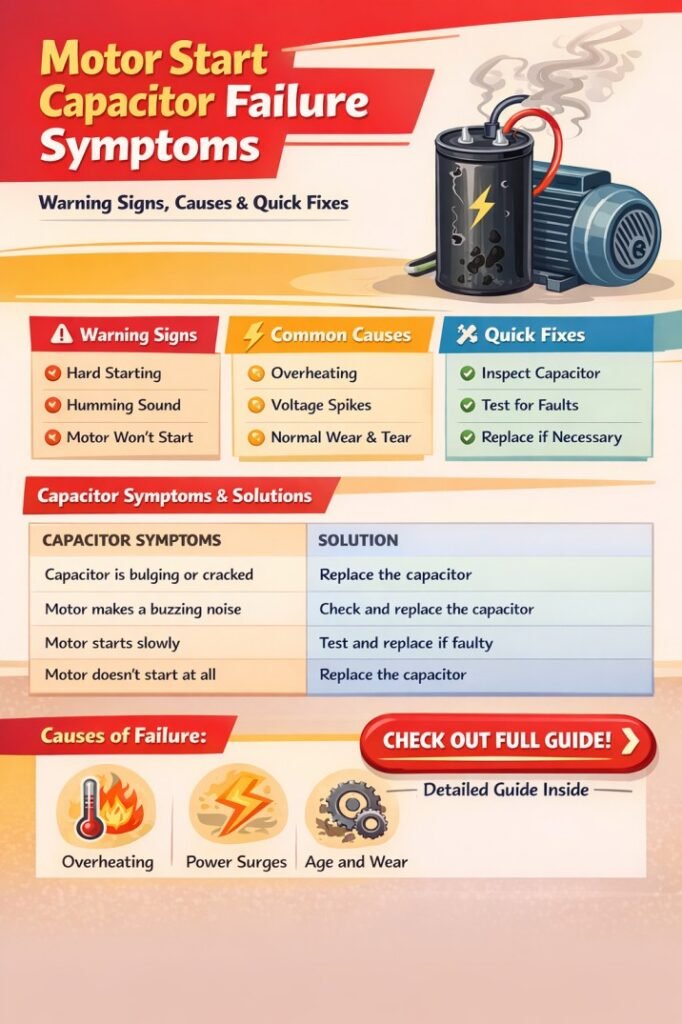
Table of Contents
This guide explains the most common warning signs, underlying causes, testing methods, and quick fixes in a practical and easy-to-understand way.
What a Motor Start Capacitor Does
A motor start capacitor provides an extra electrical boost during motor startup. It temporarily increases current to the auxiliary winding, creating a phase shift that generates high starting torque. Once the motor reaches around 70 to 80 percent of rated speed, the capacitor is disconnected by a centrifugal switch or relay.
When this process fails, clear motor start capacitor failure symptoms begin to appear during operation.
Know more about VFD vs Soft Starter: Key Differences You Must Know for Motor Control
Common Motor Start Capacitor Failure Symptoms
Identifying early motor start capacitor failure symptoms can prevent motor burnout. The following signs are most frequently observed in the field.
• Motor hums but does not start
• Motor starts slowly and struggles to reach speed
• Circuit breaker trips during startup
• Motor overheats quickly
• Burning smell near motor housing
• Bulging or leaking capacitor casing
• Motor requires manual spin to start
• Intermittent starting problems
These motor start capacitor failure symptoms often worsen over time if the faulty component is not replaced.
Motor Behavior Comparison Table
| Motor Condition | Starting Response | Noise Level | Heat Generation | Risk Level |
|---|---|---|---|---|
| Healthy capacitor | Instant start | Normal | Normal | Low |
| Weak capacitor | Slow start | Humming | Moderate | Medium |
| Failed capacitor | No start | Loud hum | High | Severe |
This table helps differentiate normal motor operation from motor start capacitor failure symptoms.
Learn more about servo motor interview questions
Why a Motor Hums but Will Not Start
One of the clearest motor start capacitor failure symptoms is a motor that only hums when powered on. This happens because the start winding does not receive the required phase-shifted current. The magnetic field is too weak to rotate the rotor, so the motor remains stationary.
If power stays applied in this condition, overheating can damage the windings within minutes.
Frequent Causes of Motor Start Capacitor Failure
Motor start capacitors fail due to electrical stress, environmental conditions, and aging. Understanding these causes helps prevent repeated failures.
• Voltage fluctuations and power surges
• Excessive motor starts per hour
• High ambient temperature
• Poor ventilation around motor
• Low-quality or underrated capacitor
• Mechanical overload on motor shaft
Many motor start capacitor failure symptoms can be traced back to improper sizing or harsh operating conditions.
Know more about Motor Starter Size Chart: 7 Essential Insights for Better Selection
Electrical Stress and Its Impact
Repeated voltage dips or surges weaken the capacitor’s dielectric material. Over time, capacitance value drops below the required range. The motor then draws higher current during startup, accelerating capacitor failure and increasing the risk of winding damage.
Physical Signs of a Failed Start Capacitor
Visual inspection can often confirm motor start capacitor failure symptoms without test equipment.
| Visual Indicator | What It Means |
|---|---|
| Bulged top | Internal pressure buildup |
| Oil leakage | Dielectric breakdown |
| Burn marks | Overheating or short circuit |
| Corroded terminals | Moisture or chemical exposure |
Any of these signs indicate that replacement is necessary rather than repair.
Know more about Motor Starter Types: A Powerful Guide with 7 Key Options You’ll Appreciate
How Motor Performance Changes Over Time
In many cases, motor start capacitor failure symptoms appear gradually. The motor may start normally at first, then struggle during hot weather or under load. This intermittent behavior often confuses users, but it is a strong indicator of a weakening capacitor.
Ignoring early symptoms usually leads to complete startup failure.
How to Test a Motor Start Capacitor Safely
Testing confirms whether observed issues are truly motor start capacitor failure symptoms.
• Disconnect power supply completely
• Discharge capacitor using a resistor
• Remove capacitor from circuit
• Measure capacitance with a multimeter
• Compare reading with rated value
If the measured value is more than 10 percent below rating, the capacitor should be replaced.
Know more about How does the star delta starter reduce starting current? Important Concepts
Typical Capacitance Deviation Guide
| Rated Value | Acceptable Range | Action Required |
|---|---|---|
| 100 µF | 90–110 µF | Normal |
| 100 µF | 80–89 µF | Weak |
| 100 µF | Below 80 µF | Replace |
Capacitance outside the safe range confirms motor start capacitor failure symptoms.
Quick Fixes and Practical Solutions
Once motor start capacitor failure symptoms are confirmed, the solution is usually straightforward.
• Replace capacitor with same µF rating
• Ensure voltage rating is equal or higher
• Use motor-grade start capacitor only
• Improve motor ventilation
• Reduce frequent start-stop cycles
Never attempt to bypass a faulty capacitor, as this can damage the motor permanently.
Know more about Difference Between Star Delta and DOL Starter: A Comprehensive Guide
Choosing the Right Replacement Capacitor
Selecting the correct replacement prevents recurring motor start capacitor failure symptoms.
| Parameter | Recommendation |
|---|---|
| Capacitance | Same as original |
| Voltage rating | Equal or higher |
| Duty type | Intermittent start duty |
| Temperature rating | Minimum 70°C |
| Certification | Industrial motor standard |
Using an incorrect capacitor can cause immediate failure or unsafe operation.
Difference Between Start and Run Capacitor Failures
Many users confuse run capacitor issues with motor start capacitor failure symptoms.
| Feature | Start Capacitor | Run Capacitor |
|---|---|---|
| Usage | Startup only | Continuous |
| Failure effect | No start | Low torque |
| Typical rating | High µF | Low µF |
| Duty cycle | Short | Continuous |
Understanding this difference helps diagnose motor problems accurately.
Know more about Motor Overload Protection Chart: Important Concepts
When Ignoring Symptoms Becomes Costly
Prolonged exposure to motor start capacitor failure symptoms increases motor current draw. This leads to insulation breakdown, winding short circuits, and bearing damage. Replacing a small capacitor early is far cheaper than rewinding or replacing a motor.
Preventive Maintenance Tips
Preventing motor start capacitor failure symptoms starts with routine checks.
• Inspect capacitor annually
• Clean motor cooling vents
• Monitor starting current
• Ensure stable power supply
• Avoid undersized motors for heavy loads
Preventive maintenance significantly extends motor and capacitor life.
Final Thoughts
Motor reliability depends heavily on a healthy start capacitor. By recognizing motor start capacitor failure symptoms early, you can avoid downtime, reduce repair costs, and protect connected equipment. From humming sounds and slow starts to visible capacitor damage, these warning signs should never be ignored.
Know more about Thermal Overload Relay: Working Principle, Types and Important Settings Calculation
A properly rated replacement, combined with good operating conditions, ensures smooth motor starts and long-term performance. Understanding these symptoms equips you to make fast, informed decisions whenever a motor begins to behave abnormally.
Follow Us on Social:
Subscribe our Newsletter on Electrical Insights for latest updates from Electrical Engineering Hub
#MotorStartCapacitorFailureSymptoms, #MotorCapacitorProblems, #ElectricMotorFaults, #MotorTroubleshooting, #StartCapacitorIssues, #SinglePhaseMotor, #HVACMotorRepair, #ElectricalMaintenance, #MotorStartingProblems, #ElectricalEngineering