Motor Control Center vs Switchgear: Key Differences, Applications & Selection Guide
Motor Control Center vs Switchgear is one of the most searched and discussed comparisons in electrical engineering, especially for industrial and commercial power systems. Engineers, consultants, and plant managers often face confusion when selecting the right solution for motor control, protection, and power distribution. Although both systems are essential for electrical installations, their purpose, design, and application areas differ significantly. Understanding Motor Control Center vs Switchgear in detail helps ensure safety, efficiency, and long-term reliability of electrical networks.
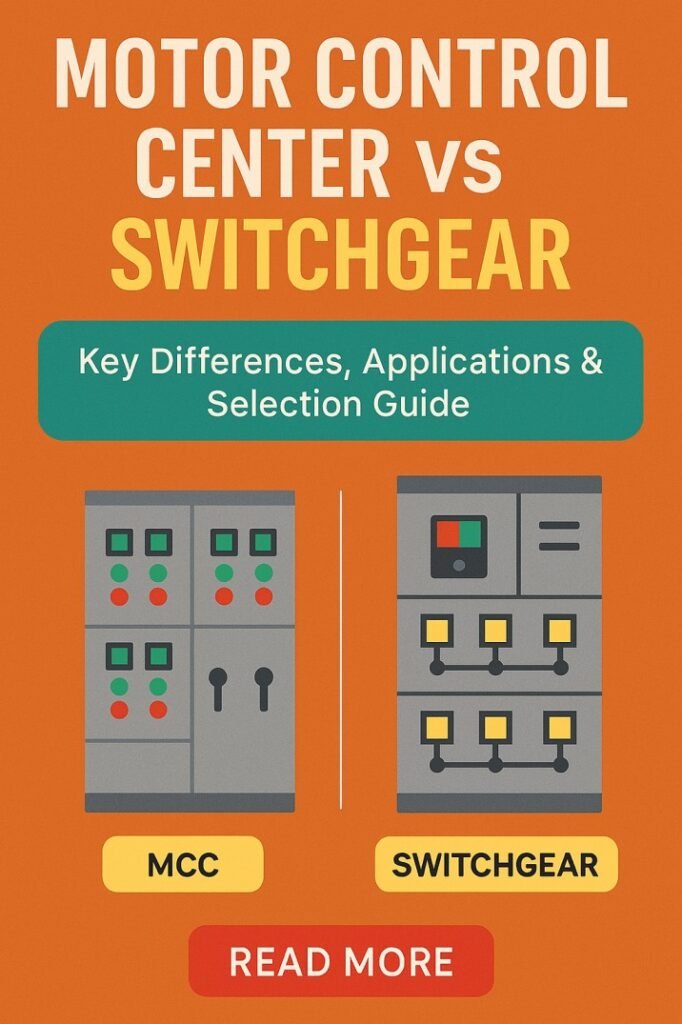
Table of Contents
This article provides a clear, practical, and human-written comparison of Motor Control Center vs Switchgear, covering construction, functions, applications, and selection criteria, while keeping the discussion simple and easy to understand.
Understanding Motor Control Center
A Motor Control Center, commonly known as MCC, is an assembly of motor starters, protective devices, and control equipment. It is mainly designed to control and protect electric motors used in industrial processes. MCC panels are modular in design, allowing easy expansion and maintenance.
In most industrial plants, motors are the backbone of operations. Pumps, compressors, conveyors, fans, and mixers rely on MCCs for reliable operation. A Motor Control Center typically includes contactors, overload relays, circuit breakers, variable frequency drives, and control wiring within a single enclosure.
MCCs simplify motor management by centralizing control functions. Engineers often rely on tools like mcc panel design software to plan layouts and ensure compliance with standards during the design stage.
Understanding Switchgear
Switchgear refers to electrical equipment used for switching, controlling, and protecting electrical circuits. Unlike MCCs, switchgear focuses on power distribution rather than motor control. It handles high currents and voltages, making it suitable for incoming feeders, outgoing feeders, and system protection.
Use our online tool for free Power Factor Correction Capacitor Calculator – Complete Technical Guide
Switchgear assemblies usually include circuit breakers, disconnectors, relays, busbars, and metering devices. They are widely used in substations, commercial buildings, power plants, and industrial facilities where safe isolation and fault protection are critical.
When comparing Motor Control Center vs Switchgear, it becomes clear that switchgear operates at a higher system level, managing electrical power flow rather than individual motor operations.
Key Functional Differences
The primary difference between Motor Control Center vs Switchgear lies in their function. MCCs are motor-focused, while switchgear is power-focused.
A Motor Control Center is designed to:
- Start and stop motors
- Protect motors from overload and short circuits
- Control motor speed using drives
- Provide operational feedback and interlocking
Switchgear is designed to:
- Distribute electrical power safely
- Protect circuits from faults
- Isolate sections of the network
- Enable maintenance and fault clearing
These differences influence how each system is designed, installed, and maintained.
Know more about Top Electrical Equipment Suppliers in UAE and UK
Construction and Design Comparison
The physical construction also highlights the contrast between Motor Control Center vs Switchgear. MCCs are modular and compartmentalized, with each motor feeder housed in a separate unit. This allows quick replacement and reduced downtime.
Switchgear, on the other hand, is built to withstand high fault levels. It has reinforced enclosures, robust busbars, and advanced protection systems. The design emphasizes safety and arc fault containment.
Below is a clear comparison table to help visualize the differences.
Table 1: Motor Control Center vs Switchgear – Design Overview
| Feature | Motor Control Center | Switchgear |
|---|---|---|
| Primary Purpose | Motor control and protection | Power distribution and protection |
| Typical Voltage Level | Low voltage | Low, medium, and high voltage |
| Modularity | Highly modular | Limited modularity |
| Components | Starters, drives, relays | Circuit breakers, relays, busbars |
| Expansion | Easy to expand | Expansion requires planning |
Applications in Real Projects
Choosing between Motor Control Center vs Switchgear depends heavily on application requirements. In industrial plants, both systems often coexist but serve different roles.
Motor Control Centers are commonly used in:
- Manufacturing plants
- Water and wastewater treatment facilities
- Oil and gas processing units
- HVAC systems in large buildings
Switchgear is typically used in:
- Electrical substations
- Power generation plants
- Commercial complexes
- Industrial power distribution networks
In practice, switchgear feeds power to MCCs, which then distribute controlled power to individual motors.
Know more about Dry Type Transformer Types
Protection and Safety Aspects
Safety is a critical factor in Motor Control Center vs Switchgear selection. MCCs provide motor-specific protection such as overload, phase failure, and thermal protection. These features extend motor life and prevent operational failures.
Switchgear provides system-level protection. It isolates faults, protects transformers, cables, and feeders, and ensures the stability of the entire electrical network. Advanced switchgear systems include protection relays and monitoring devices for real-time diagnostics.
Both systems must comply with international standards such as IEC and IEEE to ensure safe operation.
Maintenance and Troubleshooting
Maintenance requirements differ significantly when comparing Motor Control Center vs Switchgear. MCCs are easier to maintain due to their modular design. Faulty motor feeders can be replaced quickly without shutting down the entire system.
Switchgear maintenance is more complex and often requires system shutdowns. However, its robust design ensures longer service life and higher fault tolerance.
Proper training plays a key role here. Engineers who undergo electrical control panel design training gain better insight into maintenance planning and fault analysis for both systems.
Cost Considerations
Cost is another important factor in Motor Control Center vs Switchgear decisions. MCCs are generally cost-effective for motor-intensive applications. They reduce wiring complexity and installation time, which lowers overall project costs.
Switchgear is more expensive due to its heavy-duty construction and advanced protection features. However, the cost is justified by the level of safety and reliability it provides in power distribution.
A simplified cost comparison is shown below.
Table 2: Cost and Complexity Comparison
| Parameter | Motor Control Center | Switchgear |
|---|---|---|
| Initial Cost | Moderate | High |
| Installation Time | Shorter | Longer |
| Wiring Complexity | Lower | Higher |
| Maintenance Cost | Lower | Moderate |
| Fault Handling | Motor-level | System-level |
Know more about IEC Standard for Busbar Clearance
Selection Guide for Engineers
Selecting between Motor Control Center vs Switchgear requires a clear understanding of project needs. Asking the right questions helps make the correct decision.
Consider the following points:
- Are you controlling multiple motors?
- Is the system focused on power distribution?
- What voltage level is involved?
- How critical is system uptime?
- What are the future expansion plans?
If the requirement is motor operation and control, an MCC is the right choice. If the goal is power distribution and system protection, switchgear is essential. In many cases, both are required for a complete and reliable electrical system.
For detailed planning, engineers often refer to resources like an mcc panel design guide pdf to ensure correct selection and compliance.
Future Trends and Digital Integration
Modern electrical systems are evolving rapidly. Digital monitoring, smart relays, and communication protocols are becoming common in both MCCs and switchgear. These advancements improve energy efficiency, predictive maintenance, and operational visibility.
The debate around Motor Control Center vs Switchgear is no longer about replacement but about integration. Smart factories rely on seamless coordination between both systems to achieve automation and reliability.
Final Thoughts
Motor Control Center vs Switchgear is not a competition but a comparison of purpose and application. MCCs excel in motor control and operational flexibility, while switchgear ensures safe and reliable power distribution. Understanding their differences helps engineers design efficient, safe, and scalable electrical systems.
By carefully evaluating application needs, safety requirements, and long-term goals, professionals can select the right solution with confidence. A well-designed system that balances both MCCs and switchgear leads to improved performance, reduced downtime, and enhanced operational safety.
Follow Us on Social:
Subscribe our Newsletter on Electrical Insights for latest updates from Electrical Engineering Hub
#MotorControlCenter, #Switchgear, #MCCvsSwitchgear, #ElectricalEngineering, #PowerDistribution, #IndustrialElectrical, #ElectricalPanels, #MotorControl, #ElectricalDesign, #LVSwitchgear