Industrial Control Panel Design Software – Best Tools, Features & Pro Tips for Engineers
Industrial automation has evolved rapidly, and control panel engineering is no longer a task handled with pen, paper, and generic CAD tools. Today, industrial control panel design software plays a critical role in ensuring safety, compliance, efficiency, and scalability. Engineers are expected to deliver accurate schematics, error-free wiring layouts, and compliant panel documentation within tight project timelines.
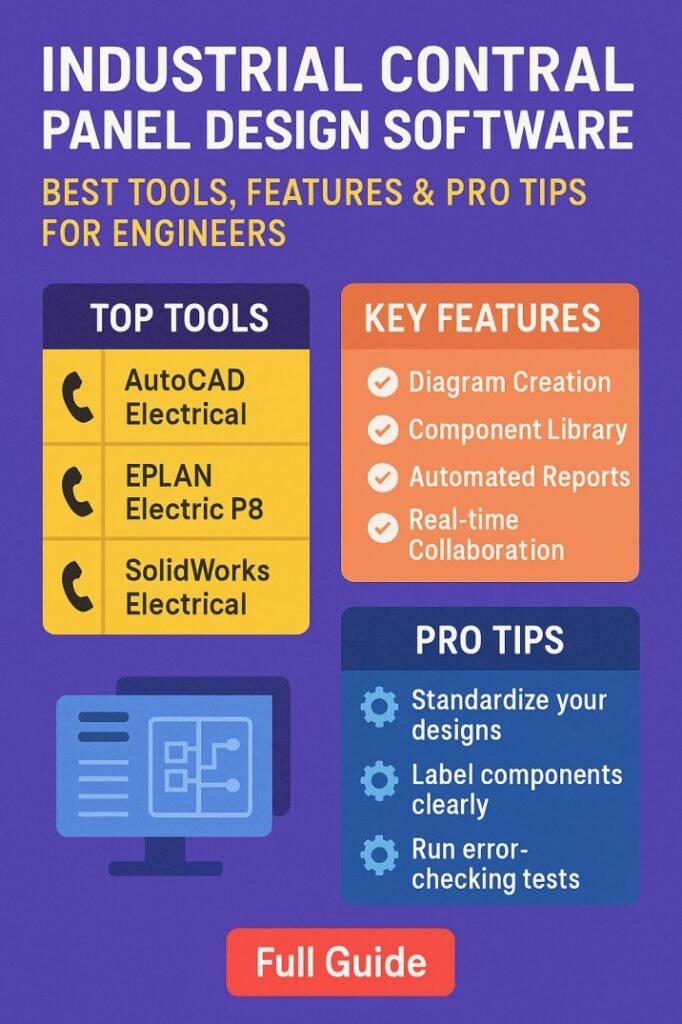
Table of Contents
This guide explains what industrial control panel design software is, why it matters, the best tools available, essential features, and practical design tips used by experienced engineers in real-world projects.
What Is Industrial Control Panel Design Software
Industrial control panel design software is a specialized engineering tool used to design electrical control panels for industrial applications. These panels may include PLCs, HMIs, motor starters, VFDs, relays, protection devices, power distribution components, and communication equipment.
Unlike generic drafting tools, this software understands electrical logic, component behavior, wire numbering, terminal management, and panel layout constraints. It helps engineers create schematics, panel layouts, and documentation that comply with standards such as IEC, UL, and NFPA.
Know more about Best Electrical Design Software for Industrial Projects
Modern industrial control panel design software also integrates with manufacturing workflows, reducing rework during panel fabrication and commissioning.
Why Engineers Need Dedicated Control Panel Software
Using standard CAD tools for control panels increases design time and error risk. Specialized software provides intelligence that manual drafting cannot.
Key reasons engineers rely on industrial control panel design software include:
• Faster schematic creation with reusable templates
• Automatic wire numbering and cross-referencing
• Built-in component libraries from major manufacturers
• Compliance with international electrical standards
• Accurate panel layout and heat dissipation planning
• Reduced wiring errors during assembly
These advantages directly improve project profitability and reliability, especially in large automation systems.
Best Industrial Control Panel Design Software Tools
Several professional tools dominate the market. Each has strengths depending on project scale, standards, and industry requirements.
| Software Name | Best For | Key Strength |
|---|---|---|
| EPLAN Electric P8 | Large industrial automation projects | Advanced automation and standards compliance |
| AutoCAD Electrical | Small to medium control panels | Familiar AutoCAD environment |
| Solid Edge Electrical | Integrated electrical and mechanical design | ECAD-MCAD collaboration |
| SEE Electrical | Cost-effective professional design | Fast schematic creation |
| ProfiCAD | Basic panel designs | Simple learning curve |
Choosing the right industrial control panel design software depends on budget, complexity, and required documentation level.
Know more about Top Electrical Engineering Software: AutoCAD, ETAP, MATLAB Reviewed
Key Features That Matter Most
Not all features deliver equal value. Experienced engineers focus on tools that reduce errors and save time across the project lifecycle.
Intelligent Schematic Design
Good software understands electrical logic. When you place a contact or coil, it knows how the circuit behaves. This intelligence ensures accurate cross-referencing and prevents missing connections.
Component Libraries
Built-in libraries from Siemens, Schneider, ABB, Allen-Bradley, and others speed up design work. Manufacturer data also improves BOM accuracy and panel space planning.
Automatic Wire and Terminal Management
Manual wire numbering is one of the biggest sources of mistakes. Industrial control panel design software assigns wire numbers automatically and tracks terminals across pages.
Panel Layout and 3D Capabilities
Modern projects demand compact and thermally efficient panels. Layout tools help position components, calculate clearances, and avoid overcrowding.
| Layout Feature | Engineering Benefit |
|---|---|
| DIN rail placement | Faster assembly |
| Heat calculation | Improved component life |
| Space validation | Reduced redesign |
| Cable duct planning | Cleaner wiring |
Know more about Top SCADA Software Platforms for Energy Sector
Standards Compliance
Software that supports IEC, UL 508A, and NFPA 79 ensures designs pass inspections without costly revisions. This is especially important for export-oriented panels.
Common Use Cases Across Industries
Industrial control panel design software is widely used in multiple sectors.
• Manufacturing automation
• Water and wastewater treatment plants
• Power generation and substations
• Oil and gas control systems
• Food and beverage processing
• Building management systems
Each industry benefits from structured documentation and repeatable design workflows.
How This Software Improves Panel Manufacturing
One overlooked advantage is the impact on panel fabrication. Accurate drawings reduce shop-floor confusion and rework.
Benefits for manufacturing teams include:
• Clear terminal and wiring schedules
• Accurate cable length estimation
• Error-free BOM generation
• Faster FAT and SAT processes
When engineering and manufacturing use the same data, project execution becomes smoother.
Know more about Electrical Schematic Drawing Software: A Comprehensive Guide
Pro Tips for Engineers Using Control Panel Design Software
Experienced engineers follow certain practices to get maximum value from industrial control panel design software.
Build Standard Templates
Create templates for common motor starters, VFD panels, and PLC I/O racks. This reduces design time and maintains consistency across projects.
Use Naming Conventions Strictly
Consistent tag naming for devices, wires, and terminals avoids confusion during troubleshooting and future upgrades.
Validate Early and Often
Run design checks before finalizing drawings. Many tools highlight missing connections, overloaded terminals, or duplicate tags.
Coordinate With Mechanical Teams
If your software supports ECAD-MCAD integration, use it. Proper coordination avoids space conflicts inside enclosures.
Keep Libraries Updated
Outdated component data leads to wrong footprints and ratings. Regular updates prevent installation issues.
Know more about Electrical Design Analysis Software: A Comprehensive Guide
Comparison of Manual CAD vs Specialized Software
| Aspect | Generic CAD | Industrial Control Panel Design Software |
|---|---|---|
| Electrical intelligence | None | Built-in |
| Error detection | Manual | Automatic |
| Standards support | Limited | Extensive |
| Wire numbering | Manual | Automated |
| Documentation | Time-consuming | Auto-generated |
This comparison explains why professional engineers rarely rely on generic tools for complex panels.
Cost vs Value Consideration
While industrial control panel design software may appear expensive initially, it saves significant costs over time. Reduced design hours, fewer site issues, and faster approvals easily justify the investment.
For small firms, entry-level tools may be sufficient. Large system integrators benefit most from advanced platforms with automation and database-driven design.
Future Trends in Control Panel Design Tools
The industry is moving toward digital twins, cloud collaboration, and automated panel manufacturing. Some tools already support CNC wire cutting and automated labeling directly from design data.
Artificial intelligence-assisted design checks and energy efficiency optimization are also emerging features that will shape the next generation of industrial control panel design software.
Know more about Transformer Design Software: Revolutionizing Transformer Engineering
Final Thoughts
Control panels are the backbone of industrial automation systems. Using professional industrial control panel design software ensures accuracy, safety, and long-term maintainability. Engineers who master these tools gain a strong competitive advantage in project delivery and system reliability.
Selecting the right software, understanding its core features, and applying best practices can significantly improve design quality and reduce costly errors. As automation systems grow more complex, investing in the right design tools is no longer optional but essential for modern electrical engineers.
Follow Us on Social:
Subscribe our Newsletter on Electrical Insights for latest updates from Electrical Engineering Hub
#IndustrialControlPanelDesignSoftware, #ControlPanelDesign, #ElectricalPanelDesign, #PLCPanelDesign, #AutomationEngineering, #IndustrialAutomation, #ElectricalCAD, #PanelWiringDesign, #SCADAEngineering, #ControlSystems