IEEE Standard for Oil Filled Transformer: Complete Guide to Testing, Compliance, Procedures and Industry Best Practices
The IEEE standard for oil filled transformer is a widely recognized technical framework that defines how power and distribution transformers filled with insulating oil should be designed, tested, installed, and maintained. In modern electrical systems, these transformers play a key role in ensuring reliable power transmission, especially in industrial grids, utilities, and renewable energy integration.
The IEEE standard for oil filled transformer provides engineers and technicians with a structured guideline to ensure safety, efficiency, and long service life of equipment operating under high electrical stress.
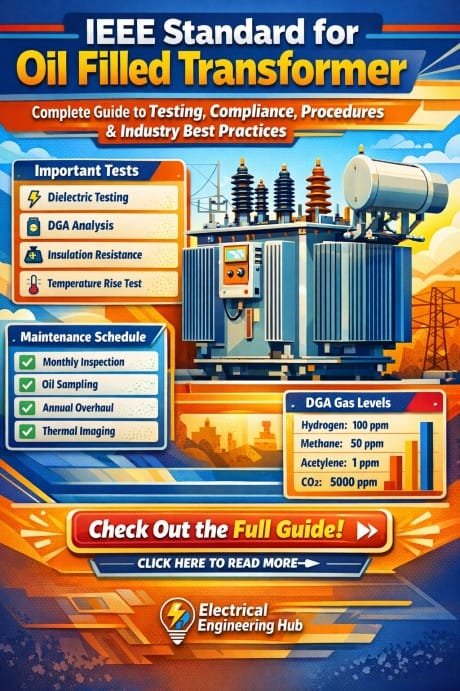
Table of Contents
Across power distribution networks, transformer failures often lead to costly downtime and safety hazards. This is why the IEEE standard for oil filled transformer is not just a recommendation but a critical reference used in procurement, testing labs, and utility inspection programs. It defines acceptable limits for dielectric strength, temperature rise, insulation performance, and oil quality parameters, ensuring transformers operate reliably under varying load conditions.
Understanding IEEE standard for oil filled transformer is essential for engineers involved in commissioning and maintenance, as it helps align field practices with international benchmarks. It also supports asset management strategies by reducing operational risks and improving predictive maintenance planning.
Know more about Transformer Cooling Methods: ONAN, ONAF, OFAF & More
Overview of Transformer Standards and Design Expectations
The IEEE standard for oil filled transformer outlines the core requirements for transformer design, material selection, and operational performance. These standards are developed to ensure uniformity across manufacturers and to guarantee compatibility in power systems worldwide.
Oil filled transformers use mineral or synthetic insulating oil to provide both cooling and electrical insulation. The standard defines key design parameters such as winding insulation class, core losses, and dielectric strength. It also ensures that transformers are capable of handling overload conditions without compromising safety. Explore details on largest transformer manufacturer in usa
Key design expectations include:
- Efficient heat dissipation through oil circulation
- Strong insulation coordination between windings
- Mechanical strength to withstand short circuit forces
- Low no-load and load losses for energy efficiency
- Proper sealing to prevent moisture ingress
Explore all about Transformer Bond Sizing
Key Technical Parameters Defined by IEEE
| Parameter | Standard Requirement | Purpose |
|---|---|---|
| Dielectric Strength | High breakdown voltage limit | Ensures insulation safety |
| Temperature Rise | Controlled within defined limits | Prevents overheating |
| Oil Quality | Low moisture and acidity | Maintains insulation performance |
| Losses (Core & Copper) | Minimum allowable thresholds | Improves efficiency |
| Impulse Voltage Strength | Withstand lightning surges | Ensures grid reliability |
These parameters form the foundation of the IEEE standard for oil filled transformer and help manufacturers maintain consistent product quality.
Testing Procedures and Quality Assurance Methods
The IEEE standard for oil filled transformer defines strict testing procedures that must be followed during factory acceptance tests and site commissioning. These tests ensure that each transformer meets performance expectations before being energized in the field.
Find more Transformer calculators here
Testing is generally divided into routine tests, type tests, and special tests depending on application requirements. Each category serves a specific purpose in validating electrical and mechanical integrity.
Common testing procedures include:
- Insulation resistance testing using megger instruments
- Dielectric breakdown voltage test of transformer oil
- Load loss and no-load loss measurement
- Temperature rise test under full load conditions
- Short circuit impedance testing
- Winding resistance measurement
Transformer Testing Categories
| Test Type | Description | Importance |
|---|---|---|
| Routine Test | Performed on every unit | Ensures manufacturing consistency |
| Type Test | Conducted on prototype models | Validates design compliance |
| Special Test | Based on customer requirement | Checks specific operating conditions |
The IEEE standard for oil filled transformer emphasizes accurate calibration of instruments during testing to avoid measurement errors. Even small deviations can affect performance evaluation and long-term reliability.
Oil sampling and dissolved gas analysis (DGA) are also critical parts of quality assurance. These methods help detect early signs of insulation breakdown, overheating, or internal arcing.
Know all about Transformer Sizing for EV Charger
Compliance Requirements and Industry Regulations
Compliance with the IEEE standard for oil filled transformer is essential for manufacturers, utility companies, and engineering contractors. It ensures that transformers meet global safety and performance expectations, especially in high-voltage applications.
Regulatory compliance involves adherence to design documentation, manufacturing traceability, and test certification. Many international tenders require proof of compliance with IEEE and IEC standards before procurement approval.
Important compliance aspects include:
- Verified material certification for copper and core steel
- Proper transformer labeling and rating plate details
- Factory test reports signed by authorized engineers
- Environmental compliance for transformer oil handling
- Safety compliance for fire and explosion prevention
Know more about Transformers Earthspark Size Chart
Compliance Checklist
| Area | Requirement | Verification Method |
|---|---|---|
| Electrical Safety | Proper insulation coordination | High voltage testing |
| Documentation | Complete design records | Audit review |
| Oil Quality | Meets dielectric standards | Lab analysis |
| Manufacturing | Standardized process control | Factory inspection |
| Installation | Correct grounding and protection | Site inspection |
The IEEE standard for oil filled transformer also aligns with international environmental and safety regulations, ensuring reduced ecological impact and improved workplace safety.
Industry Best Practices for Performance and Reliability
Following the IEEE standard for oil filled transformer is not enough without implementing strong operational best practices. These practices help extend transformer life, reduce maintenance costs, and improve system reliability in real-world conditions.
Maintenance teams and electrical engineers adopt preventive and predictive maintenance strategies based on condition monitoring and diagnostic tools.
Find all about Transformer Disconnect Sizing
Recommended best practices include:
- Regular oil filtration and purification to remove moisture and contaminants
- Periodic dissolved gas analysis for early fault detection
- Infrared thermography for hotspot identification
- Tight monitoring of load cycles and thermal stress
- Proper grounding and surge protection systems
Maintenance Activity Schedule
| Activity | Frequency | Objective |
|---|---|---|
| Oil Testing | Every 6–12 months | Detect insulation degradation |
| Thermography | Quarterly | Identify overheating points |
| Electrical Testing | Annually | Ensure performance stability |
| Bushing Inspection | Bi-annually | Prevent flashover risks |
| Cooling System Check | Monthly | Maintain temperature control |
The IEEE standard for oil filled transformer also encourages utilities to adopt digital monitoring systems. Smart sensors and SCADA integration allow real-time tracking of transformer health, improving decision-making and reducing unexpected failures. Know more about Best Transformer Testing Companies in Canada | Trusted Electrical Testing Experts & Utility Service Providers
Proper installation practices are equally important. Transformers should be placed on stable foundations, away from excessive vibration sources, and in environments that allow proper ventilation. Load balancing across phases further ensures optimal performance.
Conclusion and Future Outlook in Transformer Technology
The IEEE standard for oil filled transformer continues to evolve as power systems become more complex and demand higher efficiency. Modern grids require transformers that are not only reliable but also compatible with renewable energy integration and smart grid infrastructure.
By following the IEEE standard for oil filled transformer, manufacturers and utilities can ensure consistent performance, improved safety, and longer operational life of critical assets. The focus on testing accuracy, compliance documentation, and maintenance discipline helps reduce failures and optimize energy distribution networks.
Know more about Top Dry Type Transformer Manufacturers in the USA
As technology advances, digital monitoring, AI-based diagnostics, and eco-friendly insulating materials are expected to further enhance transformer performance. However, the foundation will always remain rooted in established engineering principles defined by international standards.
Follow Us on Social:
Subscribe our Newsletter on Electrical Insights for latest updates from Electrical Engineering Hub
#ieee, #oilfilledtransformer, #transformer, #transformeroil, #insulationoil, #powertransformer, #electricaltesting, #ieeestandards, #substation, #powerengineering