IEEE Standard for Digitizing Waveform Recorders: Best Guide to Compliance, Testing & Accuracy
The ieee standard for digitizing waveform recorders plays a critical role in modern electrical measurement systems. From high-voltage testing labs to power system monitoring and transient analysis, waveform recorders are essential tools. However, without standardization, measurement inconsistencies can lead to inaccurate conclusions and costly errors. This is where IEEE standards provide a structured framework for performance, accuracy, and compliance.
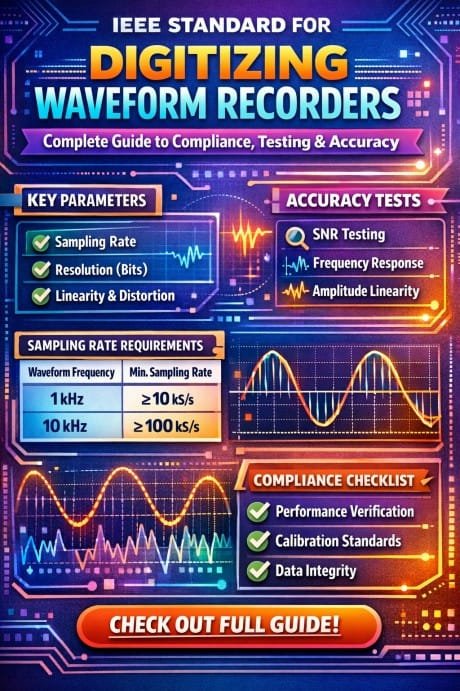
Table of Contents
Understanding the ieee standard for digitizing waveform recorders helps engineers, technicians, and decision-makers ensure that their equipment delivers reliable and repeatable results. This guide explains the key concepts, compliance requirements, testing procedures, and accuracy considerations in a practical and readable way.
Know more about IEC Standard for Neutral to Earth Voltage – Limits, Measurement & Safety Guidelines
Understanding Digitizing Waveform Recorders
Digitizing waveform recorders are instruments designed to capture, store, and analyze electrical signals in digital form. These devices are widely used in:
- Power system disturbance analysis
- High voltage impulse testing
- Protection system validation
- Industrial signal monitoring
Unlike analog systems, digital recorders convert signals into numerical values, making it easier to analyze and store data. The ieee standard for digitizing waveform recorders ensures that these conversions maintain signal integrity and accuracy.
Why IEEE Standards Matter
The IEEE framework provides globally accepted guidelines that help maintain consistency across equipment manufacturers and testing environments. The ieee standard for digitizing waveform recorders ensures that:
Find all about Capacitor Bank Sizing for Power Factor Correction – Step by Step
- Measurements are accurate and repeatable
- Devices from different manufacturers are comparable
- Testing procedures are standardized
- Calibration methods are well-defined
Without these standards, waveform measurements could vary significantly, especially in high-frequency or transient conditions.
Key IEEE Standards for Waveform Recorders
Several IEEE standards are relevant to waveform recording systems. The most commonly referenced ones include:
| Standard Number | Description | Application Area |
|---|---|---|
| IEEE Std 1057 | Digitizing waveform recorders performance | General waveform measurement |
| IEEE Std 1241 | ADC testing and characterization | Analog-to-digital converters |
| IEEE Std 181 | Pulse measurement methods | Transient and impulse signals |
| IEEE Std C37.111 | COMTRADE format for waveform data | Power system disturbances |
Each of these standards complements the ieee standard for digitizing waveform recorders, forming a complete ecosystem for measurement and analysis.
Find all about IEC Standard for Relay Testing: Best Guide
Compliance Requirements
Compliance with the ieee standard for digitizing waveform recorders involves several technical and procedural aspects. These requirements ensure that the recorder performs within acceptable limits under various conditions.
Key Compliance Parameters
- Sampling rate accuracy
- Bandwidth performance
- Resolution and quantization error
- Time base accuracy
- Signal fidelity
Environmental Considerations
Waveform recorders must also perform reliably under different environmental conditions:
- Temperature variations
- Electromagnetic interference
- Humidity levels
Meeting the ieee standard for digitizing waveform recorders requires proper shielding, calibration, and design robustness.
Find all about BS 7671 Wiring Regulations: Expert Guide to Compliance, Safety, and Practical Applications
Testing Procedures for Compliance
Testing is a crucial part of ensuring compliance. The ieee standard for digitizing waveform recorders defines specific methods to verify performance.
Common Testing Methods
| Test Type | Purpose | Key Metric |
|---|---|---|
| Linearity Test | Measures signal distortion | Integral nonlinearity |
| Frequency Response Test | Evaluates bandwidth | -3 dB point |
| Timing Accuracy Test | Checks time base precision | Time deviation |
| Noise Measurement | Assesses signal clarity | Signal-to-noise ratio |
These tests are performed using calibrated reference signals and high-precision instruments.
Calibration Practices
Calibration ensures that the recorder maintains its performance over time. According to the ieee standard for digitizing waveform recorders, calibration should be:
- Periodic and documented
- Traceable to national standards
- Conducted using certified equipment
Proper calibration reduces measurement uncertainty and improves confidence in results.
Know all about ieee and iec standards
Accuracy and Measurement Uncertainty
Accuracy is one of the most critical aspects of waveform recording. The ieee standard for digitizing waveform recorders defines how accuracy should be evaluated and reported.
Factors Affecting Accuracy
- Analog front-end design
- ADC resolution
- Sampling jitter
- Signal noise
Accuracy vs Resolution
It is important to understand that resolution does not always equal accuracy. A recorder may have high resolution but still produce inaccurate results due to poor calibration or noise.
| Parameter | Definition | Impact |
|---|---|---|
| Resolution | Smallest detectable signal change | Data detail |
| Accuracy | Closeness to true value | Measurement reliability |
| Precision | Repeatability of measurements | Consistency |
The ieee standard for digitizing waveform recorders emphasizes balancing all these factors.
Data Handling and Storage Standards
Modern waveform recorders generate large volumes of data. The ieee standard for digitizing waveform recorders aligns with data formats like COMTRADE to ensure compatibility.
Know more about IEC Standard for MV Cable Testing: Complete Acceptance, Routine & Type Test Guide
Benefits of Standardized Data Formats
- Easy data sharing between systems
- Compatibility with analysis software
- Long-term data storage reliability
Proper data handling is essential for post-event analysis and regulatory compliance.
Practical Applications in Industry
The ieee standard for digitizing waveform recorders is widely used across industries:
Power Systems
- Fault analysis
- Relay performance evaluation
- Grid stability monitoring
High Voltage Testing
- Lightning impulse testing
- Switching impulse measurements
- Insulation coordination
Industrial Automation
- Signal monitoring
- Process optimization
- Equipment diagnostics
These applications rely on accurate waveform capture, making compliance with the ieee standard for digitizing waveform recorders essential.
Know more about IEC Standard for Busbar Clearance
Best Practices for Implementation
To fully benefit from the ieee standard for digitizing waveform recorders, organizations should follow best practices:
- Select equipment that meets IEEE certification
- Perform regular calibration and maintenance
- Train staff on testing procedures
- Use proper shielding and grounding techniques
Equipment Selection Checklist
| Criteria | Importance |
|---|---|
| IEEE compliance certification | High |
| Sampling rate capability | High |
| Software compatibility | Medium |
| Environmental rating | Medium |
Choosing the right equipment ensures long-term reliability and compliance.
Common Challenges and Solutions
Even with standards in place, organizations may face challenges when implementing the ieee standard for digitizing waveform recorders.
Challenges
- High initial equipment cost
- Complex calibration procedures
- Data management issues
Know more about Phase to Phase Clearance as per IEC 61439: Best Guide
Solutions
- Invest in scalable systems
- Use automated calibration tools
- Implement data management software
Addressing these challenges early helps maintain compliance and operational efficiency.
Future Trends in Waveform Recording
The field of waveform recording continues to evolve. The ieee standard for digitizing waveform recorders is also adapting to new technologies such as:
- High-speed digital sampling
- Cloud-based data storage
- AI-driven signal analysis
These advancements are improving accuracy, reducing manual effort, and enabling real-time monitoring.
Conclusion
The ieee standard for digitizing waveform recorders is a cornerstone of modern electrical measurement systems. It ensures accuracy, consistency, and reliability across various applications, from power systems to industrial automation.
Learn more in detail on NEMA 250 Enclosures – Electrical Enclosure Standards | Best Manufacturing Companies in USA
By understanding compliance requirements, testing procedures, and accuracy factors, professionals can make informed decisions when selecting and using waveform recorders. Implementing these standards not only improves measurement quality but also enhances operational efficiency and safety.
Follow Us on Social:
Subscribe our Newsletter on Electrical Insights for latest updates from Electrical Engineering Hub
IEEEStandard, #WaveformRecorders, #DigitizingSystems, #PowerSystemTesting, #DataAcquisition, #ElectricalEngineering, #SignalProcessing, #IEEECompliance, #TestingEquipment, #EngineeringStandards